

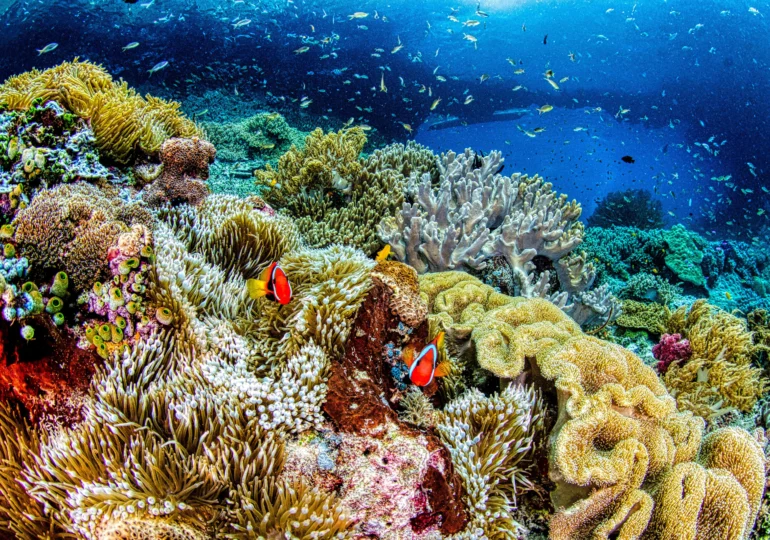
Coral from the Galápagos Islands has preserved in their skeletons the history of Pacific Ocean temperatures over the past millennium. Information extracted by researchers from these true natural archives shows a worrying change: El Niño episodes in recent decades have become much stronger than those from the pre-industrial period.
The discovery is all the more important as a new El Niño is intensifying in the Pacific and could become one of the most powerful ever observed.
The study, published in the journal Science, provides some of the clearest evidence to date that global warming caused by human activity is altering this natural phenomenon, as reported by CNN.
El Niño temporarily warms the planet and causes droughts, floods, fires, and agricultural losses in various regions of the world. However, research shows that the relationship also works in reverse: global warming makes El Niño episodes more intense.
“El Niño can accelerate global warming, but global warming can also amplify El Niño. That's what we're seeing now,” explained Julia Cole, a researcher at the University of Michigan and the study's coordinator, as cited by The Guardian.
A Climatic Archive Hidden in Corals
El Niño usually occurs once every two to seven years when winds that push warm water towards the western Pacific weaken. The warm water moves eastward, near the coasts of South America, and the ocean temperature change disrupts atmospheric circulation globally.
To understand how the phenomenon has changed over time, researchers analyzed live and fossilized corals from the Galápagos Islands, located right in the region where El Niño effects are very strong.
Like tree rings, the successive layers in the corals' skeletons retain information about the environment in which they grew. The ratio of certain elements and isotopes changes depending on the water temperature, allowing scientists to reconstruct the evolution of ocean temperatures over approximately 1,000 years.
The team spent years searching for fossilized coral pieces brought by waves to the archipelago's shores. Each sample provided researchers with a "window" into a specific period from the past.
A Change Unseen in the Last 1,000 Years
The data shows that the intensity of the phenomenon remained relatively stable for centuries. The change began to become visible with industrialization and has intensified significantly in the last four decades.
The temperature variations associated with El Niño are now about 36% larger than in the pre-industrial period. After the very strong event in 1982, the differences became even more evident.
“What's happening in the last 40 or 50 years is truly unusual. We don't see anything like it in our records from the past millennium,” Cole stated to Scientific American.
Researchers also analyzed whether the change could be explained by natural factors, but the data does not support this hypothesis. The results indicate warming caused by greenhouse gas emissions as the most likely explanation.
However, the study does not definitively establish the mechanism by which global warming intensifies El Niño.
One possible explanation is the warming of the surface water layer in the Pacific. Higher temperatures and increased precipitation make this layer less dense and isolate it from the cold water below. When the winds weaken, the surface water reacts more strongly, and the eastern Pacific warms more than in the past.
A Local Phenomenon Changing Global Weather
El Niño forms in the Pacific, but its effects reach thousands of kilometers away.
It can bring heavy rains and floods to western South America and the southern United States. In contrast, India may experience a weaker monsoon, while Australia and Indonesia may face drought and vegetation fires.
Changes in agriculture and fishing can lead to food price increases and humanitarian crises. According to an estimate cited by The Guardian, the current El Niño event could push around 50 million people into acute food insecurity by the end of next year.
El Niño episodes have also contributed to the record global temperatures recorded in 1998, 2016, and 2024. The phenomenon releases a large amount of heat from the ocean into the atmosphere and temporarily raises the planet's average temperature above the trend already caused by global warming.
What These Corals Cannot Yet Tell Us
The coral records show what has happened so far but cannot determine whether El Niño will continue to grow stronger in the coming decades.
There is even the possibility that, at a certain level of warming, the difference between the eastern and western Pacific could diminish so much that the mechanism driving the phenomenon could change. Climate models do not yet provide a definitive answer.
The immediate conclusion, however, is clear: El Niño is already producing stronger effects than in the past, and vulnerable states must prepare for more severe floods, droughts, and agricultural losses.
“We can prepare and try to adapt. But we also have to look at the root cause, the fossil fuels we burn every day,” says Julia Cole.