

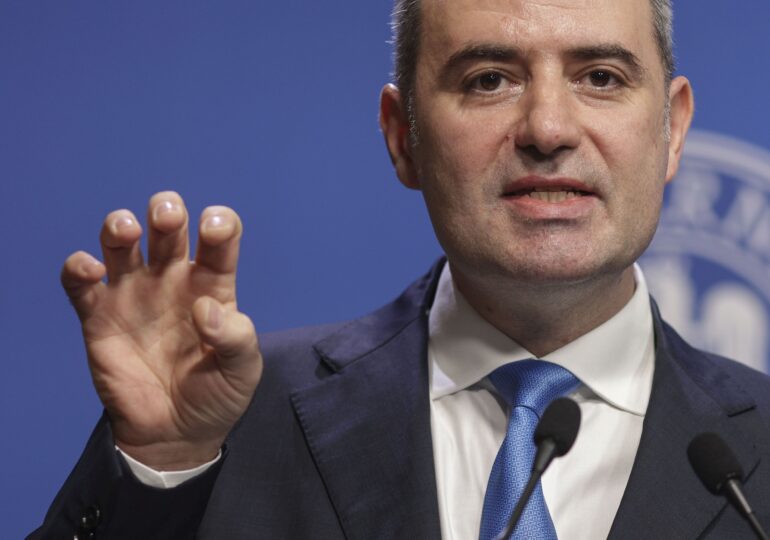
Romania’s budget deficit reached 78.3 billion lei in the first nine months of 2026, down from 102.47 billion lei recorded in the same period last year. As a share of GDP, the deficit decreased from 5.31% to 3.81%, according to data presented by Finance Minister Alexandru Nazare.
However, the official warns that pressures on the budget remain high, especially due to interest payments, payment obligations, and uncertainties regarding the full collection of funds from the Recovery and Resilience Plan (PNRR).
“The nine-month budget execution confirms that we are on the right track in the fiscal-budget consolidation process,” said Alexandru Nazare, who emphasizes that the deficit reduction must continue without sacrificing public investments.
Main data from the budget execution for the first nine months of 2026:
- Budget deficit: 78.3 billion lei, compared to 102.47 billion lei in the same period in 2025.
- Deficit as a share of GDP: 3.81%, compared to 5.31% in the first nine months of last year.
- Budget revenues: 522.69 billion lei, an increase of 11.9%.
- Budget expenditures: increased by 5.5%, at a slower pace than revenues.
- Public investments: 107.77 billion lei, 25.15 billion lei above the level of the first nine months of last year.
- Personnel expenses: reduced by 4.43 billion lei.
- VAT collections: increased by 24.8%.
- Social security contributions: increased by 6.8%.
- Interest expenses: 50.63 billion lei, 10.69 billion lei above the level in the same period last year.
Nazare: European funds have supported investments
The Finance Minister states that public investments have been decisively supported by European funds and the Recovery and Resilience Plan (PNRR). According to him, European funding has covered over 70% of this year’s public investments, reducing pressure on the national budget.
Revenues from European funds increased by 39.8%, while payments for projects financed through PNRR and other European programs advanced by 48.8%.
Romania has so far received 13.27 billion euros through the PNRR and still has 6.43 billion euros to receive, corresponding to payment requests 5 and 6. Their validation by the European Commission is essential to ensure funding related to the fulfilled milestones and targets.
The minister warns that the amounts requested or allocated are not equivalent to the money actually collected. If certain funds are not validated, pressure on the national budget could increase, depending on expenses already made and contractual obligations assumed.
In this context, Nazare says he has asked ministries to clarify the status of projects and to evaluate investments based on completed works, remaining payment obligations, and certain sources of funding.
Interest payments and payment obligations put pressure on the budget
Despite the deficit reduction, interest expenses continue to rise. They reached 50.63 billion lei in the first nine months, 10.69 billion lei more than in the same period in 2025.
“The more the state borrows and under less favorable conditions, the larger the share of public resources must be directed towards interest payments, to the detriment of investments and public services,” the minister warned.
Other pressures on the budget come from enforceable titles exceeding 13 billion lei due in 2026, the financing needs of the health system, and reimbursement requests related to energy compensation schemes.
Nazare also draws attention to commitments made for investment projects, which in some cases would exceed the budget credits available within the deficit reduction trajectory.
2027, a key year for fiscal consolidation
The Finance Minister warns that the budget revision and the construction of the 2027 budget will be difficult. The government will have to align estimated revenues with already assumed obligations, permanent expenditures, possible indexations, ongoing investment contracts, and defense commitments through the SAFE program.
“2027 is a key year for fiscal adjustment, not a year of spectacular budget increases. Budgets will be built based on what we can finance, not on what we would like to spend,” said Alexandru Nazare.
The official emphasized that additional expenditures cannot be committed without identifying sources of funding and assessing the impact on the deficit and public debt.
In the minister’s opinion, a possible deterioration of the country’s rating could lead to more expensive borrowing for the state, increased financing costs for companies and, indirectly, for citizens, as well as reduced resources available for development.
Nazare also recalled that Romania continues to have the largest budget deficit in the European Union and argued that reducing imbalances must continue without abandoning investments that can support long-term economic growth.