
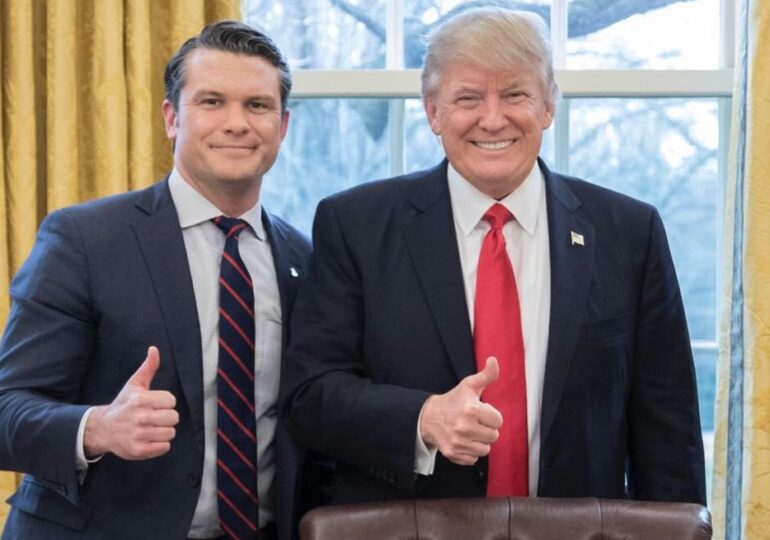
President Donald Trump announced during an improvised press conference at the White House that he will support Secretary of Defense Pete Hegseth if he is subjected to impeachment proceedings.
Trump offered his strongest support yet to Hegseth shortly after one of his fiercest opponents, Republican Thomas Massie, filed eight articles of impeachment against the Secretary of Defense in the House of Representatives, CNN reports CNN.
The statement of support came during another unusual public appearance. Trump described the moment as “a bit of fun,” again offered Dana White, head of the Ultimate Fighting Championship (UFC), the position of White House spokesperson, then added that he was “joking, kind of.”
“But seriously, what did Hegseth do? He won the war. He was in charge. He won the war in Venezuela, as I said, in 48 minutes. It was flawless. No one was killed. And I certainly believe he won the war in Iran. Or, at least, he is winning it,” Trump told reporters.
The special forces operation that captured President Nicolás Maduro was bold and risky, but it can hardly be called a war. Moreover, the claim that the U.S. has won in Iran, at least strategically, is debatable.
Hegseth is the Cabinet member who resembles Trump the most
Beyond the war, there are also political reasons why a president increasingly retreating into a close circle of confidants would hesitate to give up Hegseth.
The Pentagon chief is the Cabinet member who has most visibly succeeded in replicating Trump’s political style. He had the courage to ban press access to the Pentagon, promotes cultural confrontations and campaigns against “woke” ideology, and seems determined to turn the impeachment process into a source of pride.
If Trump were to reject the man who renamed the Pentagon the “Department of War,” he would actually harm his own political image.
Still, while criticizing what he considered unfair treatment of Hegseth in the White House briefing room, Trump also highlighted the political trap he is in. The president is trying to win a political battle already lost: millions of voters recently sanctioned, in the midterm elections, the war and his confrontational politics. Insisting on maintaining his position could worsen his situation.
Both Trump and Hegseth seem to present their own reality regarding a war in which a smaller, less powerful, and repressive regime resisted the attack launched by the American superpower. The conflict has already cost tens of billions of dollars, alienated U.S. allies in the Gulf region, and caused an energy crisis and a rise in the cost of living.
In an interview on Sunday’s “60 Minutes” on CBS, the president stated that he “would not change anything” about the conflict. On Monday, Hegseth told reporters he would be willing to debate “all day” the success of the administration’s military operations.
Trump’s claims that Iran’s nuclear program has been permanently eliminated might only be fully assessed in a few years. However, continuing to try to convince voters that a war they disapprove of is a victory seems like a political strategy with little chance of success.
Massie attacks Hegseth
Impeachment is the most serious constitutional sanction that can be applied to a public official. At least that was the case in the ordinary political world, which seems to have unraveled after Trump arrived at the White House.
Hegseth is accused, among other things, of having initiated and continued the war in Iran illegally, violating constitutional provisions regarding Congress’s war powers; of ignoring laws designed to reduce civilian casualties; and of abusing his position by coordinating “extrajudicial executions” of vessels suspected of drug trafficking in the Caribbean Sea and the Pacific Ocean.
Each of the eight articles of impeachment raises serious constitutional issues. The document also includes the military strikes in Yemen, as well as the attempt to sanction Republican Senator Mark Kelly of Arizona for telling soldiers they can refuse illegal orders.
In a certain sense, however, Trump is right: it is a deeply political process.
Massie, a longtime opponent of the president, provoked his anger after helping pass a law allowing the publication of Epstein’s files. Trump also intervened to shorten his political career by supporting a MAGA-aligned challenger in the Republican primary elections.
“He is a sick man, very sick. Actually, something is wrong with him,” Trump said on Monday, calling Massie an “absolute loser.”
Massie returned the compliment. On Monday, he mocked Hegseth, anticipating how the Secretary of Defense might react at the less usual press conference he scheduled for Tuesday.
“I hope he responds to the eight articles of impeachment and does not stand before the press to misquote the Bible in Quentin Tarantino style, do some pull-ups, and then call everyone fat and gay just because they support this impeachment process,” Massie told reporters.
The timing chosen for initiating the procedure is also important. After the Republicans’ defeat in the midterm elections, the move gives Republican lawmakers who will soon lose their seats the opportunity to vote against Trump and the war that contributed to their losing office.
A significant number of Republicans who might join the effort would weaken Hegseth’s authority and increase the political costs Trump must bear to continue supporting him.
The Democrats are watching this confrontation with satisfaction.
“I fully support the impeachment resolution, as I have already said,” said House Democratic minority leader and possible future Speaker Hakeem Jeffries on Monday.
He mocked the administration’s strategy in Iran, calling it “Epic Fail Operation,” and added that “Pete Hegseth abused power, undermined America’s national security, and is the architect of the disastrous, costly, and irresponsible war in Iran that the administration chose, which led to soaring fuel prices for ordinary Americans and made the country less safe.”
Democrats in the House of Representatives would enthusiastically vote to impeach any official from the Trump administration. However, in the new Congress, they will need to find a balance: avoid overstepping boundaries in the investigations they intend to conduct against Trump, but also heed voters’ demands to take measures to reduce the cost of living.
However, the current procedure, initiated by a Republican, gives Democrats the opportunity to vote without bearing the political costs they would have faced had they launched the effort themselves.
Hegseth’s bet and reasons why he might not survive in office
Hegseth’s press conference might not follow the scenario anticipated by Massie. However, appearing before reporters carries risks.
If the Secretary of Defense adopts the extremely aggressive tone from the video recordings released, apparently to get Trump’s attention, he could heighten the dissatisfaction of Republican lawmakers in the House of Representatives with his activity and unintentionally provide additional arguments in favor of impeachment.
In the short term, Hegseth does not seem at risk of losing his position, as it is unlikely that a two-thirds majority required for conviction would be reached in a possible Senate trial.
Still, a Secretary of Defense who has drawn criticism from both parties over the war is not yet out of danger.
Furthermore, Hegseth could become a problem for Trump when he needs the support of a Democrat-controlled Congress to approve defense budget requests.
On Monday, Massie told CNN journalist Kaitlan Collins that, in his opinion, there is a “high probability” that Hegseth will no longer hold the position by the end of the year.
There is also the war that shows no signs of ending.
On Monday, Trump again demonstrated that he has no clear plan for achieving lasting peace. The president shifted from predictions of an imminent deal to statements that the conflict wasn’t even a real war, then warned that he is “armed to the teeth and ready for action” for a new attack.
If he fails to exit this conflict, the war will overshadow his last two years in office. However, it will be difficult to change political direction as long as Hegseth remains in charge of the Pentagon.
Therefore, the most dangerous moment for the Secretary of Defense might not come with the impeachment process, but when Trump concludes that he can best protect himself not by defending Hegseth, but by sacrificing him.