
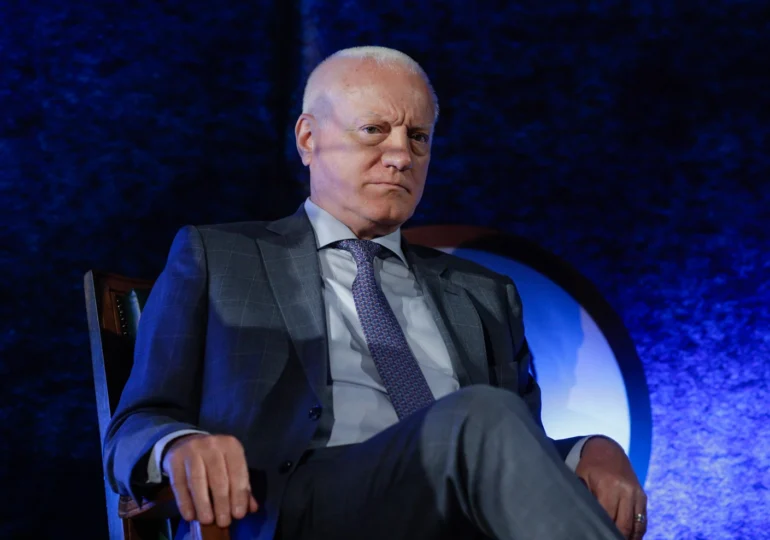
Former PNL president Valeriu Stoica warns the liberals and USR that a possible collaboration with AUR to dismiss the Luca Niculescu Government could have a major electoral cost in 2028. In his opinion, the current Executive has a chance to survive until the next elections, but everything depends on how it will overcome the first major obstacle: next year’s budget.
Stoica argues that PNL and USR would compromise their electoral chances if they voted alongside AUR on a motion of no confidence, even though the three parties are in opposition to the current government.
“If PNL and USR made the mistake of being, in quotes, partners in the motion of no confidence with AUR, they would compromise all their chances for 2028,” he said Sunday evening on Digi24.
Bolojan did not exclude a joint vote with AUR
Stoica’s warning contrasts with the position expressed last month by the current PNL leader, Ilie Bolojan. He stated that the liberals do not rule out voting for a motion of no confidence initiated by AUR if the arguments against the Government are well-founded.
“If other parties submit it, we have to see the reasons, what the Government has done. If those reasons are relevant, PNL might vote for it,” Bolojan explained.
Valeriu Stoica, however, draws attention to the electoral cost that such a decision could have for the liberals and USR, regardless of the reasons invoked for dismissing the Government.
How the Government could survive without a majority
Valeriu Stoica starts from the idea that any new government benefits from an initial political credit of about six months, a period during which it can demonstrate that it is capable of managing the country's problems. For the Executive led by Luca Niculescu, the first and most important test will be the adoption of the 2027 budget.
“If during this period the government passes several trials by fire, then its survival until 2028 could become a possible option. Everything depends on what happens in these six months,” Stoica explained.
The problem is that PSD, the main party of the current Executive, holds about 20% of the seats in Parliament, and negotiations to obtain a majority to support the budget are expected to be difficult. Stoica sees only one pragmatic solution: the Government's assumption of responsibility. “When you have only a 20% share in Parliament, negotiations for the budget are almost impossible. So the pragmatic solution, the only one I see and which was also suggested by PSD, is the Government's assumption of responsibility,” he said.
The procedure allows the adoption of the project without the usual parliamentary vote if no motion of no confidence against the Government is adopted. The opposition can submit such a motion, but the Executive falls only if it gathers the required number of votes.
This is precisely where Stoica sees the advantage of the current governmental formula. To dismiss the Niculescu Cabinet, PNL, USR, and AUR would have to vote together, an association the former liberal leader considers politically impossible at this moment.
However, he warns that assuming responsibility should not become a usual method for adopting important laws and reminds that the president can resend a law adopted through this procedure back to Parliament.
The budget, the test that could decide the Government’s fate
Beyond parliamentary arithmetic, Stoica draws attention to economic difficulties. The Government must build a budget that respects deficit targets, amid pressures for salary increases and pension indexation. Additionally, rating agencies are set to reassess Romania’s financial situation.
“This budget is like litmus paper. We will see if the Finance Minister really has a serious say and if the macroeconomic balances are maintained because he holds the reins well in preparing the budget, or if he is imposed solutions that are then very dangerous,” Stoica warned.
He expressed confidence in Finance Minister Alexandru Nazare, whom he says has the power to refuse compromises that would endanger budgetary balances. At the same time, he believes that PSD cannot afford to promote an unsustainable budget that could lead to a downgrade of the country’s rating.
“That would be disastrous for all Romanians, no matter where they are, no matter their situation, whether they work in the public or private sector. For the private sector, it would be a disaster,” he warned.
Stoica invoked the example of Greece and the harsh measures imposed during the debt crisis, arguing that PSD would pay a huge political price if Romania ended up in a similar situation. In his assessment, if the Government manages to get through the first six months and adopt a credible budget, maintaining power until 2028 becomes a possible scenario.