
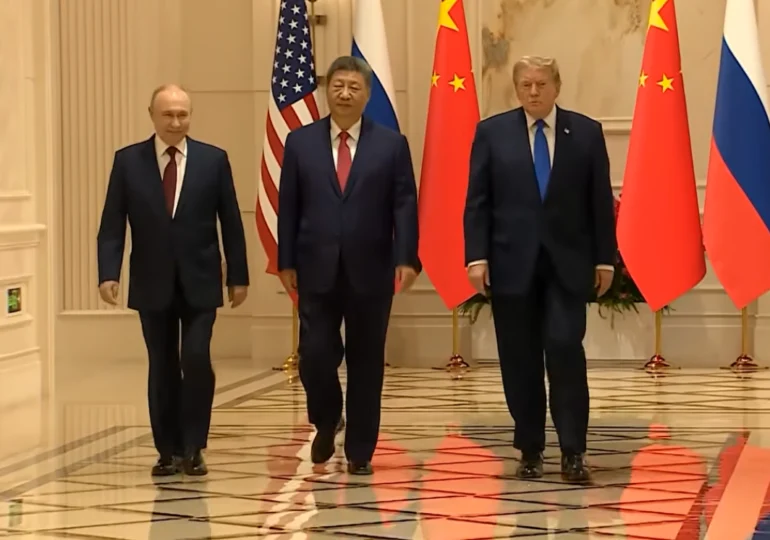
Officials were candid before Thursday’s unprecedented tripartite talks: it was unlikely that U.S. President Donald Trump, Chinese leader Xi Jinping, and Russian leader Vladimir Putin would leave Shenzhen with major agreements. As it turned out, diplomatic progress was not the main goal, but the discussions themselves were.
Gathered around a round table in an official state residence on the outskirts of the modern Chinese metropolis, each of the three leaders invoked the “responsibility” they share to jointly manage a complex world. “History teaches us that when great powers are at peace, the world is safe; when great powers enter into conflict, the world sinks into chaos,” Xi said at the start of the talks.
At the same time, each sought to gain an advantage from the power projection offered by this meeting:
- Putin had the opportunity to return to the top global stage alongside much more powerful nations, after having been isolated nearly five years ago due to the invasion of Ukraine. A joint statement issued after the meeting mentioned the immunity of state officials as being of “fundamental importance” — a crucial aspect for a leader wanted by the International Criminal Court for war crimes.
- Xi managed to present himself — and China — as an influential diplomatic actor, even though domestically he faces persistent economic problems.
- Trump, whose final term was hastened by the midterm election defeats held earlier this month, succeeded in demonstrating that he remains a relevant player in relations with two leaders whose power in their own countries is practically unlimited.
“No peace was ever built by refusing opportunities for dialogue and interaction. We choose a different path,” Trump said at the start of the meeting. “Let’s see if we can achieve something,” he added before the press was invited to leave the room and the actual discussions began.
A CNN analysis presents five conclusions drawn from the Shenzhen summit:
What was actually the objective of the meeting?
It is not yet clear whether Thursday’s meeting will be remembered as a historic turning point — or just as another photo opportunity. Eighty-one minutes were certainly insufficient to resolve all the major differences among the three countries related to conflicts, economy, and cutting-edge technologies.
Before the talks, the leaders’ objectives seemed to differ.
The summit was initially proposed by Putin as a way to discuss the war in Ukraine without Ukrainian representatives at the negotiating table — a prospect that caused deep concern in Kyiv and led to comparisons with the 1945 Yalta Conference, when the great world powers divided the postwar world into spheres of influence.
Both Xi and Putin referred in their opening statements to the post-World War II period — a time when powerful countries united to shape the world — thus suggesting how they viewed Thursday’s meeting.
Initially, U.S. officials stated that Ukraine would not be on the agenda, although Trump later said he would address the topic.
More important, in Trump’s view, was a discussion about nuclear arms control among the world’s largest nuclear powers. Trump wants to negotiate a new non-proliferation pact with Moscow and Beijing, although he openly acknowledged the difficulties in reaching an agreement. “Once you have nuclear weapons, it’s very hard not to have them,” he said. “That’s just how life is.”
Xi seemed uninterested in concluding a nuclear deal with two countries whose warhead arsenals are often much larger than China’s. Moreover, according to U.S. officials, he was initially reluctant even to host tripartite talks, fearing they might overshadow his own APEC summit.
Strengthening relations
The dynamics of the relationships among the three leaders is complex, CNN notes. Over the past two years, Trump has made intense efforts to cultivate relationships with both Xi and Putin, hoping that closer personal ties would lead to a more fluid geopolitics. He resorted to flattery and lavish summits to honor and elevate his counterparts.
In previous separate meetings, he called both “friends.”
So far, these expressions have not led to significant progress. Trump expressed dissatisfaction that his relationship with Putin — also supported by a summit held last year in Alaska — has not yet succeeded in ending the war in Ukraine. Trade disputes and those related to rare earth deliveries continue to be sources of tension in U.S.-China relations. Additionally, both countries provide assistance and technology to Iran.
Xi and Putin, who declared five years ago that they are “no-limits” partners, have met dozens of times. After another meeting held here on Wednesday, Chinese state media described their relationship as “rock-solid despite wind and rain.”
Xi and Putin have long been united by the shared belief that the global balance of power is undergoing a fundamental transformation in their favor, as the East rises and the West declines. Or, in other words, that the era of American superpower is nearing its end.
Through this unprecedented three-way meeting, which also included Trump, Xi and Putin gained an element that both will surely use as new, highly significant evidence supporting this vision.
The wars that annoy Trump
Two of the three men present at Thursday’s meeting are involved in wars against smaller adversaries, conflicts that have lasted longer than anticipated. Trump’s war in Iran and Putin’s in Ukraine have drained military resources and caused global price increases — also provoking Xi’s dissatisfaction, who sees these conflicts as a threat to global stability.
Both wars were topics Trump hoped to discuss with Xi and Putin, both maintaining ties with Tehran. The U.S. president has reached the end of his patience over these conflicts.
The war in Iran — which he initially said would last six weeks — is extremely unpopular domestically and, as he himself admitted, led to massive electoral losses for Republicans during the midterm elections. He is currently considering military options to trigger a new phase of intense bombings.
It is unclear to what extent Xi and Putin can contribute to ending these wars. Also, the capacity of a summit — in which neither Ukraine nor Iran participate — to bring peace appears limited, although Trump seemed optimistic.
The battle for supremacy in AI
Even before Trump arrived in Shenzhen, the scandal involving former Nvidia CEO Jensen Huang, alongside a person suspected of being an agent of Chinese intelligence services, overshadowed this visit. The same happened with successive service interruptions in the United States — caused, in some cases, by updates to artificial intelligence (AI) systems — which generated concern to which the administration initially responded slowly.
Questions about how the U.S. will compete in the rapidly developing AI industry seemed all the more pressing in this shining center of technology and chip production in China. And the revelations about Huang exposed a deep rift within Trump’s cabinet regarding how — or whether — the sale of high-performance AI chips to China should be restricted.
Having dinner with Xi on Wednesday evening, Trump addressed the subject only briefly, as he later stated. Before arriving in China, he mentioned that he was cautious, fearing he might “offend” the Chinese side by pressing too much on the espionage issue.
Many members of his administration take a tougher stance and want to block China’s access to the most advanced AI chips. Trump, on the other hand, opposed any measures that might “stifle” progress in artificial intelligence.
Xi, an influential diplomatic actor
Undoubtedly, Beijing will consider this summit a major success for Chinese diplomacy, the cited analysis shows.
Trump’s praises of China and his assurances that, as long as he and Xi are in power, “they will never have problems,” are welcome for the leadership in Beijing. They closely monitor any change in the tone of U.S. policy toward China, in a context where American lawmakers increasingly call for tightening controls over China’s access to advanced American technologies.
Beijing was clearly interested in leveraging Trump’s visit to capitalize on the American president’s goodwill toward China – especially in light of a power shift in Congress and as Trump enters the final stage of his last term. Xi’s gesture of welcoming Trump at the airport – a departure from usual protocol – as well as his evidently cordial attitude in interactions with the American president, were most likely carefully calculated with this objective in mind.
Even the absence of concrete results following the trilateral meeting also served Beijing’s agenda: it is generally believed that Xi wanted to avoid a situation reminiscent of “Yalta 2.0” regarding discussions about Ukraine’s fate. Such a scenario would have contradicted China’s declared insistence on a more pronounced multilateralism on the global stage, CNN notes.
Instead, Xi had the opportunity to present himself as an international mediator – an influential actor whose diplomatic stature allows him to stand on equal footing with the U.S. – without taking on complex commitments.
The timing is opportune for Xi, who seeks to strengthen his image ahead of a crucial Communist Party congress scheduled for next year, where he is expected to secure his fourth term at the helm of China’s power structure.
T.D.