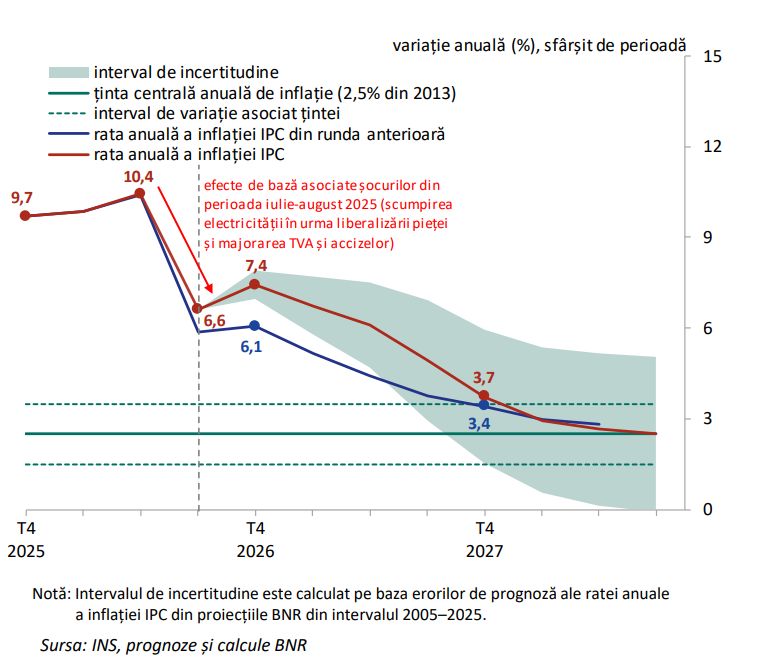
Prices will rise more than anticipated by the National Bank of Romania (BNR), and inflation will remain high until the end of the year. BNR has raised its forecast for December 2026 from 6.1% to 7.4%, mainly due to the increase in energy and fuel prices. A somewhat better news could come next year: inflation is expected to start declining, and interest rates could be reduced from spring.
The new estimates were presented on Monday, November 16, by Governor Mugur Isărescu, during a press conference dedicated to the Quarterly Inflation Report.
BNR now estimates an inflation rate of 7.4% at the end of 2026, 1.3 percentage points above the forecast published in August.
The forecast for next year has also been revised upwards: inflation is expected to reach 3.7% in December 2027, compared to 3.4% previously anticipated by the central bank.
A return to the BNR’s target range of 1.5%-3.5% is expected only in the first quarter of 2028.
What does this mean for buyers? Even if inflation decreases next year, it does not mean that food, services, or other products will automatically become cheaper. It means that prices will continue to rise, but at a slower pace.
For example, a product that costs 100 lei and increases in price by 7.4% will reach 107.40 lei. If the next year its price increases by another 3.7%, it would reach approximately 111.37 lei. This is just a calculation example, not a forecast for a specific product.
Why BNR Worsened the Forecast
The main problem is the rise in energy and fuel prices. Tensions on international markets, fueled by geopolitical conflicts, have led to higher prices for oil and energy products. These increases are not only visible at the pump or on energy bills.
They gradually transmit into the prices of other products, as companies pay more for transport, production, and supply.
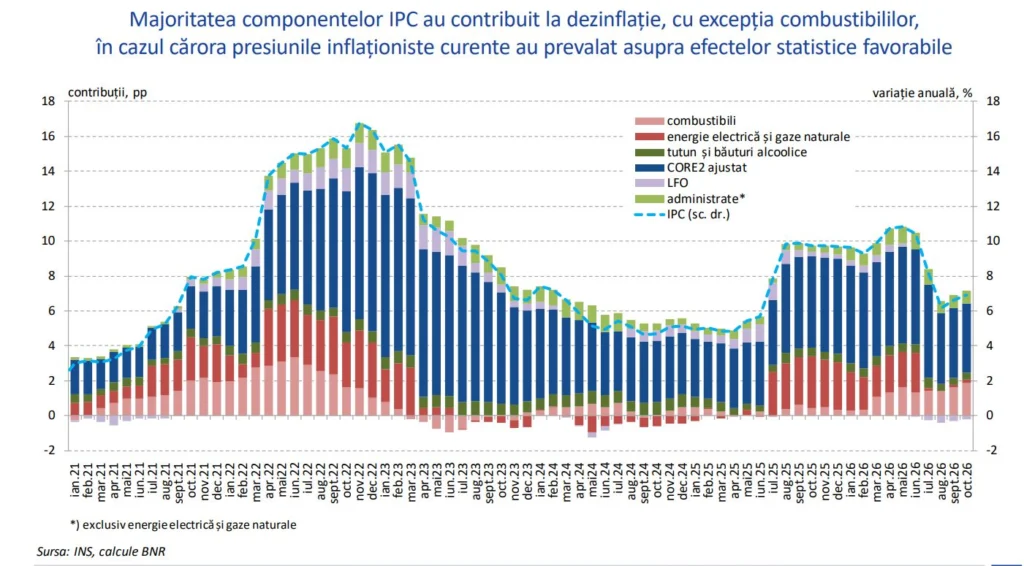
Another factor is the depreciation of the leu, which can make imported products and raw materials bought from abroad more expensive. According to BNR, the annual inflation rate reached 6.94% in October, compared to 6.61% in September and 6.17% in August. The increase in October was mainly caused by fuel prices, but also by the rising costs of vegetables, fruits, and eggs.
However, the situation is different from the first half of the year, when inflation exceeded 10%. Governor Mugur Isărescu explained that the statistical effect of price increases caused by the VAT hike and the removal of price caps on electricity has considerably diminished.
The so-called “inflation hump” has faded, the governor noted, according to Economedia. In other words, last year's large price hikes no longer push up the annual inflation rate to the same extent. However, other pressures have emerged in the meantime, especially from the energy sector.
Isărescu also sought to temper fears of a price explosion before the holidays. “Attention, this is about the CPI index, it is not about price explosions, as there is a tendency to say! Prices will probably be relatively stable during the holidays or there will be normal increases, as in previous years,” the governor said, quoted by Profit.ro.
When Interest Rates on Loans Could Decrease
For Romanians who have loans, one of the most important pieces of information is that BNR is considering lowering interest rates in the spring of next year. For now, the monetary policy rate remains at 6.5% per year, a level maintained by the central bank at the November 12 meeting.
Mugur Isărescu explained that a reduction could become possible if inflation evolves according to the new estimates. “The most optimistic scenario is that inflation decreases according to this forecast. And of course, by spring, we have no choice, so to speak, we will also lower interest rates, right?” the governor said, quoted by Profit.ro.
However, this is not a decision already made nor a promise that interest rates will decrease on a certain date. Even if BNR starts to reduce the key rate in the spring of 2027, this does not mean that loan installments will immediately decrease.
For Romanians with variable interest loans, the evolution of installments depends on the ROBOR and IRCC indices, depending on the loan contract. ROBOR can react more quickly to market changes, while IRCC, used for most new loans granted to the population in lei, is updated quarterly based on interest rates from a previous period. In the case of IRCC-linked loans, the effects of an interest rate reduction might be seen only after several months.
Weak Economy Can Help Reduce Inflation but Puts Pressure on the Population
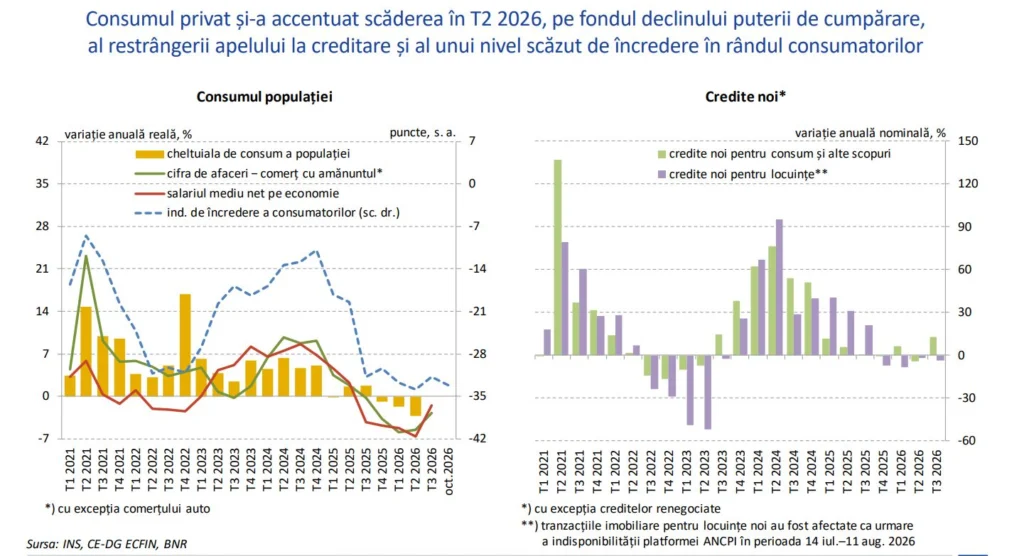
BNR also draws attention to another problem: consumer demand remains weak, and the economy shows no signs of a strong recovery. Against the backdrop of budget adjustments and high costs, the population and companies are more cautious with spending.
This situation can contribute to slowing inflation. When people buy less, companies have fewer opportunities to raise prices without losing customers.
But there is also a downside: reduced consumption affects sales, investments, and economic activity. Data analyzed by BNR show that the economy shrank by 0.1% in the first quarter of 2026 and stagnated in the second quarter, compared to previous quarters.
Moreover, household consumption continued to decline compared to the previous year. For the upcoming period, BNR expects that weak demand will contribute to tempering price increases, alongside the dissipation of the effects of energy shocks.