
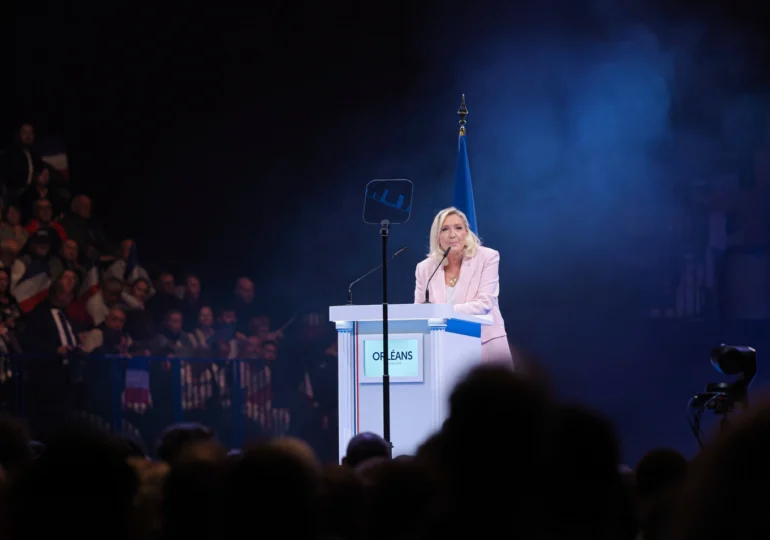
For a month now, officials from Brussels, London, Paris, and Warsaw have been repeating the same question marked by concern: what happens if we rearm, and the far right comes to power?
After decades of delegating much of its defense to the United States – and following two major shocks: the large-scale Russian invasion of Ukraine and President Trump’s ambivalent attitude toward the United States’ role within NATO – Europe has begun to strengthen its military capabilities on an unprecedented scale.
However, as this process gains momentum, far-right parties are making significant gains in elections and polls, especially in Germany and France. There is a possible scenario, in the near future, where European countries could be governed by Eurosceptic formations – in some cases, openly pro-Russian – that could hijack or abuse the rearmament process of their own states.
Liana Fix, senior fellow for Europe at the Council on Foreign Relations, examines in an article published by the New York Times how Europe's rearmament process could fall into the wrong hands and how this danger can be avoided.
Two major European powers slide into the mirage of populism
France represents the primary immediate concern:
- The presidential elections are scheduled for April, and recent polls show that Marine Le Pen, the candidate of the far-right formation National Rally (Rassemblement National), would place first in the first round, obtaining between 35% and 37% of the votes.
- Marine Le Pen is deeply Eurosceptic and has stated she would reduce financial aid to Ukraine. She wants France to withdraw from NATO’s integrated military command structure (after the end of the war in Ukraine) and has criticized the concept of “forward deterrence,” calling it a “political public relations exercise.” In the event of a crisis with Russia — if, for example, Russia were to test NATO through aggressive action against the Baltic states — it is hard to imagine an RN-led France taking on the role of European defense leader.
But Germany represents the deeper, longer-term concern.
- The far-right Alternative for Germany (AfD) broadly expresses skepticism toward the EU and NATO; it has argued that sanctions against Russia hurt Germany more than the intended target and advocates for a return to Russian gas as an energy source. Last month, the party leader, Alice Weidel, stated at a press conference that Germany needs “a sustainable, reliable, and cheap energy resource, guaranteed by Russia for the last four decades,” adding that sanctions have destroyed the country’s “business model.”
- There is no imminent scenario in which AfD comes to power nationally, but such an evolution is no longer inconceivable, notes Liana Fix, author of the book “Germany Rearmed: The Return of War and the End of Illusions”. In national polls, the party scores about 28%, significantly ahead of Chancellor Friedrich Merz’s Christian Democratic formation. In September, it achieved a crushing victory in the regional elections in the eastern state of Saxony-Anhalt. The “cordon sanitaire” – the agreement among established German political parties to refuse any cooperation with parties considered extremist – remains in place but is under pressure.
- Even if the “cordon sanitaire” against AfD holds, as expected, in the next elections – anticipated in 2029 – Germany’s neighbors are already worried about what will come next. AfD’s popularity could peak in the mid-2030s, by which time Germany’s rearmament would be nearly complete. It is not at all impossible that a rearmed Germany led by AfD could pressure its neighbors and destroy decades of European integration and cooperation.
Can rearmament be shielded from populist forces?
It is not possible to completely protect Europe’s rearmament from populism, the author of the analysis emphasizes.
If a far-right party in Paris or Berlin were determined to break ties with its neighbors, it could do so. However, Europeans can take measures to buy time and make any potential withdrawal from the European common defense system much more costly.
European countries must interconnect their military capabilities and defense industries so closely that the cost for any of them to cancel or abandon European defense rises significantly. This requires broader joint funding of defense, which creates incentives for cooperation – the existing SAFE program, which offers EU-guaranteed loans for joint acquisitions, is a good starting point.
Integrating European forces and concluding long-term production contracts based on shared supply chains would encourage European states to rely on each other. If this sounds familiar, it is because it was also the logic behind the European Coal and Steel Community – the core of what later became the European Union, the expert notes.
In her view, the United States should support such efforts. Washington wants Europe to defend itself, but the transfer of security responsibilities will only work if Europeans cooperate instead of viewing each other with distrust.
The Trump administration welcomes the rise of “European patriotic parties,” as if they naturally form a friendly bloc with which the US could cooperate. But these parties often define their national interests in opposition to those of their neighbors, leading to competition and fragmentation in Europe — exactly the opposite of what the transfer of security responsibilities seeks, Fix warns.
Europe has lost one pillar. It has two left
For decades, Europe’s security rested on three pillars:
- the security guarantee provided by the US through NATO, which kept the Soviet Union and later Russia at bay;
- the Franco-German friendship, at the heart of the European Union, which maintained peace among Europeans;
- Germany’s integration into NATO and the European Union, which alleviated fears of possible German dominance.
The US security guarantees have already been undermined. If Marine Le Pen and the AfD led by Alice Weidel were to call into question the other two pillars, the result would not be a Europe capable of defending itself. Instead, it would be a rearmed Europe left adrift.
T.D.