
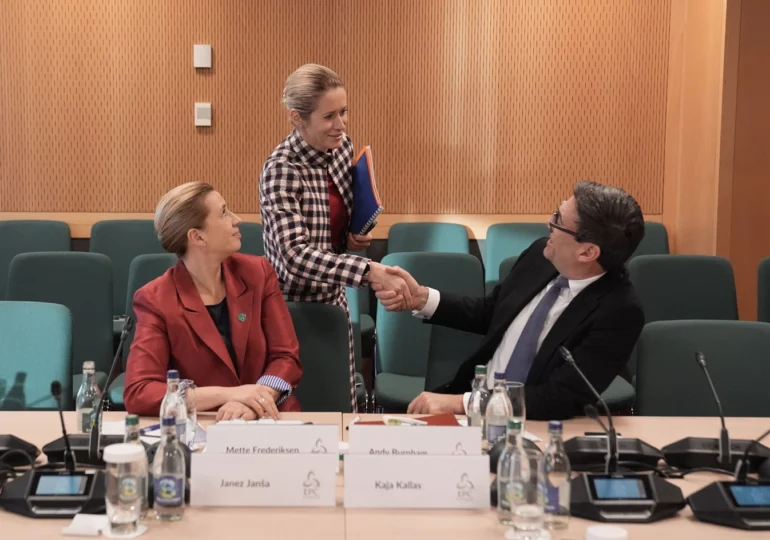
After the EU and its allies clashed over who should represent them in talks about Ukraine, they now face an even tougher decision: to take a hard line against Russia or to try a more nuanced approach?
The difficulty in establishing “red lines” – or principles – for the European side in potential negotiations is already causing divisions: the EU’s top diplomat, Kaja Kallas, argues that Europeans should start by demanding as much as possible, while some governments, such as Austria’s, advocate for a more flexible approach that includes confidence-building measures, writes Politico.
“There are a number of issues on which Europe should make clear that it is not willing to engage in discussions,” said Norwegian Foreign Minister Espen Barth Eide.
From Who to What
Europe was largely excluded from the talks between Russia, Ukraine, and the US that took place last week in Abu Dhabi, but the Kremlin and the White House have signaled that this will not happen again at future meetings. After days of disagreements, EU leaders agreed on a team made up of officials from four key countries — France, Germany, Italy, and Poland — plus the United Kingdom, as well as high-ranking representatives from NATO, the European Commission, and the European Council.
Currently, “the focus must shift from ‘who’ to ‘what’,” said Austrian Foreign Minister Beate Meinl-Reisinger.
In a 15-point document presented ahead of Monday’s foreign ministers meeting, Austria detailed some of the confidence-building measures that could be adopted: for example, proposing limited or partial ceasefires to pave the way for a broader armistice, or offering willingness to create an international forum to monitor a potential peace agreement.
The proposal amounts to “an offer to all 27 [EU countries] to work towards establishing a common position,” said Meinl-Reisinger.
The Cold War Example
Norway, which is not part of Europe’s negotiating team but has had direct contacts with Russia, is also putting forward ideas to reduce tensions. Supporters of Ukraine should look to the Cold War for examples of how Russia and the West managed extreme tensions – especially the “Helsinki Accords” of 1975, which established principles for relations between states – Foreign Minister Barth Eide said.
“NATO force deployments in NATO member countries, for example, are not a subject for discussion with Russia,” yet the Cold War-era arms limitation agreements “must remain relevant in the post-war scenario.”
Along the same lines, officials close to the talks advocate for a “flexible” mandate that would allow participants to negotiate effectively, rather than having their hands tied. The task of drafting this mandate should fall to the ambassadors of EU member states in Coreper meetings, not the foreign ministers, two European officials argued.
An additional difficulty is that such a mandate would target the European representatives present at the negotiating table – Bjoern Seibert from the Commission, Anna-Maria Boura from the European Council, as well as advisers from France, Poland, Italy, and Germany – but not those from the United Kingdom or NATO.
The Strategy of a Lawyer
Kallas, however, believes that the foreign ministers she convenes monthly in Brussels should be the ones to draft the mandate – and in her view, this approach should demand concessions from Russia right from the start, not the other way around.
“Foreign ministers are ready to continue this work,” she told journalists on Monday, noting that she has already proposed a list of demands.
“I was a lawyer,” she said. “How do you enter negotiations? First, you present or prepare the optimal version – everything you would like to achieve. Then, without making this public, you establish how far you are willing to concede and what the ‘red lines’ are, meaning the issues on which no negotiation is possible under any circumstances.”
Ministers from several Baltic, Nordic, and Eastern flank countries supported Kallas’s approach.
“We must strictly respect the order of steps: first, we must agree on a ceasefire, and once the guns fall silent, we can negotiate a lasting peace for Ukraine,” said Lithuanian official Kęstutis Budrys.
Estonian Foreign Minister Margus Tsahkna supported the same idea: “First of all, Putin can initiate the ceasefire. Then come the peace negotiations between Russia and Ukraine; and if peace is reached, we must discuss the security guarantees that will be offered to Ukraine. We also need security guarantees from Ukraine for our region.”
Pragmatism is Needed
The only problem is that Europe has effectively accepted that talks continue even without a ceasefire. According to two EU officials, European negotiators anticipate resuming discussions in the coming weeks in Abu Dhabi and are counting on the presence of Russian representatives at the negotiating table. This despite Moscow continuing daily attacks across the entire territory of Ukraine.
“It’s about pragmatism,” said a senior EU official who requested anonymity to speak openly. “People present at the talks must have the capacity to make decisions.”
T.D.