
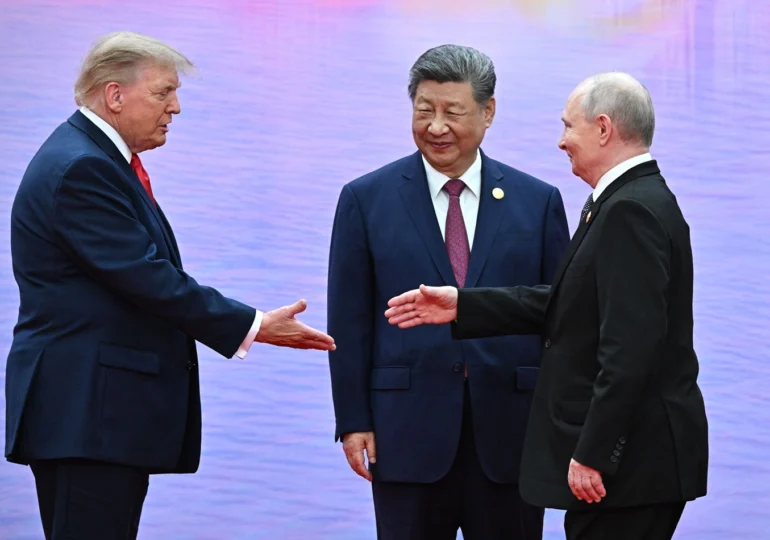
The American president considers his willingness to engage with authoritarian leaders a virtue. Critics, however, argue that this approach could allow them to take advantage of his thirst for adoration.
In a summit overshadowed by war, nuclear tensions, and economic uncertainty, President Donald Trump sent a simple message in China to Vladimir Putin and Xi Jinping: we are friends.
On the last day of this year's Asia-Pacific Economic Cooperation (APEC) leaders' meeting, Trump showed great cordiality towards Xi Jinping and Putin – referring to personal relationships, offering hugs, and at one point helping Xi onto an escalator by taking his hand.
He also suggested that this friendship could help achieve progress in resolving some of the world's most difficult issues. "You are my friend and we have a very special relationship," Trump said before a meeting with Xi, "and I believe that as long as you and I are in charge, we will never have a problem."
A few hours earlier, Trump's words about his relationship with Putin dominated much of the two leaders' public statements – statements that lasted less than a minute before a closed-door meeting. "We have had an excellent relationship for many years. We've known each other for a long time and I think many great things can come out of that, or at least can be born."
Trump considers his willingness to engage with authoritarian leaders – whom other Western governments avoid – a virtue, arguing that personal relationships are essential in negotiations with them. His critics, however, claim that this approach has blurred the line between diplomacy and servility, allowing Putin and Xi to exploit Trump's need for adoration while pursuing their own strategic interests, according to an analysis published by the New York Times.
Diplomacy in Trump’s Style
Xi responded "strategically" to the respect Trump showed during his state visit to Washington in September, says William Yang, senior analyst for Northeast Asia at the International Crisis Group. "However, we must distinguish between a gesture of reciprocity dictated by necessity and a genuine appreciation of the personal relationship."
The Chinese leader greeted Trump with a hug the moment he landed in Shenzhen – the first time during his term that Xi personally went to the airport to receive a guest. The event also included hundreds of dancers chanting warm welcome wishes, as well as a flyover by military aircraft.
In contrast, the Japanese Prime Minister was greeted at the airport by a single retired Chinese diplomat, without any low-altitude aircraft flyovers.
The summit provided a vivid illustration of the diplomacy style preferred by Trump: personal, theatrical, and based on the premise that even the most bitter adversaries on the world stage can be won over through a relationship with the American president.
It remains to be seen whether this cordiality will translate into concrete concessions. Putin and Xi have repeatedly shown they are willing to accept Trump's overtures without necessarily giving him what he wants.
Xi and Putin Know How to Handle Trump
The meeting in China contrasts with the bipartisan skepticism awaiting Trump upon his return to Washington.
The espionage and sexual scandal involving former Nvidia CEO Jensen Huang has increased pressure on Republican legislators to tighten restrictions on American chip exports. Some Republican foreign policy "hawks" were already concerned that the administration was too lenient towards China. Democrats have also promised to investigate any ties between Trump and Russia as part of their electoral commitments to fight corruption.
Before the summit, Democrats adopted a sharper tone, urging Trump to take a firm stance against the geopolitical rivals he greeted as friends. Senate Minority Leader Chuck Schumer (Democrat from New York) said Wednesday that Putin and Xi "play Donald Trump like they’re playing a cheap violin."
"Xi and Putin know that if they tickle Trump’s ego, distract him with pomp and ceremony, and offer a few compliments, he will make concessions on issues that matter most to Americans," Schumer said.
As Democrats prepare to take control of both chambers of Congress in January, they have signaled their intention to investigate Huang’s relationship with an alleged Chinese spy, as well as the actions of the Trump administration. Last week, Democrats in the House and Senate requested that Trump preserve documents related to Nvidia.
Trump’s predecessors had very different reactions to Putin and Xi:
- Joe Biden called Putin a "killer," "war criminal," and "butcher," and in 2024 referred to him with an insulting phrase ("crazy son of a bitch"). Biden also called Xi a dictator – including immediately after a four-hour summit with the Chinese leader held in 2023.
- Barack Obama cultivated relationships with Putin and Xi but rarely confused diplomatic courtesy with strategic friendship. He described Putin as "extremely polite" during their meetings, while warning that the Russian leader is driven by nationalism rooted in the past.
"Friends" Take Advantage of Trump’s Vanity
The displays of personal friendship this week come at a time when the national and geopolitical objectives of the Trump administration have been hindered by Putin and Xi, notes the American newspaper.
Xi has exploited China’s control over critical supply chains to extract concessions from Trump. After Trump launched a large-scale tariff offensive in 2025, Beijing restricted exports of rare earth elements essential to the American manufacturing industry. The resulting tensions forced Washington to relax restrictions on chip design software and Nvidia AI processors in exchange for China’s cooperation on mineral exports.
"Beijing has used this period quite well, maintaining strict control over rare earth minerals and somewhat strengthening its global position relative to the United States," Yang said.
Even on a sensitive issue like the alleged Chinese espionage, Trump seemed reluctant to pressure Xi. He told Fox News that he addressed the topic only "very briefly" during dinner, later downplaying the allegations and presenting them as standard practice among rival powers.
"We spy on China, they spy on us. So you can't ask them to stop. It makes no sense," he said.
At certain moments, Trump expressed frustration that Putin had not kept promises to end the war in Ukraine. "Putin serves us a lot of nonsense," Trump said during a White House cabinet meeting in July 2025. "He’s very nice all the time, but in reality, it’s all meaningless."
A week later, he was even more direct: "Putin surprised a lot of people. He speaks nicely, and then at night he bombs everyone."
T.D.