
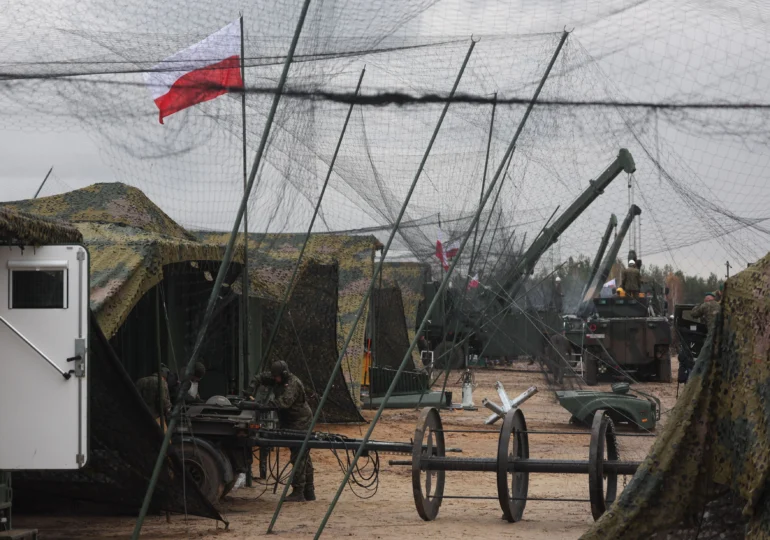
Russia is believed to have intentionally violated Polish airspace with two missiles and a drone while thousands of Western soldiers were participating in an exercise dedicated to a potential peacekeeping mission in Ukraine. The Institute for the Study of War (ISW) believes Moscow sought to intimidate states supporting Kyiv and to test NATO’s response. One of the missiles fell approximately 35 kilometers from the military exercise area.
The incidents occurred on the morning of November 20, during one of the largest Russian missile and drone attacks on Ukraine this month, according to the ISW report.
Polish Defense Minister Wladyslaw Kosiniak-Kamysz announced that a Russian Kh-101 cruise missile crashed in a rural area near the locality of Nowy Lipowiec. A second missile, possibly of the same type, fell near Rudnik nad Sanem, and a Russian jet-propelled drone, possibly of the Geran-5 type, crashed near Molodycz.
None of the three incidents caused casualties or significant material damage.
A Western military exercise near the site where the missile fell
ISW analysts believe the timing of the incursions was not accidental. In Poland, between November 9 and 22, the military exercise "Koalicja" is taking place, organized by the military component of the Coalition of Will, an international initiative bringing together 37 states willing to contribute to a potential peacekeeping force in Ukraine after the war ends.
The exercise in Nowa Deba involves between 5,000 and 6,000 soldiers from Belgium, France, Estonia, Spain, the Netherlands, Lithuania, Germany, Sweden, and the United Kingdom. Poland provides logistical support, and Turkey participates remotely. The training ground is only 35 kilometers from the area where one of the Russian missiles crashed.
"The Kremlin sought to discourage the Coalition of Will's support for Ukraine and to test NATO's reactions," ISW assesses, considering that the incursions were deliberately synchronized with the military exercise in Poland.
However, this is an assessment of Moscow's intentions, not a conclusion confirmed by direct evidence regarding orders given by the Russian military command.
NATO scrambled fighter jets but did not intercept the missiles
During the attack, NATO mobilized Polish, Swedish, and Dutch fighter jets and activated air defense radar systems. Polish forces identified up to 11 missiles and drones in Ukrainian airspace that could have posed a threat to Poland. However, the missiles and drone that entered Polish territory were not shot down.
General Ireneusz Nowak, a commander in the operational structures of the Polish army, explained that the conditions stipulated by the rules of engagement were not met.
According to ISW, Polish authorities likely assessed that interception would have created additional risks for the population and property, given that the projectiles were expected to fall in unpopulated areas.
Poland calls for strengthening NATO defense
After the incidents, Polish Prime Minister Donald Tusk spoke with NATO Secretary General Mark Rutte, and Warsaw requested the strengthening of air defense on the eastern flank.
The Defense Minister requested allies to increase the number of F-35 fighter jets and AWACS aircraft, used for surveillance and early warning. Poland also wants to strengthen NATO's "Eastern Sentry" operation, launched in September 2025 after a massive incursion of Russian drones into its airspace.
ISW analysts warn, however, that the political response of the Alliance is as important as the military measures.
Poland has not requested consultations under Article 4 of the NATO Treaty, which allows a member state to request discussion of a threat to its security.
"NATO risks raising the real threshold of allied reactions to blatant violations of its airspace by Russia," ISW analysts warn.
The Institute recommends negotiating agreements that would allow the interception of Russian missiles and drones threatening NATO territory as soon as they are in Ukrainian airspace.
G.P.