

The way we talk about ourselves can reveal much more about our mental state than we might think. The words we choose, the verb tense we use, even how we relate to the past or the future leave traces. People dealing with depression tend, for example, to talk more about the past, refer more often to themselves, and use fewer expressions related to plans. These are subtle patterns, but artificial intelligence can learn to recognize them, even when people do not explicitly say they are going through a difficult period.
But how far can an algorithm go? Can it detect signs of depression before someone receives a diagnosis? And what happens if this information about our vulnerabilities reaches employers or major digital platforms?
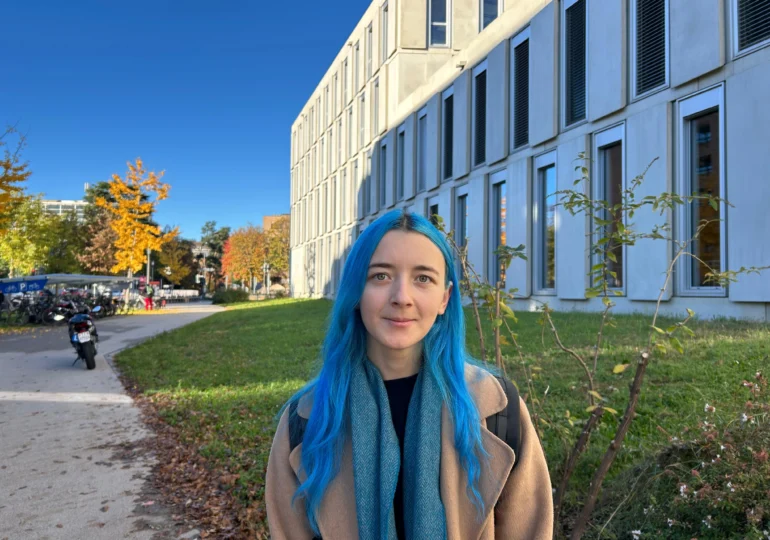
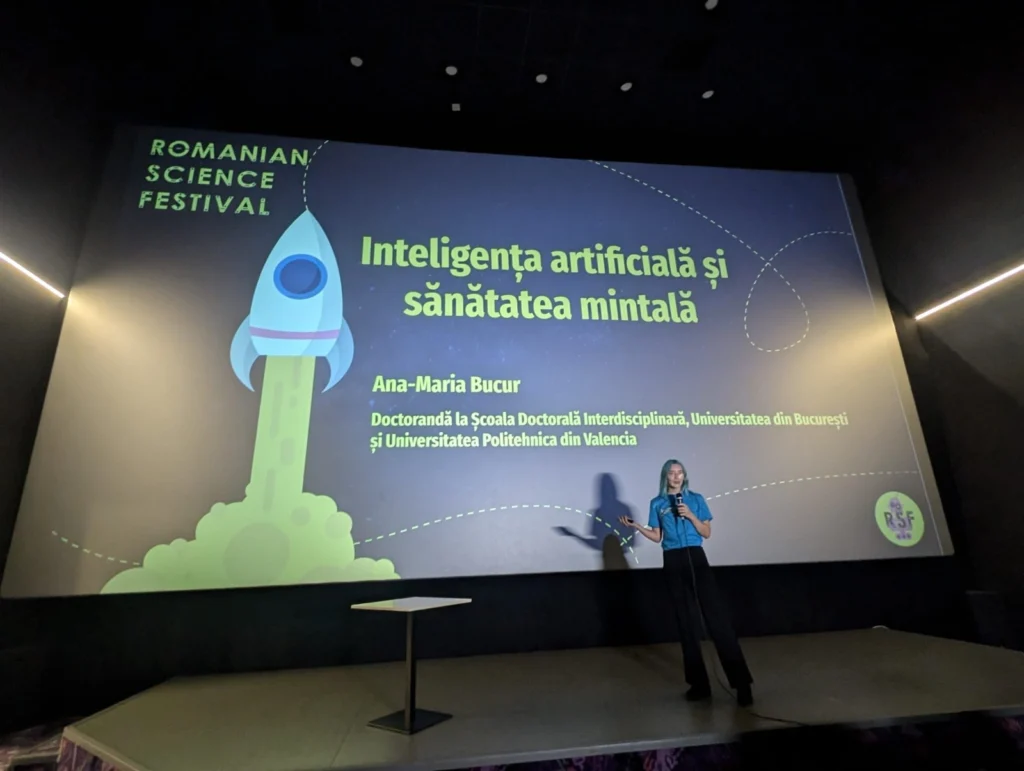
We discussed all of this with Ana-Maria Bucur, a 31-year-old Romanian researcher based in Switzerland. She develops artificial intelligence systems that try to identify patterns associated with mental health issues.
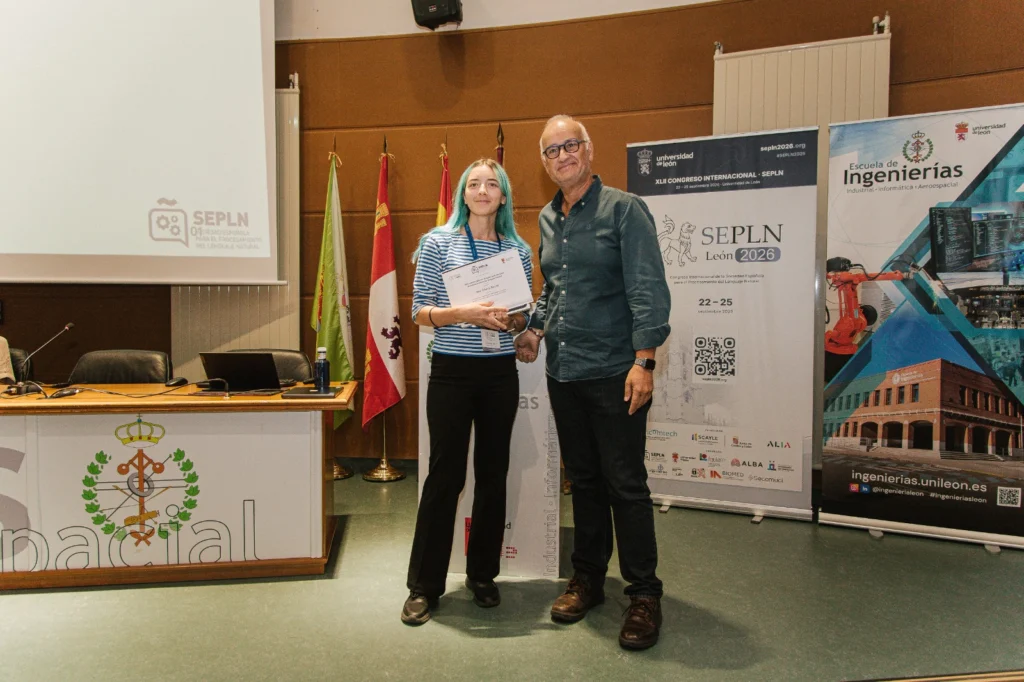
Ana-Maria studied computer science at the University of Bucharest and completed her PhD jointly with the Polytechnic University of Valencia. Her thesis, completed in 2025, was awarded the prize for the best doctoral thesis in the field of natural language processing in Spain.
Since 2024, she has been living in Lugano, where she works at the Università della Svizzera italiana, currently as a postdoctoral researcher.
Although she is a computer scientist, she has always been interested in psychology. During her PhD, she began collaborating with specialists in this field and discovered that problems involving people cannot be addressed solely through calculations and algorithms.
“Coming from computer science, maybe I did not pay enough attention to some more human aspects. However, over time, I learned to take them into account, with the help of colleagues from psychology. In computer science, the approach is usually quite simple: we identify a problem, build an algorithm, train it based on some data, and get a result. But when we talk about people and their mental health, things are much more complex,” Ana-Maria Bucur shares.
What words reveal about depression
Her research aimed both at developing more efficient algorithms for identifying mental health problems and discovering language differences between people with depression and the general population.
One observation of the team was that people with depression use offensive language more frequently, possibly as an emotional regulation mechanism. But there are also much subtler clues.
“Mental health problems affect not only how we think but also how we speak, because they are very connected. In the case of depression, people tend to focus heavily on themselves and talk a lot about themselves. We can look, for example, at how often people use first-person pronouns, which can indicate a stronger concern for oneself. Also, people suffering from depression may have a tendency to view things in a more negative light, and this is reflected in the more frequent use of words with negative connotations,” explains the Romanian researcher.
The way we relate to time also matters. People with depression may frequently revisit past experiences, repetitively analyzing what happened to them, a phenomenon known as rumination.
At the same time, less frequent references to the future may be associated with anhedonia, that is, a reduced ability to feel or anticipate pleasure.
“If people talk a lot about their past experiences and constantly think about them and ruminate on that, this is a symptom of depression. Likewise, the use of future tense verbs, events they anticipate. Again, this can be related to anhedonia, meaning I no longer anticipate pleasure in the things I do and therefore no longer want to do other things in the future or be involved in certain events or make plans,” Ana-Maria explains.
Algorithms can analyze both explicit signals, when someone talks about symptoms or a diagnosis, and implicit signals, identified from combinations of words and expression patterns.
Some of these patterns are defined by researchers based on psychological studies. Others are learned automatically by analyzing large volumes of texts.
There are even studies that have identified signals associated with depression before individuals received a clinical diagnosis, says Ana-Maria. However, she specifies that she has not personally studied whether an algorithm can detect a problem before the person or their family becomes aware of it.
However, an algorithm cannot read thoughts nor automatically discover suffering that someone chooses to hide.
For example, a person may post only vacation photos, optimistic messages, and happy events on Facebook, even though they face serious difficulties in their personal life.
“We can only understand what you show, what you share with others. That is why it is very important to consider the platform people use. For example, on Facebook, I think people tend to share more positive things that happen to them rather than negative things,” the researcher points out.
For this reason, research teams frequently use posts from Reddit, where users can express themselves under pseudonyms and are often more willing to talk about personal problems.
When AI becomes a “black box”
One of the major difficulties of artificial intelligence is that even researchers cannot always explain why an algorithm reached a certain conclusion. “AI models learn on their own from data, but they are like a black box; you don’t know exactly why they made certain decisions,” says Ana-Maria Bucur.
The more freedom an algorithm has to identify patterns on its own, the better it can perform. On the other hand, explaining the results becomes more difficult. “If you let AI choose the patterns by itself, it will be better than the patterns you chose. But then you won’t know exactly what it considered, and it may make more mistakes. And if it makes mistakes, you don’t know where those mistakes come from,” she explains.
The problem becomes especially important when the results can influence decisions regarding a person’s health.
“No algorithm can function perfectly in all situations. That is why it is important that the final decision belongs to a specialist, preferably a psychologist or psychiatrist. The algorithm can signal that a person shows signs of mental health problems, but an expert must evaluate the information and decide if intervention is necessary. We cannot leave such a decision exclusively to artificial intelligence,” the Romanian researcher believes.
Technology that could help you. Or that could tell your boss you have depression
One possible application of these algorithms would be integrating them into digital platforms so that users showing risk signals could receive information about psychological support services.
Instead of limiting itself to moderating posts, a platform could send the user a message encouraging them to seek help. But the same technology could also be used to analyze messages exchanged between employees, for example through Teams or Slack.
And here the risks are considerable. “These algorithms are tools that can be used both for the benefit of people and against them,” warns Ana-Maria Bucur.
Asked how they could be used against people, the researcher gives an example: “You can see that someone is facing a mental health problem, maybe their job performance is no longer as good, and you want to fire them instead of helping them.”
That is precisely why she does not consider real-time, large-scale analysis of people’s posts without their consent ethical. The data used in research are subject to access conditions, and their use for commercial purposes can be restricted.
“A solution could be an app that analyzes your data only with your consent, not a system that monitors users on a large scale without their consent,” explains Ana-Maria Bucur.

Why it’s not always good that ChatGPT agrees with us
The relationship between people and artificial intelligence has become increasingly personal. Chatbots are no longer used only for information or professional tasks but also for conversations about loneliness, anxiety, relationships, or emotional problems. Ana-Maria understands why people choose to talk about intimate things with a system that is always available and does not seem to judge them.
“Maybe it’s much easier, you feel much safer, you don’t feel judged in any way, because the chatbot will want to please you anyway, it won’t say ‘Oh, why did you react like that?’” she explains.
The problem arises when the user repeatedly receives confirmation of their own beliefs, including in situations where they would need a different perspective.
“If a chatbot always agrees with you and confirms your point of view just to encourage you to continue the conversation, this can become problematic. A psychiatrist, on the other hand, will not always validate your perspective but can help you see the situation from other angles and, if necessary, guide you toward specialized help,” explains the researcher.
Ana-Maria also recalls a recent study where researchers compared the effects of a conversation with a chatbot and a discussion with a real person. The study, conducted among students, showed that human interaction contributed more to reducing the feeling of loneliness than the conversation with an AI system designed to provide emotional support.
However, she emphasizes that research on the emotional effects of chatbots is still in its early stages. These tools can have benefits, especially for very lonely individuals or those who would not otherwise seek support, but they can also have negative effects.
Chatbots that "bring back" the dead. A discovery that even surprised the researcher
Some uses of artificial intelligence raise questions to which even researchers do not yet have clear answers. Even those who work daily with this technology can be surprised by the directions in which it evolves and the way it becomes involved in the most intimate human experiences.
Ana-Maria recounts that she herself experienced such a surprise at a specialized conference recently held in Wuhan, China, where she also participated in organizing a session of scientific presentations. One of the papers that caught her attention was about the so-called griefbots – chatbots that simulate the personality of deceased people, offering those left alive the possibility to continue, in a certain form, conversations with those they have lost.
Some applications allow exchanging messages with a digital representation of the lost person, while others can create virtual characters or videos. The idea is to help the bereaved get through the loss of a loved one more easily. But the effects can be much more complicated.
“The idea is that these chatbots help people get through the loss of a loved one more easily. The problem, however, is that they can create addiction. Instead of offering temporary support, until the person starts to get used to the absence of the lost one, they can encourage endless interaction, as if the deceased person were still present. They can send messages, and some applications go even further, creating virtual characters or videos that depict them,” Ana-Maria Bucur explains.
The researcher says she was impressed by the ethical issues raised by such services. One of the situations she finds worrying is the possibility that a platform initially offers conversations for free, then conditions their continuation on the payment of a subscription.
“There is a risk that people will not want to give up these interactions, and platforms could exploit their vulnerability. For example, such a service could be free in the first month, after which users would have to pay to continue the conversations. And someone who has gotten used to communicating with the lost person might be willing to pay precisely because it is hard for them to break this connection,” the researcher warns.
A future impossible to anticipate. And research hard to do in Romania
Regarding the evolution of artificial intelligence, Ana-Maria avoids categorical predictions. The pace of development in recent years is so fast, she says, that even researchers cannot anticipate with certainty what will happen in the near future.
“I think right now no one can say exactly what will happen in the future, not even in the short term, because things have advanced so quickly that you don’t know exactly how fast they will continue to advance from now on,” says the researcher.
For Ana-Maria, the professional future is currently in Switzerland, where she says research benefits from better conditions than those she knew in Romania. Low salaries and insufficient funding for projects are two of the problems that drive young researchers to seek opportunities abroad.
“It’s very hard to do postdoctoral research in Romania because the salaries are low. And the funding for research projects still seems small to me. I know this because I was part of research projects when I was in Romania,” explains Ana-Maria Bucur.
If she had the opportunity to build a team in Romania, she would continue working in the field that made her known: interdisciplinary projects at the intersection of computer science and psychology.