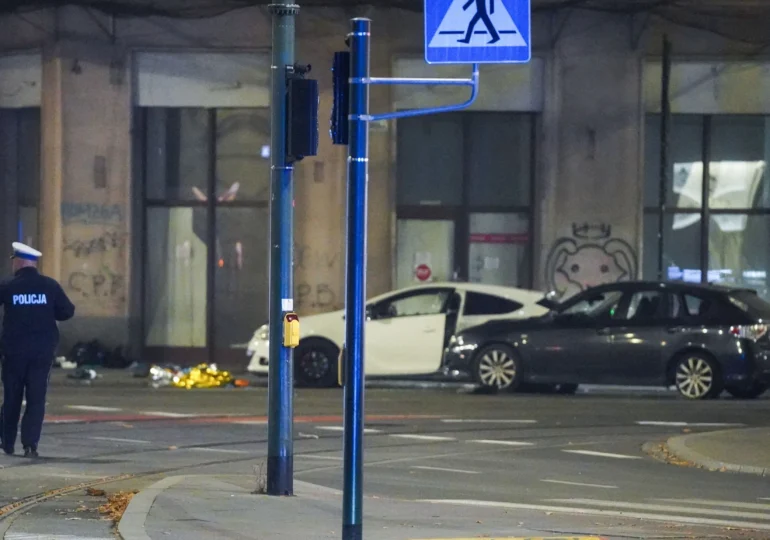
On the ground, lying on his back, there was a man dressed in military clothes of a grayish green. A police officer with a gun in his hand approaches him. Nearby, there are two cars, one with the doors open, stopped in traffic at a street corner in the historic center of the city of Krakow, Poland.
The police officer begins to shoot at the man lying on his back. Six gunshots are heard, some fired from the law enforcement officer’s weapon, but at least one other shooter hits the police officer, who, wounded, falls next to the attacker.
The circumstances under which the police officer was injured are to be clarified by Polish prosecutors. They do not exclude the existence of a second terrorist or, simply, that the police officer was hit by bullets from colleagues who were also shooting at the attacker.
The clip is filmed from a distance by a tourist speaking English who anxiously calls her partner to see the scene, wondering what is happening.
In the background, the sirens of emergency vehicles can be heard. The man approaches his partner. The scene they witness seems so unreal that she asks: “Is this a movie, right?”
“No, it’s not a movie,” the woman replies.
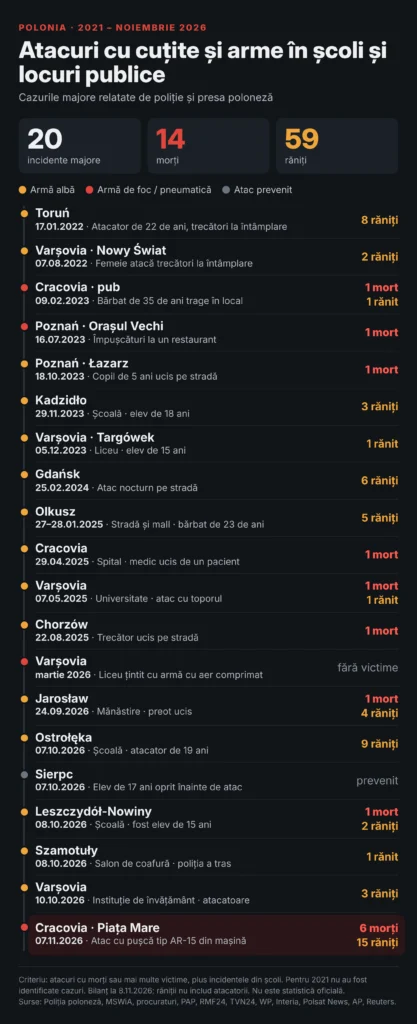
The attacker from Krakow, who killed at least eight people, including his own parents and sister, injuring another 15, is a 24-year-old man, Michal O., who had a firearms license and practiced sport shooting, being “fascinated by far-right ideologies,” according to the statement of the Polish interior minister.
Political Extremism
In just the last two months, October and November, Poland has witnessed eight violent events involving deaths and injuries. It's as if a psychosis is occurring among young people, each violent episode creating the context for the next.
“The police reacted immediately, and the officers showed courage and extraordinary dedication. Three of them were injured, and one is in critical condition. They need our prayers, our solidarity, and our full support. Why is it so hard for some people to understand this?” announced Donald Tusk, Prime Minister of Poland, shortly after the carnage in Krakow.
In Poland, political extremism has been encouraged in recent years by the nationalist-extremist rhetoric of the PiS party, Law and Justice, which lost power in 2023 after controlling the country for eight years.
The party has retained control over the presidency, with the head of state being Karol Nawrocki, a former PiS leader, as well as over the Constitutional Tribunal, which does not validate laws and parliamentary decisions.
Also, PiS runs extensive campaigns against immigrants, Ukrainians, and the European Union.
At the same time, Poland is also under enormous pressure from Russia, which conducts hybrid operations to create social tensions and violence, aiming to destabilize a key ally of Ukraine.
But all these confrontations would not have had such a devastating impact on young people if they had not been accelerated and intensified by social media.
Depression and Suicides Among Young People
“Based on two nationally representative surveys conducted among U.S. adolescents from 8th to 12th grade (506,820 participants) and national statistics on suicide deaths among young people aged 13 to 18, an increase was found in depressive symptoms, suicide-related cases, and suicide rates among adolescents between 2010 and 2015, especially among girls,” states a scientific study published by Twenge, Joiner, Rogers, and Martin in 2018, in the journal “Clinical Psychological Science.”
“Adolescents who spent more time on new communication media (including social media and electronic devices such as smartphones) were more likely to report mental health problems, whereas adolescents who spent more time on non-screen activities (face-to-face social interactions, sports/exercise, homework, print media, and attending religious services) were less likely to have such problems,” the cited study notes.
“Starting in 2010, iGen adolescents spent more time on screen activities related to new communication media and less time on non-screen activities, which may explain the increase in depression and suicide rates. In contrast, cyclical economic factors such as unemployment and the Dow Jones index were not correlated with depressive symptoms or suicide rates when analyzed over the years,” clinical psychologists further explain in their research.
Social Networks Have Become Weapons
In recent years, there has also been much research on the link between prolonged exposure to social media and violent behavior.
“Longitudinal data show that adolescents addicted to social media… have a higher likelihood of becoming aggressive, both directly and relationally. This applies to both girls and boys. The relationship also worked in reverse, but only for girls: those who already engaged in relational aggression later became more dependent on social media…”, states the study “The Link Between Social Media Addiction and Aggressive Behaviors,” published by the “Journal of Adolescents” in January 2025.
The above examples are just a few from the rich scientific literature and research demonstrating a direct link between depression, mental illness, suicides, violence, and prolonged exposure to social media and video games.
Since Vladimir Putin decided to invade Ukraine, a more complicated and toxic phenomenon has intensified: the transformation of social networks into weapons to destroy adversaries remotely, in their own country, without the need to create sophisticated and expensive bombs.
The hybrid war waged by the Kremlin has a psychological component whereby, through bombardment with violent messages that provoke fear, as well as campaigns encouraging extremism of all kinds, it seeks to affect psychologically vulnerable individuals, turning them into real weapons that trigger terrorist attacks.
Violence in Indigo
But it’s not only the Kremlin that uses social networks to create violence. This approach is widely used by political parties, leaders, and authorities to instill fear, impose certain trends among public opinion, increase general tension in confrontations, and gain advantages in electoral battles.
In the last decade, the lack of regulation of the online environment has created a social cancer that devours communities, cities, regions, and countries.
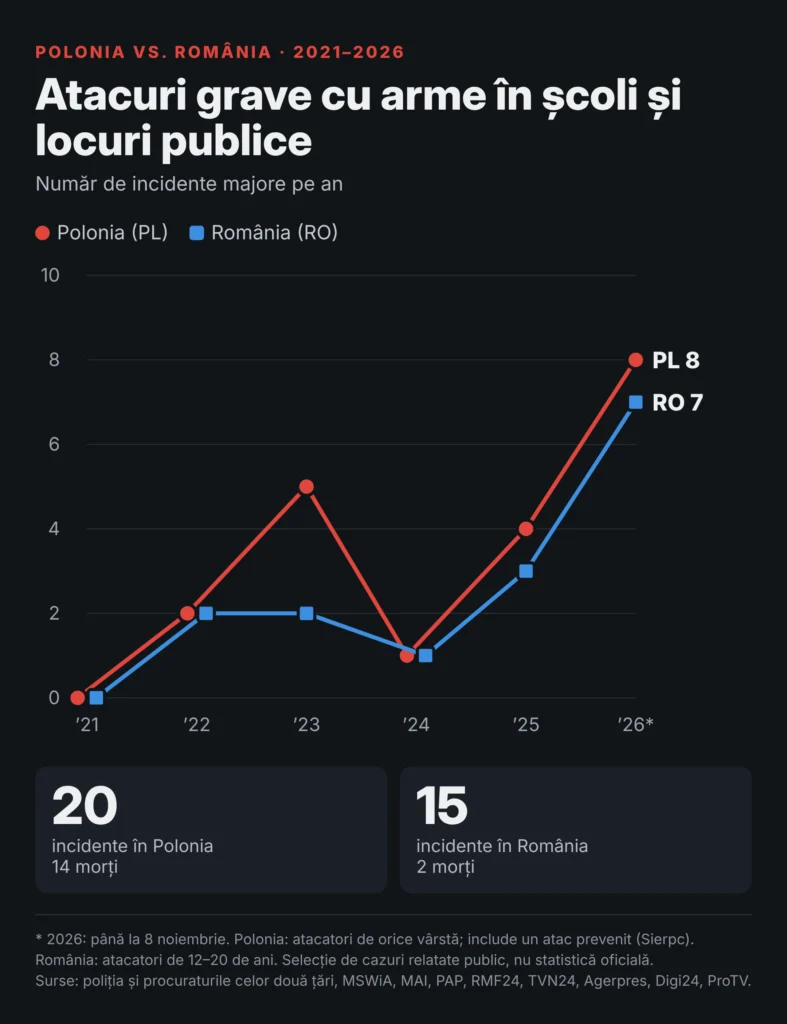
In 2023, Poland recorded a single case of an attack by a young person on a group of people. In 2024, there were none; in 2025, one; and this year, eight cases. A real explosion.
Although it seems hard to believe, the evolution of violent episodes among young people in Romania mirrors exactly that of Poland.
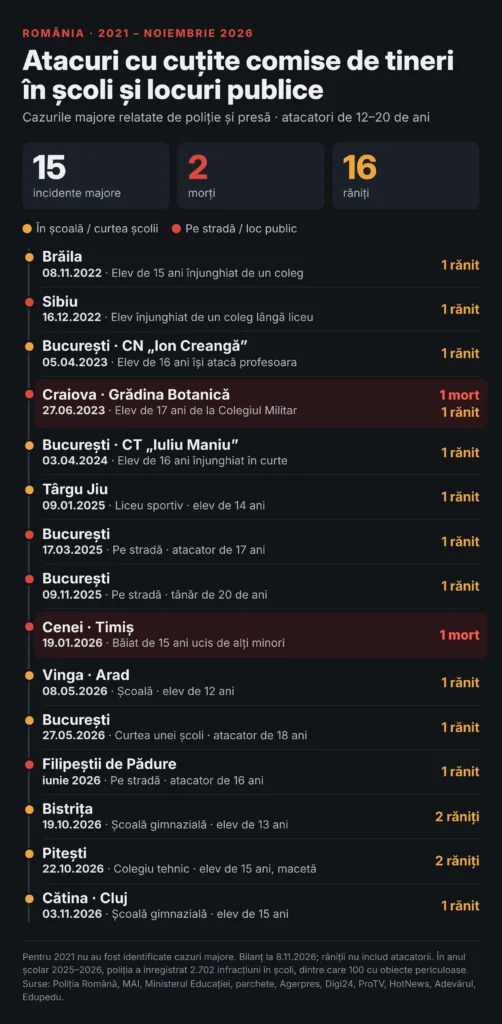
In 2021, no such cases were recorded in our country. In 2022 and 2023, two each year. In 2024, there was one case; in 2025, three. And this year, up to this date, seven cases. In Poland, eight.
After the annulled elections in 2024, when strong interference by Russia in Romania’s electoral process was discovered, the authorities promised regulatory measures and protection of the population against the wave of violence and extremism on social networks. Nothing happened. No measures were taken, while schools, cities, and the country became more insecure in the face of an unprecedented phenomenon that is not only not stopped but is encouraged by authorities, parties, and political leaders.
According to the comparison above, what happened in Poland can happen anytime, at any moment, in Romania as well.