


Romania eliminates from November 1 the 25 lei fee for parcels ordered from platforms such as Temu, Shein, and AliExpress. On the same day, a new European processing fee of 2 euros comes into effect, which is added to the customs fee of 3 euros, already applied since July. Thus, for a parcel with a single product, the fees decrease from approximately 8 euros to 5 euros.
The government approved on Friday, October 30, an emergency ordinance that removes the national logistics fee for parcels with a declared value under 150 euros, shipped from outside the European Union.
According to the official government statement, the measure aims to avoid the overlap of the Romanian fee with the two European mechanisms applicable to these imports.
What happens to the Romanian 25 lei fee
The national logistics fee was introduced on January 1, 2026, and applied to every parcel with a value under 150 euros, shipped from outside the European Union.
The government decided to abolish it along with the introduction of the new European processing fee. “With the entry into force of the new European fees, maintaining a parallel national fee would have meant double taxation on the same flows,” explained Finance Minister Alexandru Nazare, quoted by TVR Info.
For parcels delivered to recipients up to and including October 31, 2026, the 25 lei fee remains applicable.
However, for those delivered starting November 1, the fee is no longer due. If postal operators still collect it, the amounts must be refunded to payers within 30 days from the parcel delivery, according to the Ministry of Finance.
Which European fees apply
From November 1, the European processing fee of 2 euros for items shipped from outside the EU comes into effect, intended to cover the costs of customs verification and control.
This is added to the customs fee of 3 euros, introduced on July 1, 2026, for goods in parcels valued under 150 euros.
The two fees serve different purposes. The 3 euro customs fee removes the exemption previously enjoyed by cheap imports, while the 2 euro processing fee covers part of the administrative costs of customs authorities.
According to the Council of the European Union, the 3 euro customs fee is calculated by product tariff categories, not once for the entire parcel.
For example, a parcel containing two toys from the same category, a wool coat, and three bottles of shampoo can generate a customs fee of 9 euros, since it includes three distinct product categories.
How much was paid before and how much is paid now
The removal of the Romanian fee does not mean the disappearance of all costs for parcels from outside the EU. But neither does the introduction of the new European fee automatically mean that every order becomes more expensive.
For a parcel containing a single item from a single tariff category, the comparison looks like this:
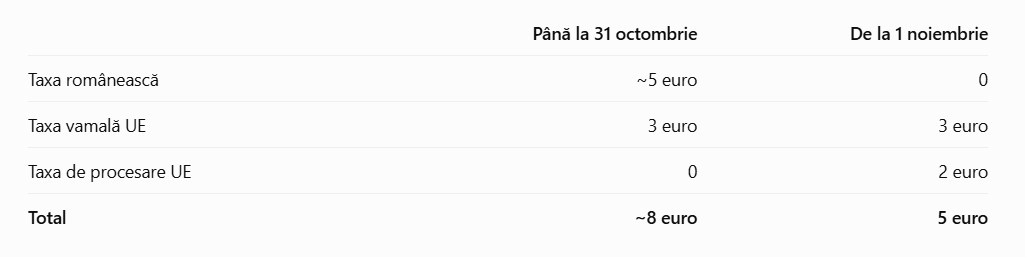
In this example, costs decrease from approximately 8 euros to 5 euros, because the Romanian fee of 25 lei (approximately 5 euros) is eliminated, and the European processing fee is 2 euros.
The calculation is indicative. For parcels containing products from multiple tariff categories, fees may vary.
What it means for buyers
Buyers will not necessarily have to pay these amounts separately upon receiving the parcel.
E-commerce platforms and delivery operators may include the costs in the product prices, shipping fees, or other charges displayed at checkout.
Therefore, the impact on the final price will depend on the type of products ordered and the policy of each platform.
The changes come into effect just before Black Friday and the winter holiday shopping season, when international platforms attract many customers with offers on cheap products.
Why the EU is changing the rules
The European Union is trying to more effectively control the huge volume of low-value parcels entering the community market, especially from China. According to data presented by European institutions, approximately 6 billion e-commerce parcels entered the EU in 2025, over 90% originating from China.
European authorities argue that the very high number of shipments complicates customs controls and product safety verification.
Brussels also aims to reduce the advantages enjoyed by merchants who ship cheap products individually to European consumers, compared to companies importing goods in large quantities and paying the usual customs duties.
The flat customs fee of 3 euros is temporary. It is expected to be replaced by normal customs tariffs once the new European digital customs infrastructure becomes operational, scheduled for 2028.