
The Ministry of Finance warns that Romania needs to reduce budget expenditures in the last weeks of the year to stay within the 6.2% of GDP deficit target. The institution argues that the budget adjustment must eliminate non-essential expenses and points out that each week of delay diminishes the effectiveness of saving measures.
Romania continues to have the highest budget deficit in the European Union, even though it decreased from 9.2% to 7.8% of GDP in 2025, according to Eurostat data presented on Thursday by the Ministry of Finance.
After the first nine months of 2026, the budget deficit reached 3.82% of GDP, compared to 5.35% in the same period last year. To meet the annual target of 6.2%, the additional deficit in the last quarter should not exceed approximately 49 billion lei.
The issue is that the last three months of the year traditionally concentrate the largest state payments.
Finance Ministry calls for expense reduction
The Ministry of Finance argues that in the remaining period until the end of the year, the Government must focus on essential expenses and postpone costs that are not justified by immediate needs. "In the remaining period of 2026, the only lever that has effects this year is the reduction of expenses, and its impact decreases with each week of delay," warns the institution.
In this context, budget adjustment becomes a priority. "Therefore, budget adjustment is a top priority: it must reduce unnecessary expenses and focus resources on ongoing investments and the essential functioning of the state," specifies the Ministry of Finance.
However, the institution does not indicate which expenses are to be reduced or which institutions or sectors could be affected.
At the same time, public investments reached 107.8 billion lei in the first nine months of the year, 25.2 billion lei more than in the same period of 2025. A large part of these investments is financed from European funds.
Romania remains with the highest deficit in the EU
Final data published by Eurostat show that Romania ended 2025 with a budget deficit of 7.8% of GDP, equivalent to 149.7 billion lei.
It is an improvement compared to 2024 when the deficit was 9.2% of GDP, and a favorable revision compared to the 7.9% estimate published in April.
Romania and Malta recorded the highest deficit reductions in the European Union in 2025, each by 1.4 percentage points.
Nevertheless, Romania remains at the top of the EU in terms of budget deficit, followed by Poland (7.2%), Belgium (5.2%), and France (5.1%). The EU average was 3.1% of GDP.
Furthermore, provisional quarterly data for 2026 shows that the seasonally adjusted government deficit increased from 5.5% of GDP in the first quarter to 9.2% in the second.
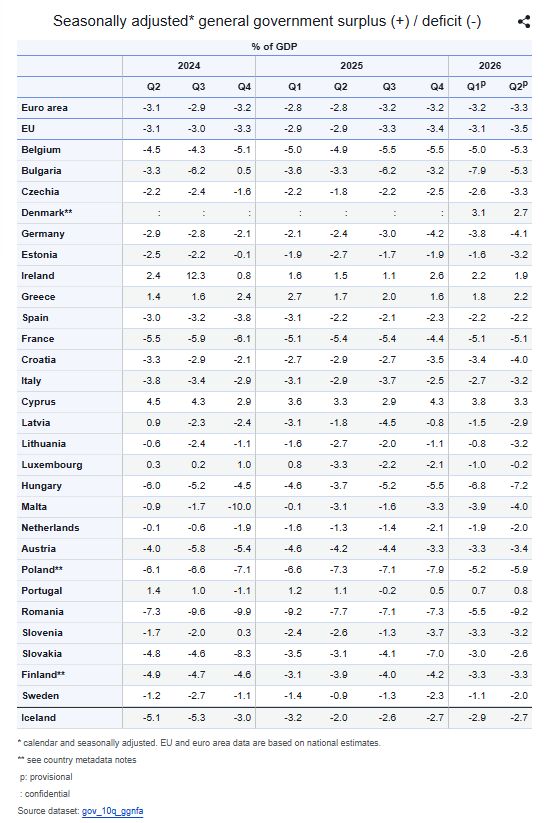
However, the Ministry of Finance explains that these percentages describe the situation of each quarter individually and do not represent the cumulative deficit of the year. The institution attributes the increase in the second quarter to the acceleration of public investments and payments for projects under the PNRR.
PNL and PSD accuse each other of data manipulation
The Eurostat data sparked a heated exchange of accusations between PSD and PNL. According to a press release quoted by Agerpres, the Social Democrats claimed that the deficit during the Bolojan government is the highest in the European Union and exceeds the level left by former Prime Minister Marcel Ciolacu. "The spotlight is on Bolojan's deficit: the highest in the European Union and well above the deficit left after Marcel Ciolacu's government. Eurostat sheds light on the deficit left by the Bolojan government! Data published on October 21 show that the Bolojan government leaves behind a deficit of 9.2% of GDP (seasonally adjusted data), the highest in the European Union and significantly above the 7.7% of GDP deficit recorded by the Ciolacu government," wrote PSD.
However, the Liberals accuse PSD of misinterpreting the statistical indicators and presenting the quarterly deficit of 9.2% of GDP as the cumulative deficit of the first six months. "PSD shamelessly lies and falsifies the meaning of Eurostat data. The deficit for the first 6 months of this year was 2% of GDP," PNL conveyed, according to Digi24.
The Liberals specify that the cumulative deficit in the first semester was 2% of GDP according to the national methodology and 3.4% according to the European ESA methodology.
PNL argues that the differences between indicators are also explained by the advance payments for PNRR projects, which will be reimbursed by the European Union, and by recording an obligation of over 3.4 billion lei to Pfizer.
Interest on public debt has reached almost 30 billion lei
Another major issue is the increasingly high cost of state borrowing. Public debt has risen from 48.3% of GDP in 2022 to 58.9% at the end of 2025, an increase of over ten percentage points in just three years.
In the first semester of 2026, Romania spent 29.4 billion lei solely on interest payments, 4.1 billion lei more than in the same period last year.
The Ministry of Finance warns that each year of delay in reducing the deficit means additional costs with interest.
The 6.2% deficit target for 2026 would represent covering approximately half the distance between the 9.2% level recorded in 2024 and the European threshold of 3% of GDP.
The rest of the adjustment is expected to be made in the following years.
According to estimates presented by the Ministry of Finance, international rating agencies anticipate deficits of 5.8% of GDP (Moody's), 5.9% (Fitch), and 6.25% (S&P) for 2026.
Since 2020, Romania has been under the surveillance of the European Commission for exceeding the 3% of GDP budget deficit limit. According to the schedule agreed with the EU, our country must correct its excessive deficit by 2030.