
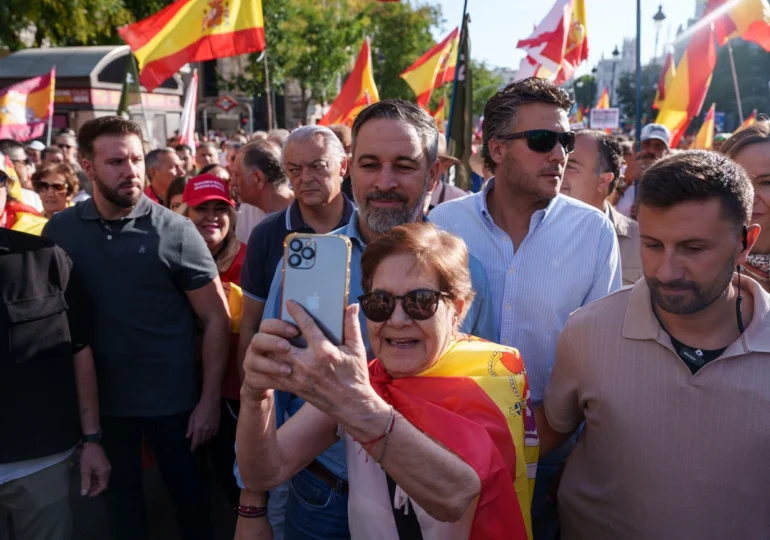
The mantle of the so-called nationalist spirit has been taken up by the heirs of a rancid discourse that many Spaniards thought they had left behind. The far-right party Vox is expected to radically change the political landscape following the elections to be held on Sunday in Spain. If one of the last anti-populist bastions in Europe falls, this change could trigger a domino effect of the far right.
In Spain in the 1990s, just 15 years after the country emerged from a far-right dictatorship, it would have been very surprising to see slogans glorifying Francisco Franco or far-right symbols. Such displays were viewed with disapproval. The glorification of fascism recalled a dark era marked by executions by shooting, mass graves, and a total absence of freedom.
However, that old restraint has now disappeared. Vox, the far-right party in Spain led by Santiago Abascal, is expected to radically change the political landscape in the elections to be held this Sunday in the country, writes Spanish journalist Paco Cerdà, in an article published by the New York Times.
The mantle of the so-called nationalist spirit has been taken up by the heirs of a rancid discourse that many Spaniards thought they had left behind. On election posters across Spain, Vox promotes itself under the slogan of "common sense." The party claims to distance itself from politics; but, after all, it is a false "anti-politics"; its members are as politically involved as anyone else across the political spectrum, the journalist emphasizes.
How these elections could change Spain
Some forecasts suggest that Vox could double its current representation in Parliament. Most polls indicate that the bloc formed by the People's Party (center-right) and Vox will secure enough votes to form a coalition government. The People's Party and Vox have even reached agreements in certain constituencies. There is no coordinated political effort to isolate the far right.
If these polls are correct, the Spanish Government could include more ministers and possibly even a deputy prime minister from Vox, a political party that typically avoids condemning Francisco Franco's dictatorship.
But Cerdà clarifies that Vox is not just a party of the past:
- It is also a formation that denies climate change, despite the fact that, two years ago, the floods in Valencia caused over 230 deaths, and last summer there were devastating fires.
- It is a party that has opposed laws aimed at preventing gender-based violence, although since 2003, more than 1,300 women in Spain have lost their lives due to domestic violence.
- It is a party that fights migration under the slogan "No more," advocating for the repatriation of undocumented migrants, sending foreign citizens without a job back to their countries of origin, as well as deporting those who (as stated in its political platform) "try to impose their foreign customs, habits, or cultures."
The rise of Vox is particularly shocking when viewed in the context of the policies of Prime Minister Pedro Sánchez's administration.
After the Russian invasion of Ukraine, Spain became a bastion of progressivism. It committed to defending Kyiv, was one of the countries that most vehemently opposed Israel's destructive war in Gaza—labeling it genocide—and criticized the US war in Iran, despite political and financial threats from President Trump.
Spain has also been a leader in Europe regarding policies of welcoming and integrating immigrants, despite difficult episodes such as the crisis in Ceuta last summer, when tens of thousands of migrants crossed the border and were, in many cases, treated horrifically.
Why the elections are a test for the Sánchez Government and for Spain
Sunday's elections in Spain will represent a test for the government led by Pedro Sánchez, now facing several problems:
- His administration has suffered due to serious corruption allegations involving the party and members of his close circle.
- The government's image is also affected by two major high-speed train accidents within nine months—resulting in 115 deaths—and, most seriously, by the inability to guarantee the right to housing for millions of Spaniards, in a real estate market blocked by speculation.
But the elections also represent a test for Spanish democracy. Paco Cerdà writes that in recent days he has heard people speak with concern about voting. They criticize the lack of unity on the left and say they cannot support this government, considering that a former minister is in prison for corruption. At the same time, the prospect of the far right entering government frightens them. So they say they will go to the polls "holding their noses" to avoid smelling the stench.
The journalist considers this feeling a failure of democracy and wonders what happened to the hope in which Spain once basked.
He places the upcoming elections in Spain in the context of the rise of extremism in Europe, warning: if one of the last anti-populist bastions in Europe falls, this change could trigger a domino effect of the far right.
What the lesson of the Spanish Civil War shows
The elections in Spain are a prelude to this spring's election in France, where polls suggest that Marine Le Pen, from the "Rassemblement National" (National Rally), is already dangerously close to the Élysée Palace.
If Spain is partially governed by the far right, and France elects a far-right president—a situation that would add to the existence of a far-right prime minister in Italy and the rise of the "Alternative for Germany" (AfD) party in Germany—then Europe, as we know it, will collapse, emphasizes Cerdà.
He evokes the memory of the Spanish Civil War—with all the evident historical differences regarding the scale and level of violence—which was itself a prelude to World War II. The civil war was triggered by a military revolt that overthrew a legitimate Spanish republican government, separating those who supported fascism from those who defended democracy.
Spain remains a democratic nation, as do France, Italy, and Germany. But what happens when a democracy is governed by leaders who refuse to condemn dictatorships and who despise politics?
What is the only solution for democracy
Today, in Spain, nostalgia for the Francoist spirit is no longer viewed with repulsion. And it is not just that people have forgotten. There is an unease that European democracies have failed to manage. There is a discourse of fear to which they do not know how to respond.
If our ballot boxes have become a place where fear and frustration are vented, the only solution is for democracy and the European social model to become useful again to every voter, not just be perceived as morally superior.
The political heirs of those who pulled Europe out of an era of hatred, and Spain out of a dictatorship, must solve the very real problems of voters—regarding housing, education, inequality, employment, promoting the role of women in society, and managing immigration.
Being useful — this is the battle that democrats are fighting today. And this is, truly, common sense, emphasizes the Spanish journalist.
T.D.