

Russia is intensifying its sabotage operations against Europe, resorting to better-trained agents and targeting infrastructure essential for supporting Ukraine. The risk that a single attack could cause numerous casualties is increasing, warn experts from the International Institute for Strategic Studies (IISS) in London. Romania appears on the map of operations associated with Russia, with 11 incidents recorded since the beginning of 2022.
Despite successes recorded by European authorities in thwarting plots and dismantling networks, there is no clear evidence that the measures adopted so far have deterred the Kremlin.
In a report published on November 26, entitled “Russia’s Unconventional War on Europe: Sabotage, Deterrence, and Future Scenarios,” researchers Charlie Edwards, Tom Field, and Zoe Lambert analyze Moscow-associated operations from January 2022 to September 2026.
The experts also present four scenarios regarding the evolution of the Russian threat until 2029, including the possibility of a ceasefire in Ukraine.
Romania on the map of operations associated with Russia
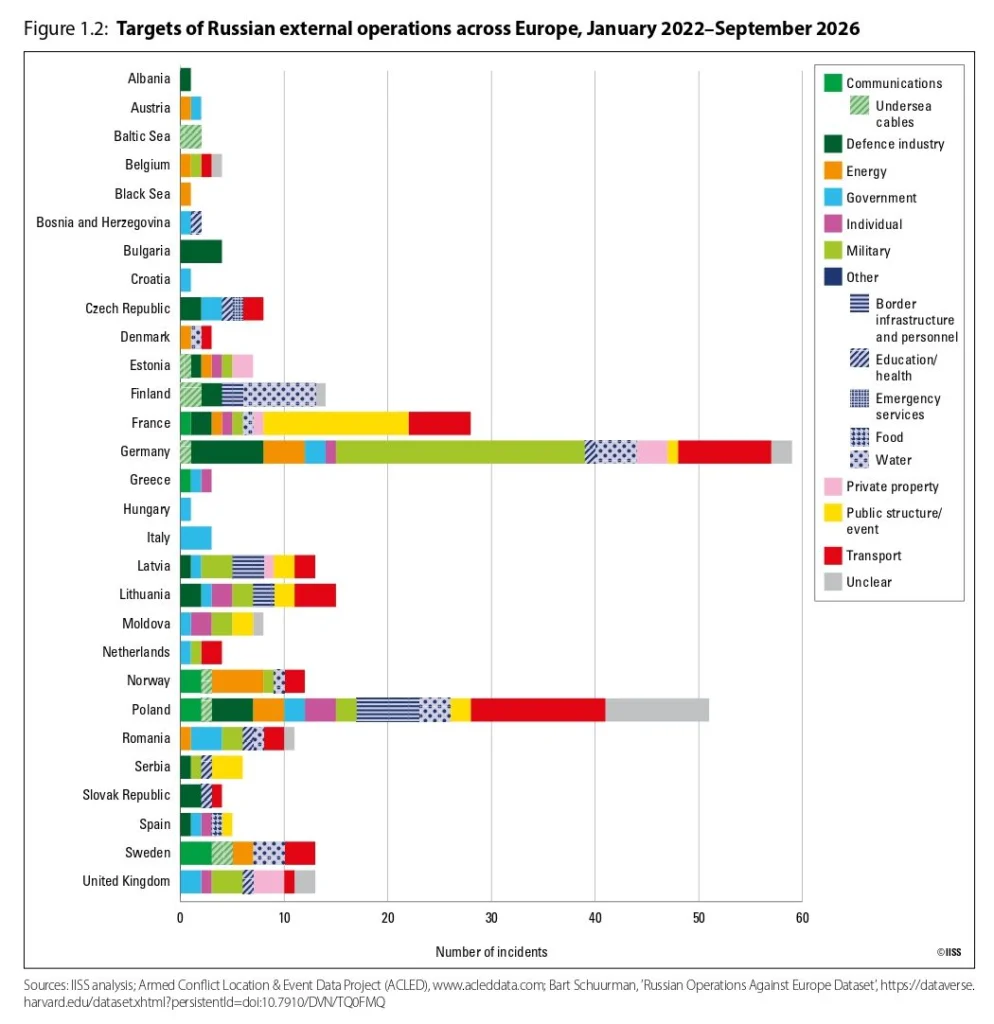
Germany and Poland are the main targets of the sabotage campaign associated with Russia, as their transport, logistics, and industrial infrastructure play a crucial role in supplying Ukraine.
Romania also appears on the map of external operations associated with Russia. According to a chart included in the IISS report, 11 incidents were recorded in our country between January 2022 and September 2026.
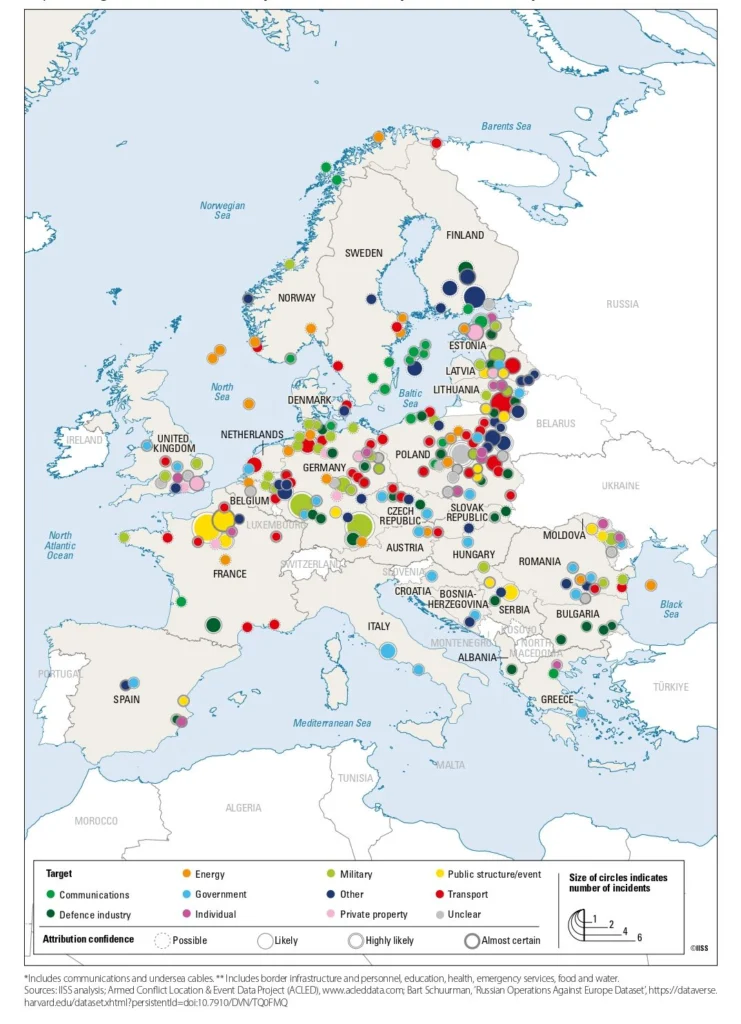
The incidents targeted, among others, the energy sector, military and governmental objectives, transport infrastructure, as well as border infrastructure and personnel.
The institute’s database does not include exclusively acts of sabotage but also reconnaissance operations, intimidation actions, persecution of opponents abroad, and other activities associated with Russia. The degree of certainty regarding Moscow's responsibility varies from one incident to another.
One of the cases from Romania analyzed in the report is the sabotage attempt foiled in October 2025 at the headquarters of the Ukrainian courier company Nova Post in Bucharest. According to Romanian prosecutors, two Ukrainian citizens involved in this operation acted under the coordination of Russian intelligence services.
The report also recalls the contamination, in the summer of 2025, of quantities of crude oil delivered to refineries in Romania, the Czech Republic, and Italy. The oil contained organic chlorides, which risked damaging refinery equipment. According to press information cited by the researchers, Romanian authorities suspected a Russian sabotage act, but the government did not publicly attribute responsibility to Russia for the contamination.
Sabotage operations become more dangerous
Between October 2025 and September 2026, the total number of incidents associated with Russia decreased compared to the previous 12 months. In contrast, the number of sabotage acts increased by 16%, according to the IISS report. The use of arson and explosives nearly doubled.
More than half of the incidents recorded during this period targeted three sectors:
- military industry – 28%;
- transport – 22%;
- energy – 7%.
Experts consider it very likely that these sectors will remain the main targets, especially where they contribute to Ukraine’s war effort.
A worrying development is the increased capability of some agents recruited by Russian intelligence services. Most operations are still carried out by untrained individuals, often criminals or vulnerable people recruited via the internet. In some cases, they do not even know the broader purpose of the operations they participate in.
However, the researchers have identified agents capable of conducting more complex operations, as well as the direct involvement of Russian intelligence officers.
“The greatest risk is not the increase in the total number of incidents, but that a single sabotage operation causes numerous casualties or long-term disruptions – either deliberately or as a result of miscalculation,” warn the report’s authors.
Such an incident would trigger calls for retaliation, expose differences among European governments, and force them to act faster than they would like.
Europe prevents attacks but has not succeeded in deterring the Kremlin
Moscow’s campaign has not led European governments to abandon support for Ukraine nor to reduce their defense investments. According to IISS data, European defense spending increased in real terms by 12.6% in 2025, the same growth rate as in 2024. In Russia, the increase was 3%.
European authorities have become more effective in identifying and thwarting Russian operations. They have expelled intelligence officers, closed Russian consulates, and strengthened measures to protect critical infrastructure.
The problem is that Russian intelligence services have maintained their capacity to recruit new agents and organize further attacks.
The Europeans’ isolated successes do not yet demonstrate that sabotage has become a less attractive strategic tool for the Kremlin, the report’s authors emphasize. The main challenge for European governments is to turn these successes into measures that limit Russia’s long-term capacity to organize and finance such operations.
Four scenarios for 2029
The evolution of Russia’s unconventional war against Europe depends on the course of the conflict in Ukraine, the Kremlin’s willingness to confront Europeans, and the effectiveness of protection measures adopted by them.
IISS researchers present four scenarios, developed with the help of Hinsley, an artificial intelligence platform designed for geopolitical forecasting. The results were analyzed and, where necessary, supplemented by the institute’s specialists. The authors emphasize that the scenarios describe plausible developments, not predictions, and that they are not mutually exclusive.
- 1. A war of attrition across the entire continent
Russia continues through the end of 2029 a widespread sabotage and intimidation campaign in Europe, aimed at affecting support for Ukraine and NATO’s military preparedness. Most incidents cause limited damage, but their cumulative effect is increased costs of defense activities and forcing governments to constantly respond to security alerts.
Russia manages to complicate aid delivery to Ukraine, without achieving a lasting reduction.
Moscow’s campaign could even have the opposite effect if repeated incidents lead to closer cooperation among European states.
- 2. The threat becomes less visible after a ceasefire in Ukraine
By the end of 2029, a ceasefire agreement has been in effect in Ukraine for at least 12 months. Russia reduces the number of visible attacks but continues recruiting agents and tries to gain access to European infrastructure and IT systems for potential future operations.
The reduction in attacks encourages some European capitals to attempt normalizing relations with Moscow. There are also pressures to reduce security spending.
Security services warn, however, that the reduced visibility of Russian operations does not prove a decrease in Moscow’s capacity or intent to act.
- 3. Concentrated attacks on logistical networks on NATO’s eastern flank
Russia focuses its operations on transport, production, and supply networks linking Germany to NATO’s eastern flank.
Repeated disruptions cause significant delays in military deliveries, while additional risks and costs discourage private companies from accepting defense contracts.
Russia manages to cause delays, but the political effects remain uncertain. European governments might decide to invest more in transport infrastructure and logistics services rather than reduce support for Ukraine.
- 4. Pressure on maritime infrastructure in northern Europe
Russia intensifies pressures on maritime infrastructure in northern Norway, the Norwegian Sea, and access zones to the North Atlantic.
Cyberattacks, reconnaissance operations, and incidents of uncertain origin generate doubts about the safety of communications, energy supply, and NATO force movements.
The Kremlin’s objective is to force allies to divide their military resources between protecting civilian infrastructure, monitoring Russian activities, and strengthening defense.
And in this case, the result could be contrary to what Moscow seeks. Intensifying patrols and a stronger NATO presence could complicate Russian operations in the region.
Romania, among the states that have not set red lines
One of the observations of the IISS report directly concerns Romania. The authors of the report note that neither Estonia, Lithuania, nor Romania have established red lines regarding sabotage operations associated with Russia. The main concern of these states remains avoiding escalation.
The risk is that the first attack with numerous casualties will dictate the terms of the European response, and governments will be forced to make decisions under pressure.
Experts recommend that European states, at least NATO members, publicly communicate what level of severity of an attack would trigger a certain type of response. Experts also recommend that retaliatory measures target directly the Russian intelligence services coordinating sabotage operations, not just the operatives, whom they can easily replace.
At the same time, several European states should take on the responsibility of protecting Ukraine’s supply routes, a task currently mainly borne by Germany and Poland. According to IISS researchers, a common strategy would be harder to implement than the current reactions of European states to each individual incident, but it would considerably reduce the risks.