
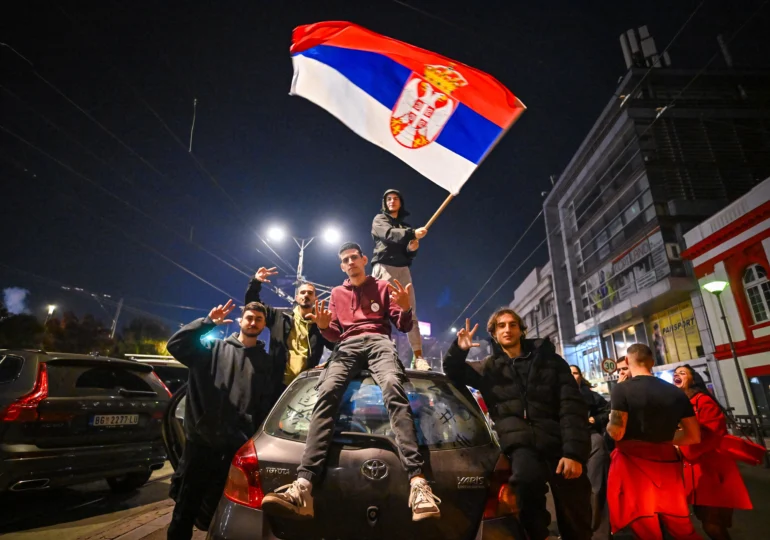
Serbia woke up Monday in a new political era. The student movement, formed during the anti-corruption protests that shook the country for two years, won Sunday’s early parliamentary elections and defeated Aleksandar Vučić, who has dominated Serbian politics as prime minister or president since 2014.
The victory resembles Viktor Orbán’s defeat in Hungary in April, writes Reuters, and could inspire other student movements that have emerged in recent weeks across Europe, with demands related to education quality and prospects.
A historic victory
With almost 99% of votes counted, the student list obtained 52.7%, compared to 39.2% for the alliance led by the Serbian Progressive Party (SNS), according to the State Electoral Commission, cited by Reuters. This gives the students 139 out of 250 mandates, while the SNS alliance has 97. The remaining 14 go to minority parties.
Vučić acknowledged his defeat late Sunday, and tens of thousands of people took to the streets in Belgrade and other cities. On Monday, student supporters cleaned a park near the Parliament building, long used as a camp by Vučić’s supporters: they gathered metal barriers and tents and wiped stickers off children’s playground equipment.
The movement formed after the death of 16 people in the collapse of a canopy at the Novi Sad station, which triggered the anti-corruption protests. Vučić and SNS have repeatedly denied accusations of corruption and repression.
“This corruption that has penetrated all aspects of our lives will change, of course. We hope to slowly move toward a normal community,” said Svetlana Karagkozidou, a 60-year-old insurance employee.
Not everyone is enthusiastic. “I don’t like this sudden and total change. I don’t even know who is behind it, who these people are, who will lead the country,” said Senka Radakovic, also 60, a civil servant.
Who will lead Serbia?
The movement does not have a single leader, a strategy used during the protests to avoid government attempts to discredit it, Reuters notes. It is not clear who will be prime minister or who will occupy other key positions.
The Student List movement also includes university professors, actors, and farmers. Among the well-known figures are cardiologist Ilija Srdanovic, who leads the list, former central bank governor Dejan Soskic, and Radomir Sajcic, a professor at the University of Belgrade, who spoke on behalf of the students after the victory.
The constitution allows up to 90 days for forming the government from the moment Parliament is convened after the announcement of the final results.
Moscow remains in play
Representatives of the student movement announced they do not intend to align with EU sanctions imposed on Russia for the war in Ukraine, according to an analysis by Reuters. Gazprom is Serbia’s largest gas supplier, with about 2.2 billion cubic meters per year, at prices below market levels. The List argues that this dependence does not mean geopolitical alignment but an acute economic dependency.
The new government will depend on American exemptions from sanctions to maintain crude oil imports, pending the sale of the Russian stake in the NIS company to the Hungarian group MOL. NIS operates the only refinery in Serbia.
The Kremlin reacted Monday. Spokesman Dmitry Peskov praised Vučić’s contribution to bilateral relations and said he hopes Vučić will continue to contribute even from the opposition, Reuters reports. Peskov also expressed hope that the new political forces will understand that cooperation with Russia is in Serbia’s interest and added: “as is known, it takes two to tango.”
Serbia has not yet joined EU sanctions against Russia and has developed close economic, political, and military ties with Moscow.
It remains unclear whether the future government will stop all arms exports to war zones, including sales to Western intermediaries who send weapons to Ukraine. Vučić has had close personal relations with both Putin and Zelensky.
- “Serbia or the mafia.” An extraordinary experiment that could reset the political system in Belgrade
Kosovo: autonomy for Serbs and rejection of agreements with Priština
According to Reuters, representatives of the student movement claim that the territory of Kosovo, which declared independence in 2008, remains an integral part of Serbia. During the campaign, candidates described it as a temporarily occupied territory that could be reintegrated through peaceful means, diplomacy, and dialogue.
Their priority is to stop the exodus of Serbs from northern Kosovo and to strengthen institutions funded by Belgrade, especially in health and education. They want members of the Serbian communities in Kosovo to benefit from autonomy and reject previous agreements with the government in Priština, including those concerning energy, license plates, and the use of the dinar.
This position complicates Serbia’s European path, as the EU conditions accession on the normalization of relations between Belgrade and Priština.
EU: First reforms, decision later
Serbia’s accession negotiations are largely blocked due to the lack of necessary reforms, and the students’ campaign deliberately avoided polarizing foreign policy topics. Soskic and Srdanovic said the government must first focus on internal reforms and close all negotiating chapter groups before the population is called to decide definitively on accession.
European Commission President Ursula von der Leyen stated that the Union is ready to support reforms, including those concerning the rule of law and press freedom, and to work together to advance Serbia’s European path.
Anti-corruption promises
The anti-corruption program is based on institutional reforms, Reuters writes. The students propose an independent police unit, subordinated to prosecutors, not the Ministry of Interior, and the removal of police officers linked to organized crime or involved in violent repression of protests.
They also want to ban political appointments in state companies in favor of transparent, merit-based hiring, and a strict law on asset origin that would allow the state to verify, confiscate, and return illegally acquired wealth by officials to the budget.
Convicted officials would no longer be able to hold public office, major infrastructure contracts would be subject to public oversight, and independent bodies supervising public funds would be created in the state.
Economy: lower prices, changed taxes, housing for young people
Serbia’s economy is closely linked to the European market and international investment flows.
The Student List wants to change Serbia’s growth model: less based on state-financed infrastructure projects and cheap labor, more attentive to the domestic market and employee rights.
The plan includes a campaign against trade monopolies to reduce food prices and a tax reform that increases taxes on the wealthy and reduces them for low-income earners. The movement also promised a drastic reduction in the maximum duration of temporary contracts.
Fiscal sustainability would largely depend on savings achieved through the anti-corruption fight and strict oversight of state spending.
To stop young people from leaving the country, the students promise affordable housing for young couples, teachers, and medical staff, free school textbooks, and cheaper medicines subsidized by the state.
G.P.