
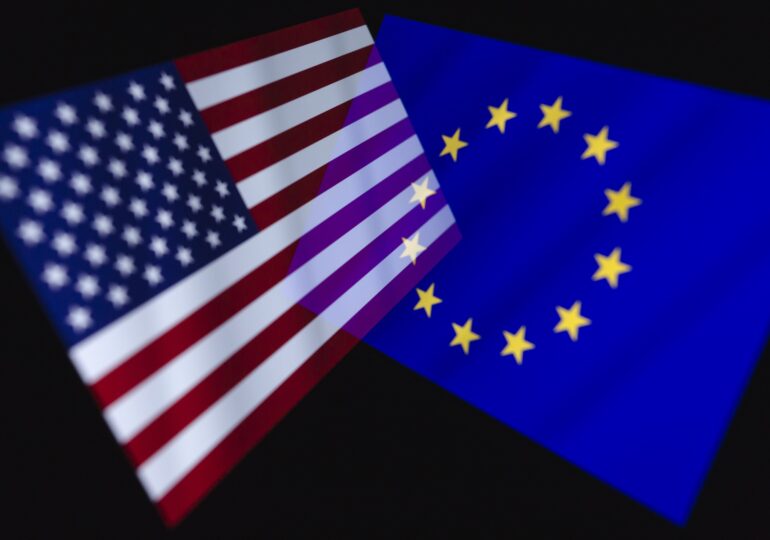
If the Democrats achieve the expected results in today’s midterm elections in the USA, champagne bottles will be opened all across Europe. However, those raising a glass in honor of victory should also think about what comes next.
A takeover of Congress by the Democrats is unlikely to bring Europe an immediate relaxation in relations with Washington, writes Politico.
Limited domestically, Donald Trump would still have the freedom to focus on foreign policy and trade, areas where the American executive power is subject to relatively little Congressional control. This could increase the risk of new disputes and tougher demands directed at Europe.
“Europeans would be mistaken to assume that transatlantic relations will warm up,” said Wolfgang Ischinger, an experienced German diplomat and former chairman of the Munich Security Conference. “My assumption is that the opposite will happen.”
A recent survey conducted across the European Union showed that 58% of respondents support the Democrats, while only 18% side with Donald Trump’s Republicans. However, although polls suggest that Europeans critical of the American president might see their wish fulfilled, they should avoid any show of triumphalism, warns Ischinger.
“There will be voices in Europe, some important, who will want to celebrate the victory and congratulate the Democrats, but I believe this would be toxic,” he told Politico.
“I would advise my European friends to exercise restraint and avoid giving the White House any excuse to be more upset with Europe than it already is,” he added, laughing.
Others are, however, skeptical that a reserved attitude could change the situation. Among them is Nathalie Tocci, former advisor to two European foreign policy chiefs.
“Honestly, I don’t think Trump needs reasons or excuses to attack Europe,” she said. Moreover, Tocci argues, it will be difficult for Europeans not to celebrate a possible failure of Trump if “they care about democracy,” given the links between the American president’s MAGA movement and far-right populist politicians in Europe.
An electoral defeat for Trump could give liberals and centrists in Europe a moral boost, who have interpreted the electoral failures of Viktor Orbán in Hungary and Aleksandar Vučić in Serbia as evidence that populism has peaked or at least begun to stagnate.
However, such a conclusion might be premature. The popularity enjoyed by Marine Le Pen in France and the recent electoral gains of the Alternative for Germany (AfD) party show that populism continues to have strong influence. Nevertheless, a defeat of the MAGA movement would give liberals and centrists in Europe a reason for optimism, Tocci believes.
Would a Democratic victory benefit the EU in the short term?
But would a Democratic victory benefit the European Union in the short term? “Not really,” Ischinger replied. A takeover of Congress by the Democrats would have a practically limited impact on Europe and could even worsen the situation.
“If Donald Trump faces Congressional investigations, impeachment procedures, and is limited domestically by a hostile Congress, it is inevitable that he will turn to areas where Congress has limited influence: foreign and trade policy,” he explained. “We must prepare not for more harmonious transatlantic relations, but for more tensions and even more demands from Trump towards Europe.”
Kurt Volker, who was the last US ambassador to NATO during George W. Bush’s administration, holds a similar opinion.
“Don’t expect major changes from the Trump administration,” he warned. “Congress will investigate everything. It will investigate Trump, his family, the Trump family businesses, Steve Witkoff and Jared Kushner, Elon Musk, Pete Hegseth and Kash Patel from the FBI. Trump will fight these investigations to the end, and it will all turn into a big show.”
“It’s true, the Democrats will support Ukraine and NATO much more, but they cannot dictate to Trump what to do,” he added. “They can approve the allocation of funds, but Trump can simply turn around and say: ‘Well, I’m not obligated to spend them.’”
Volker anticipates that Trump will increasingly resort to the so-called mechanism of rescinding funds allocated by Congress, a controversial legal interpretation that allows the administration to withdraw amounts approved by the legislature.
“This has been the pattern in many situations, especially regarding tariffs,” Volker said. “In many other areas, however, Trump prefers to stall and take the fights to court.”
What will Trump do with NATO
The former ambassador said he does not know what decision Trump will make regarding Iran: whether he will resume military operations or let Europe and Asia find a solution to the crisis. Regarding NATO and the reduction of American military forces in Europe, Volker suspects the president will act cautiously, fearing a negative reaction domestically.
On the other hand, Trump is “extremely hard to predict,” said Bronwen Maddox, director and chairwoman of the British research institute Chatham House.
“Perhaps, after an initial aggressive reaction to the election result, he will retreat and focus on the monuments he intends to build, including the White House ballroom,” she speculated, with a dose of hope but without much conviction.
Maddox believes there are no reasons to celebrate, regardless of the election outcome or Trump’s reaction. Instead, European leaders should reflect on how much the United States has changed.
“American voters elected Trump twice, and even if they are now turning against him, these elections show that their attention has shifted to domestic issues,” she said.
Europeans understood with delay the importance of the MAGA movement and how long it might endure, Maddox stated. In her opinion, there is still insufficient understanding of the profound changes that have taken place in the American political landscape, including the Democratic Party.
“I don’t think America looks at Europe the way it used to. For me, this message has been clear for some time,” she concluded.