

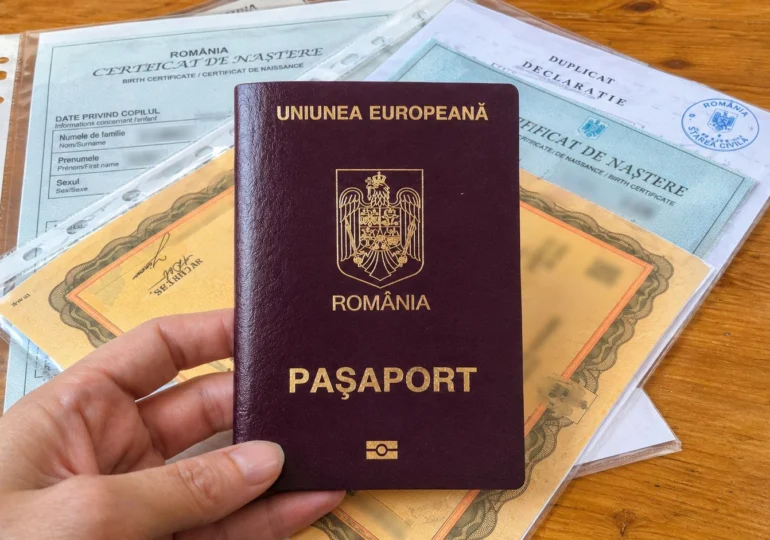
Russian citizens, including a close associate of Ramzan Kadyrov’s regime, a former director from the Russian military industry, and individuals linked to organized crime, have obtained authentic Romanian documents using forged citizenship certificates.
To conceal their Russian citizenship, at least eight of them presented themselves to Romanian authorities as Ukrainians.
The fraud opened the way for them to obtain Romanian passports, and some confirmed that they used them to travel within the European Union, despite restrictions imposed on Russian citizens after the invasion of Ukraine.
The fraud is documented in a comprehensive investigation published by Kiev Independent, conducted together with Public Record from Romania, Cu Sens from Moldova, Follow the Money from the Netherlands, Le Monde from France, and the Ján Kuciak Investigation Center from Slovakia.
Journalists analyzed the files of 55 individuals whose civil status documents are contested in court by Romanian authorities, suspected of having been obtained based on false documents. Over 30 of the 55 individuals are Russian citizens, and at least eight of them presented themselves to Romanian authorities as Ukrainians.
In Romania, there are over 800 civil lawsuits for the annulment of identity documents obtained through fraud. In parallel, prosecutors are investigating the networks that facilitated the issuance of these documents.
How the scheme worked: from a false certificate to a European passport
The scheme exploited the legal procedure through which descendants of persons who lost Romanian citizenship involuntarily, especially from territories ceded in 1940, can regain citizenship.
In some cases, applicants used forged genealogical documents to prove a family connection to these territories. In other cases, they presented directly false Romanian citizenship certificates, bypassing the official procedure, which can take years and includes security checks.
With a forged citizenship certificate, the applicant could obtain an authentic Romanian birth certificate, then an identity card, and finally a passport.
According to a Romanian lawyer quoted by Le Monde, who represented clients in dozens of document annulment cases, such a service could cost between 50,000 and 70,000 euros per person.
Who are the Russians identified in the Romanian files
Among the most important names identified is Mairbek Abdulazizov, a member of an influential family close to Chechen leader Ramzan Kadyrov. Abdulazizov is an advisor to his own brother, who leads the regional health insurance fund in Chechnya. In 2024, he received the Kadyrov Order, the highest distinction of the republic.
Although he is a Russian citizen, originally from Chechnya, Abdulazizov presented himself to Romanian authorities as Ukrainian. He submitted a Ukrainian passport and identity card, both issued in November 2020, as well as an address in Kyiv. His Russian passport was not included in the file submitted in Romania.
However, the investigation uncovered serious issues with the documents presented. His Romanian citizenship certificate referred to an order from the National Authority for Citizenship in which his name did not appear. Moreover, the certificate indicated that the oath was taken at the Romanian consulate in Istanbul but bore the stamp of the Romanian Embassy in Bratislava.
The authorities of Sector 6 in Bucharest concluded that the document cannot be considered authentic or valid.
Another case is that of Dmitrii Rudenko, former director of a Russian state company that produces explosives for tank ammunition and missile systems. Rudenko and the company were sanctioned by Ukraine in 2023, and the firm was added to the EU sanctions list in October 2026.
Rudenko also applied for Romanian documents presenting Ukrainian identity papers. Romanian authorities found that there was no order granting him citizenship, that he had not submitted an application, and that he had not sworn allegiance to Romania.
The files also mention Nurutdin Dadaev, a Russian citizen from Dagestan, sanctioned by Ukraine in 2021 for alleged links to criminal groups. In 2020, Russian authorities included him on the list of persons associated with terrorism and extremism.
Suspect Ukrainian passports and a common notary from the Republic of Moldova
The eight Russian citizens analyzed in detail used Ukrainian documents to apply for Romanian papers. Journalists checked the document numbers in the databases of Ukrainian authorities. Two of the eight passports were listed as invalidated, as were three of the identity cards.
In Abdulazizov's case, journalists discovered five incorrect control digits in the machine-readable zone of the Ukrainian passport. According to a Ukrainian forensic expert, this anomaly is not sufficient proof that the document was forged but would have made its use at the border impossible, as scanning would have triggered an error.
The declared addresses in Ukraine also raised suspicions: Rudenko indicated the headquarters of a university in Kyiv, and Abdulazizov's address corresponded to a vacant lot.
A common element in all eight files is notary Carolina Hanganu from Chișinău, who certified the Romanian translations of the duplicates of their Russian birth certificates. A few weeks after certifying the translations, the birth certificates were transcribed into Romanian registers.
Contacted by Cu Sens journalists, the notary refused to give an interview, citing professional secrecy obligations.
Some have already used Romanian passports in Europe
Judicial documents do not establish whether all eight Russian citizens also obtained Romanian passports. However, some confirmed this in discussions with journalists.
Shamil Musaev, a businessman from Dagestan, stated that he traveled several times with the Romanian passport between 2023 and 2025, including to Romania, Spain, and France. He claims he was entitled to citizenship because his great-grandmother was a Romanian citizen.
Islam Gadzhiev, another Russian identified in the files, confirmed that he holds a Romanian passport but claimed he did not use it for travel within the European Union.
Abdulazizov denied having Romanian citizenship or a Romanian passport.
Romanian officials and intermediaries investigated by prosecutors
The investigation also describes the involvement of intermediaries and Romanian officials. In a criminal case opened in December 2024, prosecutors claim that 89 false Romanian citizenship certificates were produced between 2022 and 2024.
According to documents obtained by Public Record and Follow the Money, some officials falsely recorded that foreign applicants appeared in person at the counter and were photographed.
A Romanian intermediary, Florea Covaci, submitted documents for 50 Russian citizens who were not in Romania. Prosecutors claim that he also facilitated obtaining Romanian residential addresses for a fee. Covaci, indicted in December 2025, denies knowing that the certificates were false or that he paid officials. He acknowledges filling out applications and registering clients at addresses in Bucharest but maintains his innocence.
In September and October 2026, Romanian prosecutors indicted at least 16 Russian citizens, suspected of using false citizenship certificates to obtain official documents. Some are charged in absentia, as they are outside Romania.
Although Romania has tightened controls regarding the issuance of identity documents, a significant vulnerability remains: annulling a Romanian birth certificate in court does not automatically lead to the cancellation of the identity card or passport obtained based on it. Additional procedures are necessary to withdraw these documents, and authorities in other EU countries are not automatically informed.
Experts warn that, without effective checks, the documents may continue to be used in certain operations, including opening bank accounts through online identity verification.