
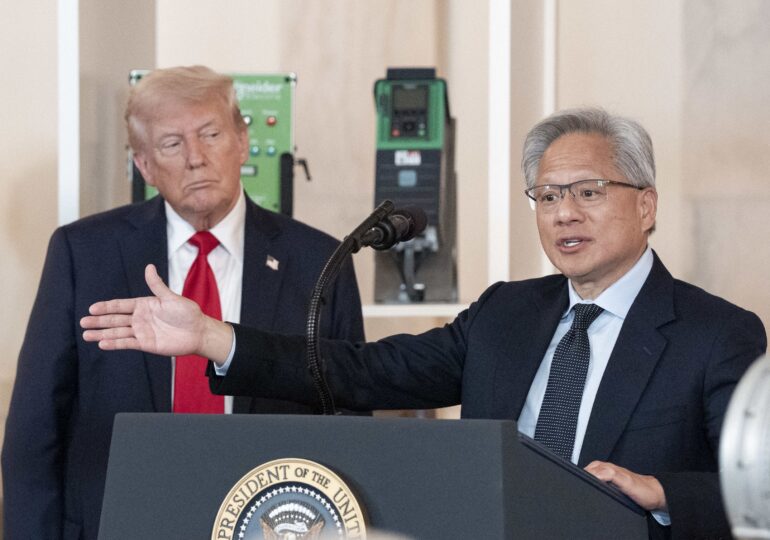
Donald Trump was informed by American intelligence services that a Chinese businesswoman, suspected of transmitting information to Beijing, had developed a close relationship with Jensen Huang, the CEO of Nvidia, one of the most important companies in the artificial intelligence industry.
The American president received this information about a year ago but did not intervene, reveals an investigation published by The New York Times, based on testimonies from individuals familiar with classified information.
According to the publication, Trump reportedly wanted to avoid the consequences that such a scandal could have on Nvidia's sales and business relations with China.
The woman suspected of espionage is Alice Huang, also known as Huang Le, a Chinese citizen and former director at Megaspeed, a data center company based in Singapore.
How she came close to Nvidia's CEO
Alice Huang came under the attention of American authorities due to suspicions that Megaspeed had helped China obtain advanced Nvidia processors despite restrictions imposed by Washington.
During her surveillance, intelligence services discovered that the woman had developed a close relationship with Jensen Huang, one of the most influential people in the tech industry.
According to NYT sources, American agencies concluded that Alice Huang was providing information to Beijing. However, it is unclear what information she transmitted and whether she obtained confidential data directly from Nvidia's CEO.
The two were photographed together at several business events, including in Taipei in 2024.
The connection caused concern in Washington because Jensen Huang leads a company essential to the development of artificial intelligence and has also become close to Donald Trump.
However, Nvidia rejects the idea that the meetings between the two were suspicious. The company claims that its CEO annually meets with thousands of client representatives, and Megaspeed did not have access to technological secrets or information relevant to national security, reports also The Guardian.
Billions of dollars in processors and suspicions regarding China
The investigation also raises questions about Megaspeed's activity. According to business documents analyzed by NYT, an affiliated company in Malaysia purchased, between June 2024 and February 2026, advanced equipment containing Nvidia technology worth at least 4.8 billion dollars. The amount is unusually high for a relatively small and little-known company.
American authorities are investigating whether this equipment was redirected to China, violating export restrictions.
Washington limits the sale of the most advanced processors to Beijing to prevent their use in developing advanced artificial intelligence systems, including military applications.
Nvidia claims it has reviewed Megaspeed's activity and found no evidence that its processors were illegally introduced into China. Jensen Huang personally defended the business relationship with this company, describing it as normal, according to Reuters.
Megaspeed announced that it takes the accusations seriously, has hired external lawyers for an internal investigation, and is prepared to cooperate with American authorities.
Why Trump did not intervene
One of the most important aspects of the investigation concerns the reaction of the American administration. According to NYT, Trump was informed of the intelligence services' conclusions but chose not to act.
Jensen Huang reportedly did not receive an official warning about the espionage risk, although American authorities sometimes use such notifications to protect individuals targeted by foreign services.
It is unknown whether American authorities chose not to warn him to avoid compromising the investigation into the alleged espionage activity.
The investigation also shows how much influence Nvidia's CEO has gained over American policy regarding China. Huang pressured for the relaxation of export restrictions on processors and obtained significant concessions from the Trump administration, including an agreement allowing certain sales to China in exchange for a 25% share for the American government.
Current and former American officials claim that the closeness between Trump and Huang contributed to blocking or slowing down investigations and proposals for trade sanctions targeting China or Nvidia.
The White House, CIA, and National Security Agency (NSA) declined to comment on the revelations. The Chinese Embassy in Washington rejected the espionage accusations, calling them unfounded.
G.P.