

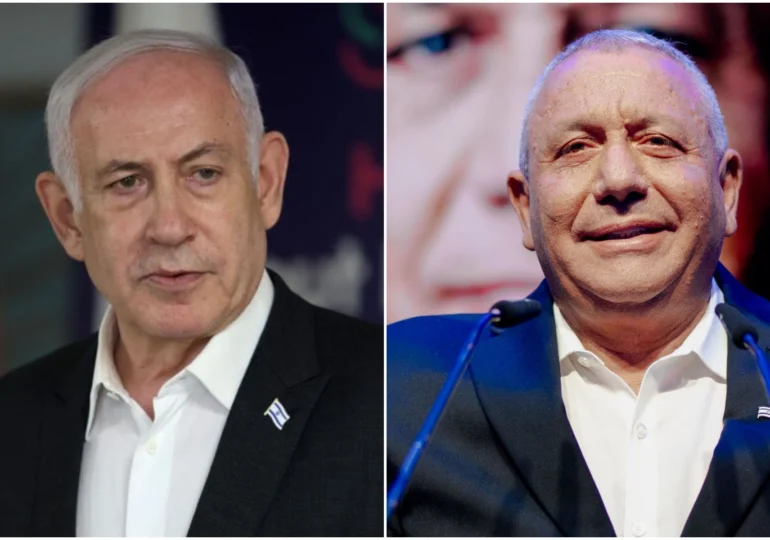
The bloc led by Prime Minister Benjamin Netanyahu has taken the lead over the Opposition in the official vote count of Israel’s parliamentary elections, but does not yet have the majority needed to form a government.
After counting votes from over 84% of the polling stations, Netanyahu’s bloc is credited with 54 seats, compared to 49 for the alliance led by Gadi Eisenkot. Arab parties would obtain 17 seats, according to data from the Central Elections Committee, cited by The Times of Israel.
To form a government, at least 61 of the 120 Knesset seats are needed.
The results are still provisional and may change as the counting continues. Votes from soldiers and other voters who voted outside their assigned polling stations will be counted separately at a later stage, according to Times of Israel.
Prime Minister Benjamin Netanyahu and his main rival, former army chief Gadi Eisenkot, each claim the right to lead the country, and negotiations to form a majority are expected to be difficult.
Netanyahu calls for a right-wing government and speaks about Iran
In a speech delivered after 3 a.m. at the Likud party headquarters in Jerusalem, Benjamin Netanyahu called for the formation of a “strong, right-wing national government.”
The Prime Minister invoked Israel's military achievements and spoke about the possibility of new actions against Iran, together with the United States. “Israel faces a unique historic opportunity, alongside our partner, President Trump, to eliminate once and for all the existential threat posed by Iran,” Netanyahu said, as quoted by Reuters.
His speech came after Gadi Eisenkot warned him not to use Israel's security issues for political purposes.
Eisenkot asks Netanyahu to step down
The former head of the Israeli army, who leads the Yashar party, claims that the election result represents a vote against the current prime minister.
Eisenkot called on Netanyahu to withdraw from politics and stated that he is ready to form a new government. “Netanyahu is now an interim prime minister, without a mandate and without the people's trust,” the Opposition leader declared, urging security institutions not to allow national interests to be subordinated to political ones.
Eisenkot also warned that holding new elections would be a mistake, after the massive turnout at the polls.
Arab parties could decide the future government
One of the surprises of the election is the result of the Arab parties, which would together obtain 17 seats, according to the partial count. These formations could play a decisive role in negotiations to form the next majority.
However, the situation is complicated by the refusal of the main parties in the two blocs to form a coalition with the Arab parties. Eisenkot has almost completely ruled out this option, although the parliamentary support of the Arab formations could be essential for removing Netanyahu.
According to the Associated Press, the scenario of a minority government, supported from outside by some parties or through their abstention in the confidence vote, remains possible.
What’s next
Voter turnout reached 77.7%, the highest level in over 20 years, according to Israel's Central Elections Committee. Participation was approximately seven percentage points higher than in the 2022 elections.
The final results are expected on Thursday or Friday.
Subsequently, President Isaac Herzog will consult the parliamentary parties and will entrust the mandate to form the government to the politician considered most capable of building a majority.
This person will have up to six weeks for negotiations. If attempts to form a government fail, Israel could return to the polls, explains the Associated Press.
Until a new executive is installed, Netanyahu remains head of an interim government.
Tuesday’s elections were the first held in Israel after the Hamas attack on October 7, 2023, and the ensuing wars. The election also represented a test for Netanyahu, who has been in power for most of the last two decades and has been criticized for the security failures preceding the attack.