

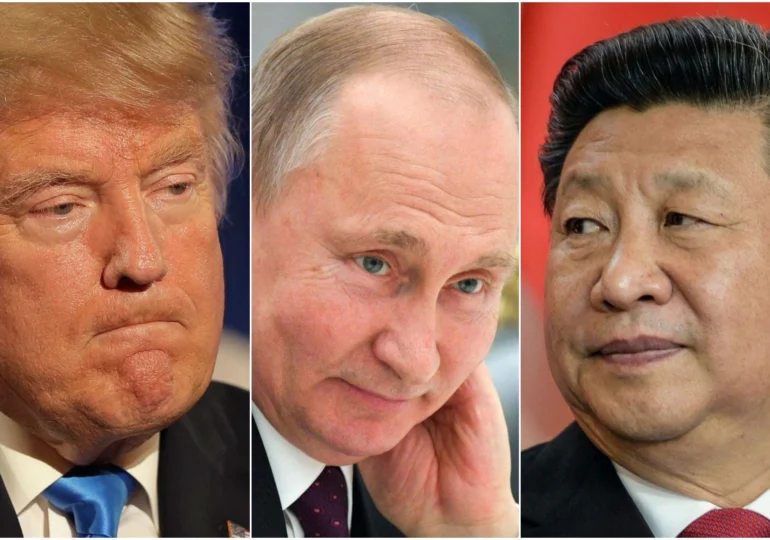
Russian President Vladimir Putin arrived in China on Tuesday, where he is set to participate in an unprecedented meeting with the leaders of the United States and China, Donald Trump and Xi Jinping. The meeting, scheduled for Thursday, November 19, in Shenzhen, raises concerns that the three major powers might negotiate the future of other countries without their participation. Ukrainian President Volodymyr Zelensky warned of the risk of a new Yalta, while the Kremlin rejected the comparison.
Putin’s plane landed on Tuesday at Bao’an Airport in Shenzhen, and his arrival was broadcast live by Russian television, Anadolu reports.
Donald Trump is already in Asia. The American president arrived on Tuesday in the Philippines, where he met with the leaders of Japan, India, and Australia as part of the Quad group. On Wednesday, Trump is scheduled to have talks with Philippine President Ferdinand Marcos Jr., after which he will head to China, according to Reuters.
In Shenzhen, the three leaders will meet on the sidelines of the Asia-Pacific Economic Cooperation (APEC) summit. It will be the first face-to-face meeting in this format, and Beijing considers it of "revolutionary importance" for international relations, according to Reuters.
Trump announced that he wants to discuss nuclear arms reduction, Iran, trade, and the war in Ukraine, although American officials had previously indicated that Ukraine would not be on the trilateral agenda.
The Kremlin hopes the meeting will conclude with a joint statement. Russian presidential adviser Yuri Ushakov said the document is already being negotiated but admitted that each leader might present the results of the discussions separately if no agreement is reached, according to Anadolu.
Beyond the official agenda, the meeting has revived a sensitive comparison for Eastern Europe: the 1945 Yalta Conference, when the leaders of the US, Great Britain, and the Soviet Union negotiated the post-war organization of Europe.
The Kremlin rejects the comparison with Yalta
Kremlin spokesperson Dmitry Peskov rejected the comparison between the Trump–Xi–Putin meeting and the 1945 Yalta Conference.
"These are political scientists’ games and have nothing to do with reality," Peskov said, cited by Reuters. "To say that someone intends to decide the fate of the world — certainly this is not about Russia nor China. We do not want anyone to decide our fate and will never try to decide the fate of others," the Kremlin spokesperson continued.
Peskov argued that Russia and China advocate for a multipolar world order, in which decisions are not imposed on other states. However, he described the talks scheduled for Thursday as "a very important meeting, unlike anything before."
Concerns about a new division of spheres of influence were also expressed by Volodymyr Zelensky. Last month, the Ukrainian president warned that he does not want a new Yalta, where great powers negotiate the future of other countries.
In an analysis published on November 14, Reuters points out that the prospect of the meeting raises concerns not only in Kyiv but also in other capitals, including Tokyo and Taiwan.
The comparison with Yalta refers to the 1945 conference, when the leaders of the US, Great Britain, and the Soviet Union negotiated Europe’s future after the war. For countries in Eastern Europe, including Romania, Yalta has remained a symbol of agreements between great powers whose consequences were borne by smaller states.
What the three leaders seek
Beyond official statements, the interests of Trump, Putin, and Xi Jinping differ, Reuters shows.
For Vladimir Putin, the meeting is an opportunity to discuss the war in Ukraine and possible conditions for an agreement with Washington. His participation alongside the US and Chinese leaders also gives Moscow the chance to reaffirm its status as a major power.
Trump primarily seeks to open negotiations on nuclear arsenal reductions. However, Washington does not expect a concrete agreement following this first meeting.
Xi Jinping holds a more reserved position. China does not want to accept obligations in nuclear negotiations similar to those of the US and Russia, which possess much larger arsenals.
Beijing also tries to avoid direct involvement in negotiations regarding Ukraine, which could complicate its relations with European states.
An analysis published Tuesday by the Atlantic Council shows that for Putin, the meeting may represent an opportunity to gain recognition of Russia as a major power and acceptance of a sphere of influence in its neighborhood.
For Xi, the meeting offers a chance to present China as a central diplomatic actor capable of bringing the US and Russian leaders to the same table. However, Atlantic Council experts warn that Beijing is trying to carefully control the course of the meeting and avoid surprises caused by the positions of the other two leaders.