
The Trump administration has been preparing for months for the possibility that the Democrats will take control of Congress after Tuesday’s elections. The White House has developed a plan allowing the president to continue implementing key policies without the approval of lawmakers. At the same time, his advisers are preparing a defense strategy against investigations that Democrats might launch against the administration.
The information was revealed by Reuters, which cites a White House official and two other people familiar with the preparations.
Senior officials, including Deputy Chief of Staff Stephen Miller and Budget Director Russell Vought, have been working since April with the White House Counsel's Office to identify measures Trump could adopt without Congress's approval.
Areas targeted include immigration, tariffs, housing costs, and federal spending, the three sources said, speaking on condition of anonymity.
White House Counsel Will Scharf and his team are also analyzing what the president can legally do through his own authority, how far he can go in exercising power, and how these decisions could be defended in court, the official explained.
Tuesday's elections could thus create a paradoxical situation. If the Democrats take control of Congress, they will be able to investigate Trump, block his legislative initiatives, and limit his budget priorities.
However, the president will retain his broad executive powers in areas such as trade, foreign policy, and federal administration leadership, which he has already used extensively in his second term.
Trump himself has acknowledged preparing for such a situation. If the Republicans lose Congress, the president expects to use his veto power for "a month or two" before starting negotiations with the Democrats.
"I guess I'll become Mr. Veto. And then, at some point, we'll probably come to agreements," Trump said in an interview aired Sunday on the New York Post's "Pod Force One" podcast.
To overturn the Republican majorities, the Democrats need a net gain of four seats in both the House of Representatives and the Senate. Republicans currently hold a majority of 218 to 214 in the House and 53 to 47 in the Senate.
Polls favor the Democrats in the race for the House of Representatives, while the battle for the Senate remains too close for a clear forecast.
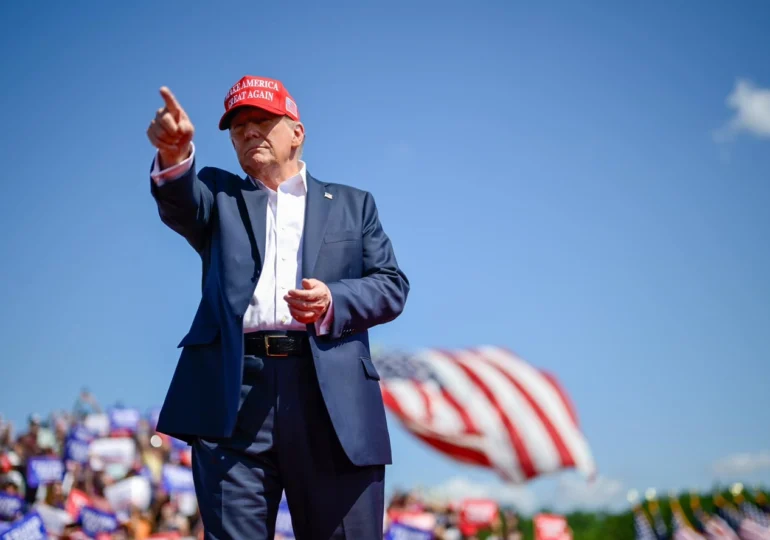
In the past month, Trump has participated in campaign rallies across the country, trying to maintain the Republican majority in Congress. At the same time, his advisers are discreetly preparing a strategy for a very different political situation in 2027.
Officially, the White House rejects the prospect of a Republican defeat and accuses the press of promoting a false image. "This administration and sensible Republicans will continue to secure our borders, restore law and order, put more money in the pockets of hardworking Americans, and achieve victories for the American people," said White House spokeswoman Lauren Bis.
What Measures the White House Is Preparing
Among the measures being analyzed are the introduction of new tariffs on imports of essential minerals and wind turbines, tightening rules regarding visas granted to foreign students and seasonal workers, as well as initiatives to reduce housing and construction costs, according to the White House official.
Federal agencies have already submitted proposals and legal analyses regarding decisions the administration could take without Congress's intervention, one of the people familiar with the plans said.
Russell Vought, who heads the White House Office of Management and Budget, is reviewing which administration priorities can be funded from funds already approved by Congress, two of the sources said.
Vought also wants to change the rules for awarding federal grants so that politically appointed officials have greater influence over programs funded with public money.
Such a change would allow the White House to have more control over how federal funds are spent without needing new approvals from Congress.
Trump has been informed about these preparations and has participated in discussions, according to the White House official.
When asked how comfortable Trump would feel governing by exercising executive powers with a Democrat-controlled Congress, one of the sources replied: "Very comfortable."
Trump Has Already Tested the Limits of Presidential Power
Since returning to the White House in January 2025, Trump has repeatedly tried to expand the limits of presidential authority.
He has used executive orders to impose expanded tariffs, tighten immigration policy, reduce the number of federal employees, and make major foreign policy decisions, including regarding the war against Iran, without Congress's approval or passing new laws.
An important exception was the extensive package of tax cuts and spending, passed by the Republican-controlled Congress and signed into law by Trump in July 2025.
"In the last two years, President Trump has practically ignored Congress and tried to do as much as possible through executive orders and executive power. I think he will continue to do so if there is a Democratic majority," said Nathan Gonzales, editor at Inside Elections, a publication specializing in nonpartisan political analysis.
Trump has repeatedly invoked the state of national emergency to expand his ability to act without passing new laws.
Congress can vote to end these states of emergency, but the president can block the decision with a veto. Overriding the presidential veto would require a two-thirds majority in both chambers of Congress.
However, a Democratic majority could create significant obstacles for the administration. If they controlled the Senate, Democrats could block appointments proposed by the White House leader in the judiciary and federal agency leadership, including a potential Supreme Court nomination.
"I expect them to be very reluctant to approve any presidential appointment," said Andrew Busch, professor of public policy at the University of Tennessee, Knoxville, and author of a work on the history of midterm elections.
Democrats could also block legislative projects supported by Trump.
The president, in turn, could veto laws promoted by the Democrats. However, they have slim chances of obtaining the necessary majority in the House to override a presidential veto.
Courts could also intervene, blocking executive decisions that exceed the legal limits of the president's authority.
The White House intends to request legal opinions from the Department of Justice to determine what measures Trump can adopt without Congress and how he can defend them if challenged in court, one of the sources said.
Democrats Prepare Investigations. Trump's Advisers Seek Solutions
However, there is one problem Trump cannot solve through executive orders: Congressional investigations. Reuters previously reported that Democratic leaders in the House of Representatives and members of parliamentary committee teams have discussed organizing hearings, issuing subpoenas, and requesting documents to verify whether Trump used his office for personal benefit, that of allies, or donors.
According to all three sources cited by Reuters, the president's team has been preparing for this eventuality for months.
White House lawyers have explained to politically appointed officials and heads of federal agencies how to handle Congressional investigations, document requests, and subpoenas, one of the sources said. They have also advised them to be careful about the information they record in writing.
Additionally, they have requested an opinion from the Department of Justice that would allow Trump to invoke executive privilege to protect communications with his private advisers from Congressional oversight, the same source said.