
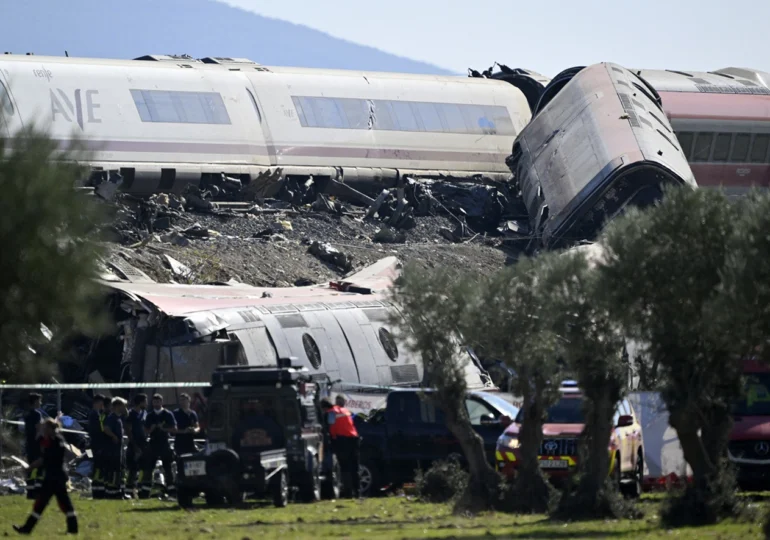
Spain’s high-speed rail network, considered for decades a symbol of the country’s modernization, is at the center of a crisis of confidence after two devastating accidents, resulting in over 100 deaths in just eight months. The tragedies have brought to light issues related to infrastructure maintenance, insufficient safety investments, and delays in upgrading train control systems.
The most recent accident, which occurred Wednesday near Toledo, resulted in at least 69 deaths. In January, another rail accident in Adamuz caused the death of 46 people.
According to an analysis published by Politico, experts warn that the problems of the Spanish railway system are older and cannot be explained solely by human errors.
The issue has also become a major political dispute ahead of the snap elections on November 29. “The death of over 100 people in two rail accidents within an eight-month period raises serious questions about the integrity of the railway system,” opposition leader Alberto Núñez Feijóo said Thursday, demanding explanations from the authorities.
How the Toledo accident happened
The initial findings of the investigation indicate a series of technical failures and decisions that led to the collision between two trains.
According to the Spanish Ministry of Transport, a computer malfunction disabled the German-made signaling system installed in 1992. Traffic control was taken over by staff responsible for managing traffic, who authorized a train to proceed on a track where another train had already stopped. The two trains collided.
Jaime Tamarit, former director of a European laboratory for railway signaling system certification, believes the malfunction raises serious questions about the state of the infrastructure. “The purpose of a train protection system is precisely to prevent human errors,” explains the expert, who participated in the development of the European system designed to prevent rail accidents.
In his opinion, the fact that such an important mechanism failed shows that the infrastructure is in very poor condition.
Huge investments in new lines, too little money for maintenance
One of the problems identified by experts concerns how Spain has spent its railway funds. Investments fell sharply during the financial crisis and years of austerity. Subsequently, funding increased but, adjusted for inflation, remained below pre-crisis levels.
Between 2018 and 2022, Spain allocated an average of 1.5 billion euros annually for high-speed rail infrastructure, more than France or Germany. The problem is that most of the money went towards building new lines.
According to European Commission data cited by Politico, only about 16% of Spain's spending on the high-speed network was allocated to maintenance, renewal, and modernization of existing infrastructure. In France, Germany, and Italy, the share was between 34% and 39%.
“If you have more train lines, you need more staff and have to spend more on maintenance,” warns Tamarit. The expert believes politicians preferred new projects, which bring public visibility, over maintenance work, which is less spectacular but essential for safety.
The Spanish railway infrastructure manager, the state company Adif, however, claims that maintenance work has been adequate and that it has always complied with safety requirements.
Safety issues were also flagged after the 2013 rail tragedy at Angrois, where 80 people died. In 2016, the EU Agency for Railways found that the accident investigation did not meet independence standards and recommended a new investigation. Subsequently, the European Commission launched an infringement procedure against Spain for deficiencies in railway safety oversight.
The January accident in Adamuz was also not free of controversy. An independent technical investigator accused the infrastructure manager, Adif, of altering reports regarding the accident. The company denies the allegations and says it cooperated with the judicial investigation.
MEP Ana Miranda, representative of the Galician nationalist party BNG, believes that political responsibility lies with successive governments, both those led by the Popular Party and the socialists of Prime Minister Pedro Sánchez.
The European system that could prevent accidents is delayed
The Toledo accident also highlights a problem affecting the entire European Union: the slow modernization of signaling and train protection systems.
The two trains involved in the collision were not using ERTMS, the European system that allows automatic traffic monitoring and can brake trains when they exceed the permitted speed or fail to obey signals. Spain had planned to install this system even on the Madrid–Sevilla line, through a modernization project authorized in 2020. However, the work was not completed.
Investigators have not yet determined whether ERTMS could have prevented Wednesday's accident.
Delays are, however, much broader at the European level. At the end of 2024, the European train control technology, the main component of ERTMS, operated on approximately 12,400 kilometers of railway, representing only 10% of the trans-European transport network, according to the EU Agency for Railways.
The EU aims to equip 57% of the main rail corridors with ERTMS by 2030, but this target also seems increasingly difficult to achieve.
European funds and research under pressure
Modernization is also complicated by disputes over European funding. In negotiations for the EU’s future multiannual budget, the Irish Presidency of the Council proposed a 14% reduction in funds allocated to the Connecting Europe Facility compared to the European Commission’s initial proposal.
Meanwhile, a project concerning the future structure of the European Horizon Europe program, consulted by Politico, could completely remove railway research from dedicated funding.
The European Commission is trying to accelerate ERTMS implementation through an agreement with industry aimed at standardizing technical requirements, simplifying approvals, and encouraging investments. However, the first technical results are expected only at the end of 2027, and some components will require additional testing.
G.P.