
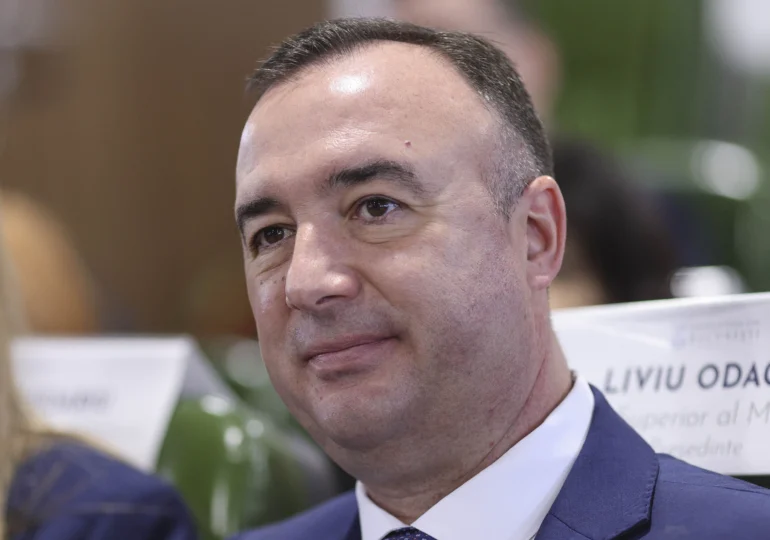
The President of the Superior Council of Magistracy, Liviu Odagiu, argues that the attacks on the judicial system over the past year were part of a coordinated action aimed at diminishing public trust in Justice and preparing for legislative changes through which the political factor would regain influence over the judiciary.
In a series of statements made on Friday, on the „Off the Record” show at Mediafax, the head of the CSM rejected accusations that the institution had drawn up a „blacklist” of politicians, journalists, and representatives of civil society, and stated that the decision recently adopted by the Judges’ Section represents solely an initiative to defend the independence of Justice.
Liviu Odagiu also warned of the danger of a justice system made under the pressure of public opinion or politics, invoking the biblical episode of the release of the thief and the crucifixion of Jesus.
Regarding the speed at which the Ilfov Tribunal judged the request of the PNL coup plotters, the head of the CSM justifies: "We are always told that trials take too long."
Comparison with the trial of Jesus
"A populist justice is one of the most dangerous justices. And it's not me saying it, but history. 2,000 years ago, there was a case in human history when popular justice decided to release a thief and send a savior to the cross," Liviu Odagiu stated.
The President of the CSM argued that courts should not make decisions based on what the public wants or the interests of politicians.
How he explains the speed of the Ilfov Tribunal
Asked by a journalist about criticisms regarding the speed at which some courts pronounce judgments, in the context of Thursday's decision of the Ilfov Tribunal regarding the PNL, Odagiu responded that Justice cannot be judged solely based on the convenience of the solution.
The Ilfov Tribunal suspended decisions taken in the National Political Bureau of the PNL against the liberals supporting Adrian Veștea, the decision being pronounced quickly, following the request submitted by 16 party members.
"We are always told that trials take too long. Delayed justice is no longer justice. Apparently, when we have swift justice, we are still not satisfied, as that is not justice either," said the President of the CSM.
Odagiu claims that the public debates over Justice in the past year, including those regarding magistrates' pensions, had a broader purpose than just reforming the system.
"Everything that happened over the course of a year was not absolutely random. They were not isolated positions of individuals or politicians, but a concerted action aimed at certain goals," accuses the President of the CSM.
According to him, the main goal was to diminish public trust in the judicial system.
"All these discussions during the pension period were not about the pension amount or the retirement age. They had only one purpose: to discredit and lower the level of trust in Justice," Odagiu believes.
Major accusation: political control over Justice
The President of the CSM argues that the reduction of public trust should have been followed by legislative changes impacting the system's independence.
"Everything that happened in the past year had as its final goal the restoration of political control over the judicial system," says Liviu Odagiu. "The purpose was to lower the level of trust in Justice to a threshold where legislative changes strengthening and restoring complete political control over Justice would be superimposed," he stated.
Odagiu criticized proposals regarding the appointment of the leadership of the Judicial Inspection, the designation of the President of the High Court of Cassation and Justice, or the modification of the selection method of CSM members.
"We see several concrete elements, not just declarative ones, through which the political factor is effectively seeking to subordinate the judiciary," he declared.
Response to the "blacklist" scandal
One of the most controversial topics in recent days was the decision by the Judges' Section of the CSM to inventory individuals and organizations it claims participated in a campaign against Justice.
However, Odagiu rejects the label of a "blacklist."
"No, Justice did not create any kind of blacklist. Justice, the Superior Council of Magistracy, the Judges' Section, with the unanimity of the present members, have noted that there has been, for a year, a constant attack on the independence of Justice," stated the head of the CSM.
He argues that the document does not contain hypotheses, but rather concrete facts and actions attributed to identified individuals.
"This narrative of blacklists emerged immediately after the decision was published and (...) spread throughout the media," said Odagiu.
Message for protesters and NGOs
When asked about the protest announced on Friday by several civil society organizations, the President of the CSM stated that the demonstration represents "an event allowed by democratic rules."
He specified that the institution has never opposed protests organized by civil society, but added that he did not clearly understand the objective of the action.
"I read the call for the protest, but I did not understand if it is protesting against something or in support of something," Odagiu said.
"I do not enter into such speculations"
When asked if the decisions pronounced on Thursday in cases involving political leaders, including Ciprian Ciucu and Dominic Fritz, are mere coincidences, Liviu Odagiu refused to engage in political polemics. "I do not enter into such speculations," he said.
The President of the CSM insisted that courts should be judged solely based on their professional activities.
"Romanian courts are deeply European courts that apply exclusively the rules of law in their activities and ensure and guarantee citizens' rights and freedoms. The rest of the political speculations are not in my field, and I do not want to make any considerations," said Odagiu.
What he says about Recorder and CSM communication
The President of the Superior Council of Magistracy commented on the documentary "Captured Justice" by Recorder.
"I saw a documentary extremely well made from a technical point of view," said Odagiu, mentioning that subsequently the CSM referred the Judicial Inspection for verifications.
However, he believes that magistrates did not deserve to be associated with generalized accusations of corruption. "Our colleagues who are there, at the Bucharest Court of Appeal, at the other courts of appeal in the country, at all courts in the country, who work from morning till night and sacrifice families and health to guarantee rights and freedoms, I do not think they deserved to be tarnished with corruption and systemic abuses," he mentioned.
At the same time, Odagiu admitted that the institution he leads communicated poorly in recent years. "Our public communication was not at the level of the moments through which, over the years, justice has gone through," he acknowledged.