

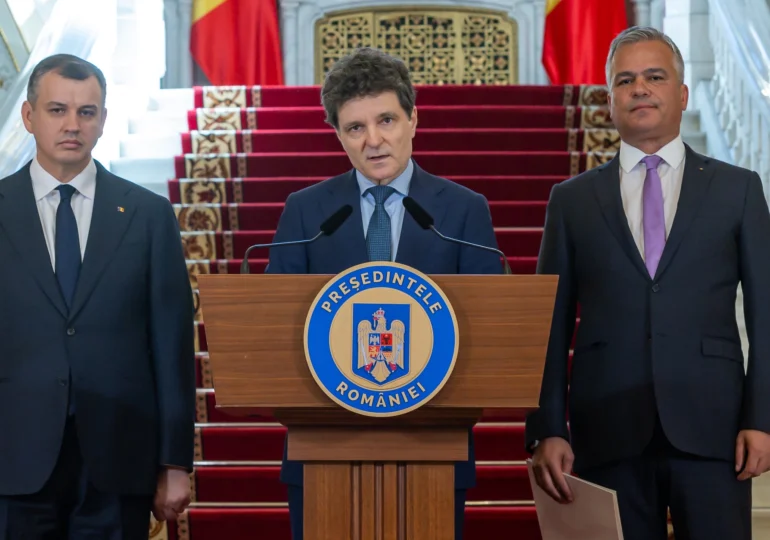
It took Nicușor Dan one year to reach the same point as Iohannis did in the fall of 2021, when he manipulated the formation of USL 2. At least the former president fought in his first term against Liviu Dragnea and PSD, managing to destabilize the party-state and reduce its influence.
Nicușor Dan didn’t even try. From the first days of his term, he developed a conflict with Ilie Bolojan, the current president of PNL, with the feeling that his only objective is to neutralize the growing support for him, which he sees as a threat to his mandate.
Paradoxically, it was precisely this conflict, the inability to negotiate and pursue his objectives that quickly destroyed his public support.
Seldom has an elected president delivered so little of what he promised in the electoral campaign in the first year of his term.
He did nothing against disinformation and the derussification of Romania. Moreover, some of his first political moves were to cozy up to AUR by contesting the Vexler Law at the Constitutional Court.
He buried the case of the annulled 2024 elections. The Justice reform ended with a total surrender to Lia Savonea, the president of the Supreme Court, who promotes blacklists against those who criticize corruption in the system.
He fueled the conflict with Ilie Bolojan, the prime minister, through passivity in the face of PSD attacks on the premier who managed, for the first time in decades, to make a handful of reforms in the public sector.
After a year, no one, absolutely no one, seems to understand what the president wants to do and in what direction he wants to steer the country.
If he caused chaos in domestic politics, he caused an even greater one in foreign policy. He damaged relations with European countries, with Germany, France, and the United Kingdom, running after Donald Trump with his tongue out, a corrupt American president almost isolated in the White House after a string of whimsical decisions.
No matter how well-intentioned someone may be towards the current president of Romania, sooner or later they reach a point where they encounter a lack of stature, an inability to inspire, major communication difficulties, and problems in analyzing and acting on multiple fronts.
Hard to Stop Trend
On the morning of February 10, 2025, Marcel Ciolacu, the leader of PSD, Ilie Bolojan, the leader of PNL, and Kelemen Hunor, UDMR, arrive at the Cotroceni Palace to meet with Klaus Iohannis in the context of a strong current of opinion in society and in Parliament for the suspension of the President of Romania, as a result of the political crisis triggered by the annulment of the elections.
The three convey to Iohannis that they have no leverage to stop the procedures initiated in the legislature and cannot obtain a majority against the suspension.
Several hours later, Klaus Iohannis announces his resignation.
The above-described episode clearly indicates that when a critical mass is created in society against the president, it is very difficult to stop. The tendency to remove the head of state can be slowed down, postponed for a period, but it can no longer be removed from the public agenda.
Under the Table Negotiations
Nicușor Dan's major mistake, which exposes him to suspension from now on, is that he failed to connect with that part of the electorate he seduced in the electoral campaign. It's about that area where he promised reforms, fighting corruption, building an "Honest Romania," and developing a relationship with Ilie Bolojan, the most popular politician at that time and even now.
Moreover, all his decisions, political positions, and actions seemed to have been deliberately aimed at disappointing that electorate.
The statutory leadership of the National Liberal Party was not consulted, not even asked about this nomination. We all found out post-factum when the phones started ringing. It is an act of aggression against a democratic party, unprecedented until now, which those who conspired against us in recent months have taken today to its most aggressive phase.
Ciprian Ciucu, First Vice President of PNL, Mayor of Bucharest
Surprisingly, in the appointment of Adrian Veștea, a liberal from Hubert Thuma's camp, the fact that it was done following under-the-table, non-transparent negotiations with PSD and the anti-Bolojan wing of PNL was striking. In other words, the president, in a non-transparent manner, violating constitutional provisions, appoints a politician from a party with statutory leadership without consulting the respective party.
"The attempt to impose a prime minister from within a party, without even having a prior consultation and after all decisions unanimously taken by the party bodies, violates any principle of loyal political collaboration," announced shortly after the designation, Ilie Bolojan, the president of PNL.
Pro-Russians and Pro-Europeans, All Against the President
Regardless of what the advisors and people surrounding the president advised him, the fact that he can take this step without political consequences, and that the Romanian state, behind closed doors, can dismantle the pro-suspension sentiment, has been proven in the past not to be true.
All advisors disappear in the face of events, wash their hands, and leave those who made the decisions to face them.
Nicușor Dan, through his attempts to avoid and postpone the change in Romania, has only accelerated and exacerbated the political crisis.
The president's position actually indicates a continuous postponement of resolving complex problems. His bet is that if he manages to form a new USL, Romanian society will calm down, and he can return to his convoluted strategies of appeasing both sides, none of which have worked so far.
Adrian Veștea is a person who has gone through all administrative stages - he was a successful mayor, a successful county council president, a successful minister who attracted European funds, concerned with development, for example, the airport in Brașov, which is a success.
Nicușor Dan, President of Romania
But the appointment of Adrian Veștea did nothing but unite against him both the pro-Russian sovereigntists of Simion and Șoșoacă, voters who did not vote for him a year ago, as well as the pro-European, reformist public whom he managed to attract to his side after the annulled elections of 2024, following Ilie Bolojan's refusal to run.
Nicușor Dan probably imagined that if he destroyed PNL, the reformist public would view him as a savior.
Economic problems are not going anywhere, and the discontent in society, with a leader who doesn't know where to steer the country, will only increase, not diminish.
Only people who haven't taken the subway in a long time or haven't taken an Uber in the past year understand the pulse of society, how huge the damage caused by corruption, betrayal, and complicity in the Romanian state is, and still believe that deep-seated problems can be solved through avoiding decisions, postponement, or under-the-table arrangements, some of which keep the citizens of Romania in the dark, so as not to disturb or jeopardize hidden interests.