
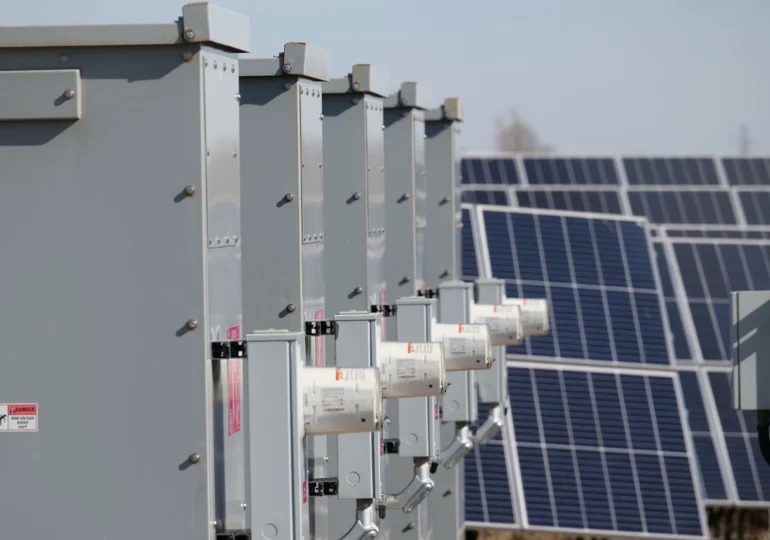
Batteries have been presented as a „crucial technology” in the EU’s transition to clean energy, but recently concerns have arisen about the risk of potential power outages they could cause.
With the share of renewable energy in the EU estimated to reach around 69% by 2030 and 80% by 2050, the need for flexible storage solutions is rapidly increasing.
Europe is already wasting wind and solar energy worth millions of euros due to network limitations and the rigid nature of these sources. When supply exceeds demand, this can lead to negative electricity prices.
Many experts have identified battery energy storage systems (BESS) as the ideal solution to this problem. The logic is simple: batteries can store electricity generated from renewable sources during the day (when consumption tends to be low) and deliver it to households when demand increases in the evening.
This is why Europe installed new BESS capacities of 36 GWh in 2025, exceeding, for the first time, a total operational capacity of 100 GWh. This quantity is enough to power approximately 75 million households, as stated in an analysis published by Euronews.
However, batteries also pose a risk that should not be overlooked: they could cause power outages. Experts indicate how significant this risk is.
Has Storage Gone Too Far?
Last week, the British newspaper The Telegraph published an article titled "Britain's Battery Boom 'Risks Overwhelming the Grid'", stating that backup systems supporting wind energy could even trigger "power outages they are trying to avoid."
The article followed a recent report by the Panel of Technical Experts (PTE), an advisory group of independent experts appointed by the UK government to provide technical advice on the electricity market reform, as reported by Euronews.
"The PTE continues to consider how battery storage systems (BESS) could behave in situations covered by capacity market notifications (CMN), as in such cases, storage units could be incentivized to charge in advance to meet their obligations under the capacity market," the report states.
A CMN is a signal transmitted in the system four hours in advance, indicating that the available energy volume for generation may be lower than estimated by system operators as necessary to cover national demand.
"This situation could lead to a rapid evolution towards a system stress event. This additional demand may require more explicit modeling when estimating peak demand during such a stress event," the document mentions.
However, the report does not state that batteries will destabilize the grid nor does it explicitly express concern about power outages. Instead, it simply emphasizes the need for simulations on how batteries respond to a CMN.
What Is the Risk of a Blackout Caused by the Battery Boom?
Fears that batteries could trigger power outages across Europe are primarily driven by the fact that grid operators cannot monitor and control numerous small, decentralized installations. If they all were to operate simultaneously, managing the situation would be challenging.
"It's the same challenge we've been dealing with solar energy for 20 years," Adrian Hiel, director of the Electrification Alliance, told the cited source.
"We have made constant progress in ensuring that (installations) benefit the network rather than affect it. Realistically, this only becomes a power outage risk if we ignore the fact that millions of batteries are being installed annually. No one is interested in that," he added.
The main solution to manage this "minor risk" associated with batteries is better modeling, Hiel asserts. This will enable grid operators to anticipate how battery parks behave in various situations.
"We can expect relatively large margins of error in their models in the next few years, but subsequently, they will become increasingly precise and accurate, just as it happened with modeling the behavior of rooftop solar systems," he adds.
"Another solution for managing grid-connected batteries will be aggregating their control by a third party. Instead of each household managing its own battery operation, a company will bring together tens or hundreds of thousands of batteries, operating them in a way that maximizes value for households and benefits for the network," the expert explained.
This approach is already implemented in many countries regarding smart charging of electric vehicles. Hiel describes it as the "next logical step" for batteries, as it allows the grid operator to contact the battery aggregator to quickly initiate either consumption (through charging) or discharge to cover sudden demand spikes.
Are Batteries Really Expensive?
An industry voice quoted in the article also claims that "batteries are very expensive," but no data is provided to confirm this. According to the International Energy Agency (IEA), average battery costs have dropped dramatically – by 90% – from 2010 to the present, thanks to advances in chemistry and manufacturing technologies.
A recent report by the energy analysis organization Ember found that by 2030, industrial-scale batteries could provide short-term flexibility in the EU at a cost 20% lower than new gas-fired power plants.
The report also revealed that in the next four years, batteries in the EU could provide over 80% of the energy that all gas-fired power plants in the EU combined can generate in one hour.
"Ecological flexibility has become a reality," said Beatrice Petrovich, a senior energy analyst at Ember.
"The rapid expansion of battery use, smart electric vehicle charging, and heat pumps can reduce the reliance on natural gas for grid balancing and reduce its demand. The current challenge is no longer about innovation but implementation: removing barriers, rewarding flexibility, and expanding these solutions at a pace fast enough to avoid getting stuck in dependence on unnecessary fossil fuel-based reserve sources," Petrovich explained.
T.D.