

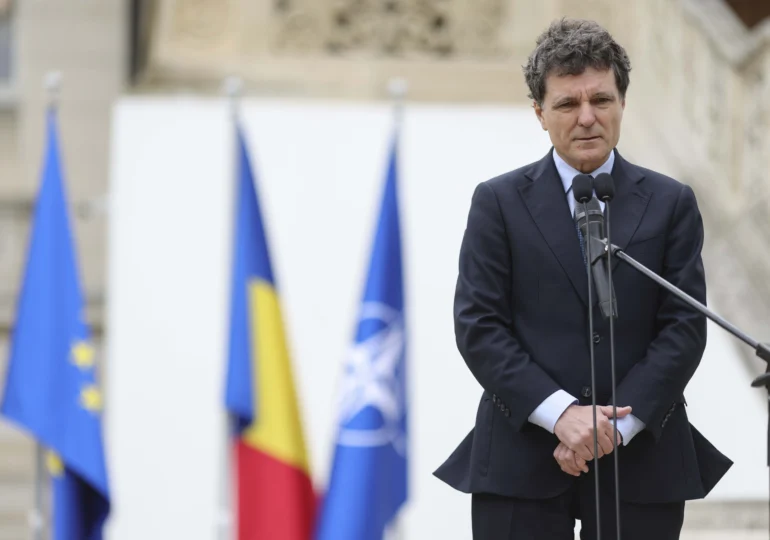
Yesterday, after a few days of silence, a period during which political agitation reached new highs, with minister hearings taking place in Parliament, and the leaders of the PNL, USR, and UDMR parties engaging in intense negotiations to form a majority, Nicușor Dan, the President of Romania, wanted to make a statement.
He did not support the designated prime minister, did not come up with any solution for the political crisis, and made no reference to what would happen after the parliamentary vote, in one way or another.
„It is time for this political crisis to end. It is time for parties to look beyond party lines, to look at the national interest,” said the head of state.
"Snap elections are not a solution; on the contrary, they would be a continuation of instability and lack of trust - both of Romanian citizens and financial markets," added Nicușor Dan.
"Regardless of what happens, Romania will maintain its financial trajectory. There is political consensus on this issue. This is the statement I wanted to make," concluded the President of Romania.
Do you remember when the same Nicușor Dan, in front of the cameras, stated with the same conviction that "the parties in the current coalition are doomed to govern together"?
It was about the PSD, PNL, USR, and UDMR. A few weeks later, the social democrats brought down the government they were part of. This is essentially the extent of the president's ability to interpret reality.
An uncertain trajectory
From the outset, it must be said that the statement is ambiguous, not committing the head of state to anything, further vulnerableizing him.
The statement consisted of three ideas:
- The crisis must end;
- There will be no snap elections;
- There is a political agreement on the "financial trajectory."
If we strictly analyze Nicușor Dan's message, it appears as an urging combined with intuitions that the Mureșan Government could gather at least 233 votes in Parliament.
The clarification that "snap elections are not a solution" following the call for parties to end the crisis, again, suggests a possibility that the new executive could be voted in, but everything is thrown into uncertainty by the phrase "regardless of what happens," followed by the announcement of a "financial" agreement, without explaining what that entails.
Thus, it can be said that the president's message is full of ambiguities, just as unclear and uncertain as today's vote in Parliament.
Grindeanu knows how to get out of the crisis, but does not say
"What will happen on Wednesday? I cannot answer that question because... if we do all the calculations, I still cannot tell you to bet... large sums that we will have 233 votes," stated Kelemen Hunor, the UDMR leader, in a press statement made Monday afternoon.
He was the only leader of the PNL, USR, UDMR alliance to suggest that the Mureșan Government has a chance to obtain the necessary votes in Parliament.
"I counted 229, based on my calculations, on those groups that were approached. Of course, there are still a few votes needed to reach 233, but there is no promise from all the groups approached by Mr. Mureșan. I do not want to comment further because we have decided together to continue with the parliamentary procedures until the end, until the vote. And, of course, until the moment of the vote, discussions are ongoing, attempting to obtain the 233...," Kelemen Hunor further emphasized.
During the dynamics of Monday and Tuesday, the UDMR president's statement was seen as an exception, a strange position against the general trend, mainly shaped by Sorin Grindeanu and the PSD communication system.
At this moment, the only certain solution for ending the crisis is the vote for the government we proposed. Any other option will take us back to May 5, without the guarantee of a rapid alternative.
Siegfried Mureșan (PNL), the designated prime minister, commenting on the president's statement
The social democrats have ruled out supporting the Mureșan Government from the start. Furthermore, they have stated that without the party's vote, the new executive team will be rejected in Parliament.
Additionally, Sorin Grindeanu has also argued that shortly after the Siegfried Mureșan premier option is exhausted, there is a possibility of quickly exiting the crisis through a new designation and a new vote in Parliament. He, too, did not detail how this would happen.
The chasm
A new major concern of the social democrats, as well as those in the UDMR, joined by some constitutional law experts, was the clarification that rejecting the second designation does not automatically trigger the process of organizing snap elections.
Regardless of what political leaders and experts say, after today's vote in Parliament, if Siegfried Mureșan is rejected, both conditions for the dissolution of the Legislature are met, and the decision to dismiss the deputies and senators becomes the exclusive prerogative of the president.
Yes, Nicușor Dan can make another 100 designations if he wants, because the law states "at least two rejections," but if he continues to prolong the crisis, avoiding a return to the people, he will be left without arguments regarding the respect of the Constitution.
Thus, he will enter a gray area from which he cannot save his mandate, regardless of the situation.
Moreover, the preventive arrest of Călin Georgescu represents a major event that will affect AUR and PSD, areas where all types of nationalists are found.
AUR, following the detention of the Russia-affiliated candidate, may rise, come close to, or even surpass 40%, energized by anger, but the entire political chessboard will split into two, between sovereigntism and Europeanism, and the PSD will fall into the chasm created by the clash of these two forces - the social democrats being neither one nor the other.
Today's vote will be on a knife's edge, but the most important effect, regardless of the outcome, is that it will bring about a profound change in society, one way or another.
It will be the culmination of a decades-long journey that will mark the end of an era, bringing about a painful, violent, and profound reset or a smoother, longer, and calmer one. Ultimately, the result will be the same - the end of the PSD, the party-state, as we know it and have endured.