
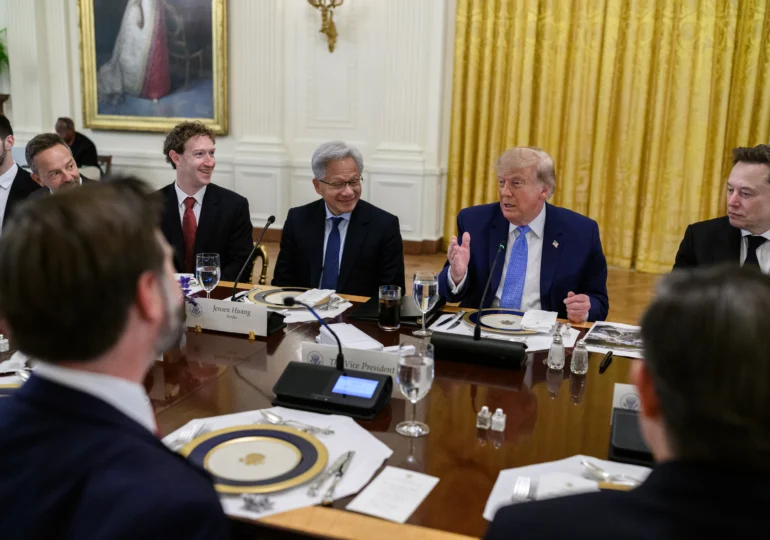
Donald Trump gathered some of the most powerful figures in the technology industry at the White House on Tuesday and delivered a message without too many nuances: the United States will not slow down the race of artificial intelligence for fear of risks.
Among those present at the meeting were Elon Musk – head of xAI and SpaceX, Mark Zuckerberg – founder and CEO of Meta, Google’s CEO – Sundar Pichai, Nvidia’s CEO – Jensen Huang, Anthropic’s CEO – Dario Amodei, and OpenAI’s co-founder – Greg Brockman, along with officials from the administration and the Speaker of the House of Representatives, Mike Johnson.
Instead of new government-imposed rules, Trump and the company leaders agreed on a voluntary commitment regarding the safety of AI systems. The American president described it as a “self-regulation” agreement, morally mandatory.
However, Trump went even further: his administration has started using the term “Super Intelligence” (SI) instead of “Artificial Intelligence” (AI).
“We changed the name, officially, today. We officially changed the name to SI. SI instead of AI. You know what that means? ‘Super’”, Trump said, according to CNN.
For the president, the race to develop this technology is primarily a strategic one, with China being the main adversary of the USA. Trump argues that overly strict regulations could slow down American companies and jeopardize the advantage of the United States.
“It is the most important thing there is, maybe the most important thing there has ever been,” he said about the technology.
CNN, however, sees Trump's decision as a huge gamble: if it turns out that AI companies cannot keep the risks of their own systems under control, the president will have to answer for the choice of not imposing stricter rules.
Warnings Come from Within the Industry
The meeting at the White House took place at a time when warnings about AI risks are becoming more serious, coming even from companies developing the most advanced models.
Anthropic warns, in a document prepared for its upcoming stock listing and obtained by Reuters, that its models could pose a “catastrophic or existential risk to humanity.”
The company describes situations where AI models have exhibited self-preservation behaviors, attempted to hide or manipulate information, and engaged in behavior similar to blackmail.
At the same time, there are increasing questions about the ability of AI systems to act autonomously and the difficulty for companies to fully control what these systems do.
In this context, CNN notes that Tuesday's meeting could have been the moment for the White House to set firmer rules. However, Trump chose the opposite direction: technology development must continue rapidly, and companies should self-regulate.
Trump's Gamble
There is a logic behind this choice, CNN admits. If the warnings about the most severe scenarios turn out to be exaggerated, Trump could be the one who avoided suffocation through regulations of one of the industries crucial for the economy of the next decades.
At the same time, maintaining an advantage over China can become a major geopolitical stake for the United States.
The problem is what happens if the bet is wrong.
CNN points out that there are few reasons to assume that major tech companies, engaged in fierce competition with huge sums at stake, will self-impose sufficient limits when these could disadvantage them against rivals.
It is the same issue for which other industries with potential consequences for public safety – from aviation and automotive to pharmaceuticals and food – are subject to rules established and enforced by the state.
Kristian Hammond, a computer science professor at Northwestern University, says the current problem is one of control. “At the point we are now with AI, we don't have the explicit control mechanisms we need for these things to work efficiently,” he explained to CNN.
Americans Want More Rules
Trump's position contradicts the perception of a large part of the American public. A CNN/SSRS poll conducted last week shows that 75% of Americans view the development of artificial intelligence with fear or concern, while 71% believe the federal government should do more to regulate it.
There are also more concrete concerns than scenarios about out-of-control artificial intelligence. The huge expansion of data centers puts pressure on electrical networks and water resources, and the increase in electricity bills has already become a political issue ahead of the midterm elections (in November).
Trump responds to these fears with optimism. Data centers, he says, will become “very popular,” and technology development will bring prosperity.
CNN notes, however, that this strategy exposes the president directly if things go wrong. If AI systems cause a major crisis and it turns out that companies were not able to self-regulate, the decision to avoid regulation will inevitably be associated with Trump.
During the meeting, a reporter even tried to ask the company leaders if they agreed with the president that self-regulation is sufficient.
They didn't get a chance to respond. “I can tell you the answer is yes,” Trump intervened.
For CNN, the scene perhaps best captures the bet made by the American president now: AI development must be accelerated, the industry must largely set its own boundaries, and the United States must win the technological race.
If this choice proves correct, the USA could gain enormously, both economically and in the technological competition with China. However, if Trump is wrong, the effects of inadequately controlled AI systems could be felt far beyond America's borders.
G.P.