

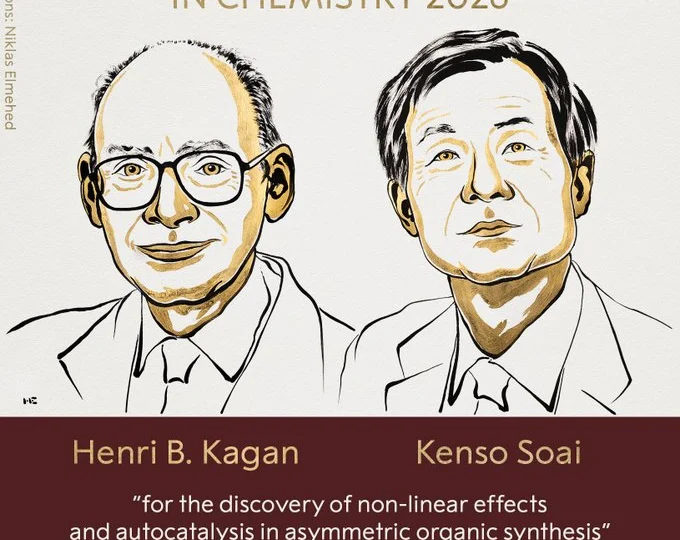
Two researchers were awarded the Nobel Prize in Chemistry on Wednesday for their discovery of new ways to control chemical reactions, opening up new possibilities for producing medicines, flavors, perfumes, and innovative materials.
The two researchers were rewarded for the discovery of „nonlinear effects and autocatalysis in asymmetric organic synthesis,” announced the Nobel Committee for Chemistry.
"Some molecules, such as amino acids, exist in two forms that are mirror images of each other. However, living organisms contain only one of these mirror images. The chemical origin of this asymmetry has long been a mystery for chemists. Henri B. Kagan and Kenso Soai were awarded the Nobel Prize in Chemistry 2026 for finding a solution to this problem," the Nobel Committee stated in a press release.
Discoveries of the Two Researchers
Henri Kagan, now 95 years old, discovered a new way to control chemical reactions, allowing for a greater excess of one of the mirrored images than previously thought possible.
His discovery was revolutionary for chemists developing reactions used in the production of medicines, flavors, perfumes, and new materials.
These forms, called enantiomers, have the same chemical formula but can have very different effects, an essential aspect in drug development.
Subsequently, Kenso Soai conceived the first chemical reaction in which only one variant of the possible mirrored images was formed. Apart from what happens in living organisms, no one had succeeded in achieving this result before. Soai's reaction is considered one of the most spectacular experiments in the history of chemistry.
Thus, thanks to Henri Kagan and Kenso Soai, we now know how homochirality can arise. Their discoveries have been crucial for chemists designing reactions for pharmaceutical production.
"Henri Kagan and Kenso Soai have provided a solution to a chemical mystery over a century old: how homochirality can spontaneously arise. The chemical reactions they developed are spectacular," said Heiner Linke, the President of the Nobel Committee for Chemistry.
What is Homochirality
Homochirality is the property of a chemical or biological system to predominantly or exclusively contain a single chiral form of a molecule.
In short, some molecules exist in two forms that are mirror images of each other, much like the left and right hand are mirror images but cannot perfectly overlap. These forms are called enantiomers.
For example:
- an amino acid can exist in a "left" and a "right" form;
- in living organisms, amino acids are almost exclusively in the L form;
- sugars in DNA and RNA also appear in a predominantly specific configuration.
This preference for a single molecular "hand" is called homochirality.
Why is it Important?
Homochirality is one of the great mysteries of the origin of life: why did life choose one form out of the two possible ones? Chemically, it was not obvious why the "left" form should be preferred over the "right" form.
However, the research of Henri B. Kagan and Kenso Soai on asymmetric organic synthesis, nonlinear effects, and autocatalysis has contributed to explaining how such a chemical asymmetry can arise and amplify.
This year's Nobel Prizes began on Monday and have so far been awarded to:
- Nobel Prize in Physics 2026: How Francis Halzen transformed Antarctic ice into a "window" to the Universe
- Nobel Prize in Medicine awarded to researchers who learned to control neurons with light. How the "neuron switch" works