
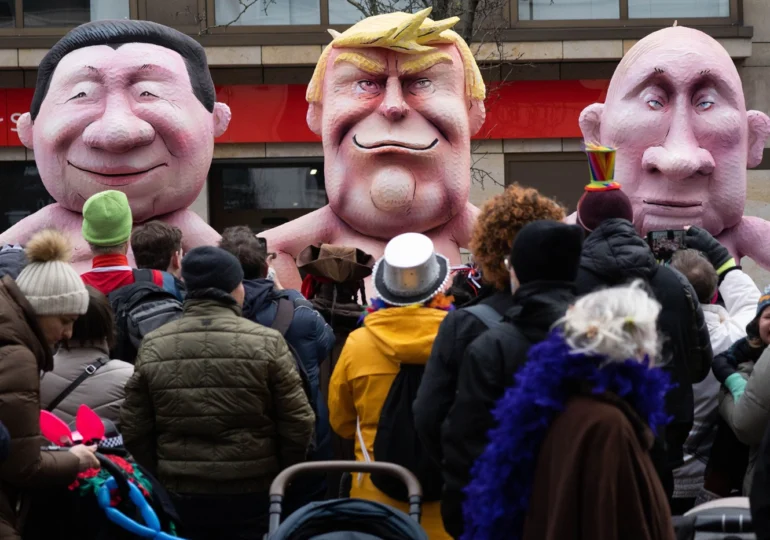
The main consequence of the trilateral summit in Shenzhen could be the message conveyed by the three world leaders standing together, dominating the planet and gazing toward the horizon. This will send chills down the spines of America’s traditional allies.
A disturbing aspect of American President Trump’s foreign policy is his constant attraction to the two dominant authoritarian leaders of the world: China’s President Xi Jinping and Russia’s President Vladimir Putin.
Like a deer drawn to the intriguing scent of hunters’ hideouts, Trump seems to feel an irresistible need to interact with the two authoritarian leaders, writes Kurt Campbell, president of the Asia Group consultancy, in an analysis published by the New York Times.
The leader of the White House’s desire has so far, during his second term, led to bilateral meetings that largely failed to meet expectations.
The 2025 Alaska summit, attended by Putin, brought no progress toward ending the war in Ukraine. The three recent meetings with Xi have yielded minimal progress in easing trade tensions or strengthening safety measures in artificial intelligence.
The Great Admirer of Dictators
This week, the three leaders are set to meet at an unprecedented trilateral forum on the sidelines of the Asia-Pacific Economic Cooperation (APEC) summit in Shenzhen, China. For Americans and partners who share the same values, this meeting is unlikely to bring any benefit, Campbell anticipates.
His main argument is that, in recent decades, most multilateral meetings involving the United States have brought together states whose national interests were largely aligned with Washington’s – such as the maritime democracies within the QUAD group (India, Japan, Australia, and the United States).
This will be the first time a sitting American president meets simultaneously with the leaders of China and Russia – countries that represent systems and approaches to global affairs generally considered diametrically opposed to American interests.
Trump’s camp argues that this approach will favor peace in Europe and give the United States time to strengthen its critical mineral reserves. But they find it hard to explain the president’s evident enthusiasm for this meeting, given his obvious lack of interest in G7 summits – the group of the seven wealthiest democracies – or meetings with European Union leaders.
Trump’s Mask
The situation becomes even more complicated when considering the actions Xi and Putin undertake behind the scenes to undermine America:
- China is the main supporter of Russia’s war against Ukraine, providing essential resources that keep Moscow’s missiles and drones operational.
- Russia provides Iran with satellite imagery and target location data, even as Iran attacks American military targets in the Gulf region.
- Chinese companies have supplied Iran with essential missile components.
- Joint Chinese-Russian military exercises in the western Pacific are increasingly intense around Japan and near disputed island territories.
Under the guise of an understanding displayed at the trilateral summit, Trump will adopt a benevolent attitude toward adversaries who have already drawn their knives against the United States’ allies and partners in three of the world’s most dangerous regions.
American Strategists Repeat a Historic Mistake
The Trump administration completely misunderstands the complexity of the relationship between Russia and China. But this is not the first time Washington has made such a mistake: there are few bilateral relationships that American strategists have so consistently misjudged throughout history, the analyst notes. In the 1960s, the brightest minds in the United States realized far too late the opportunity offered by the split between China and the USSR. Currently, they underestimate how significant the partnership between Russia and China has become.
Another notable aspect Campbell mentions in his analysis: since Xi took power in 2012, he and Putin have met officially about 50 times – an extraordinary pace for high-level diplomacy.
Theoretically, Russia and China – given their history marked by distrust, territorial disputes, and divergent ambitions – should not get along. In practice, these two leaders, who share similar visions, have built one of the most solid security partnerships on the planet.
Although both sides undoubtedly worry about the future of this collaboration, it currently holds major importance and is immune to any attempts to divide them.
What Will the Three Leaders Discuss in Shenzhen?
The American expert reviews the main objectives of each leader
- China is rapidly and discreetly developing its nuclear arsenal – which is much smaller than that of Russia or the United States – and will therefore try to avoid any negotiations that could prevent it from closing the gap.
- Russia will address the issue of peace in Europe only through ideological generalities.
- The United States will be reluctant to seek support to end the war in Iran, especially from the two countries that most actively back Tehran.
- Russia will avoid discussions about artificial intelligence, as these would highlight how far behind it has fallen in this field.
Here is also what might not happen at the summit in China:
The absence of a clear agenda for the trilateral summit will put Xi in an uncomfortable position; it is unlikely he will agree to spontaneous deals. He is focused on securing a fourth five-year term next year – the longest period in power for a Chinese leader in recent times – and does not welcome surprises. Given Trump’s inclination toward improvisation, Xi will cautiously view any attempt to achieve major diplomatic progress, the analyst estimates.
Under these conditions, the main consequence of the trilateral summit in Shenzhen could be the message conveyed by three aspirants to the status of "strongman," standing together, dominating the planet and gazing toward the horizon. This will send chills down the spines of America’s traditional allies — a definite advantage for Putin and Xi, but probably an insignificant aspect for Trump.
Even if, absurdly, the discussions focused only on building the new White House ballroom that fascinates Trump, during the flight from Moscow to Shenzhen, or on the quality of the local Chinese cuisine, in reality the true objective pursued by Moscow and Beijing could be the projection of the image of these three leaders united, concludes Kurt Campbell.
T.D.