

Mid-September 2008, Lehman Brothers, one of the largest American investment banks, declares bankruptcy. This is the moment when the global crisis erupts, which will affect the entire world for five years.
On October 20, 2009, the left-wing government in Athens, which had just won the elections, discovers a hole of tens of billions of euros in the treasury accounts and announces a 12% GDP deficit for that year.
It is the moment when the Greek economy begins to collapse. Massive layoffs in the public and private sectors are triggered, salaries and pensions are cut, and money cannot be withdrawn from banks anymore.
In addition to the social explosion, the crisis also affected the major Greek investor families, who suddenly saw their businesses sinking at the speed of a torpedo-hit ship. This was the case with the Copelouzos family, which had huge investments in economic infrastructure, from maritime to aerial.
In April 2010, a consortium of companies, including Copelouzos, receives a 30-year concession for Pulkovo Airport in St. Petersburg from Vladimir Putin.
The Russian metropolis is the stronghold of the Russian president. That is where his rise began, being an advisor to Mayor Anatoli Sobchak in the early '90s.
Thus, by participating in the modernization of the airport and by leasing operations for a long period of time, one of the largest infrastructure conglomerates gained a breath of fresh air.
Meanwhile, the company has taken control of the Greek port, located near the Turkish border, becoming the southern end of the famous "vertical gas corridor" transport route.
Infiltration of Russian Gas
The Vertical Corridor is a natural gas transport route with bidirectional flow that connects entry points in Greece (LNG Revithoussa terminal, floating FSRU terminal in Alexandroupolis, and TAP pipeline with Azerbaijani gas) to Central and Eastern Europe.
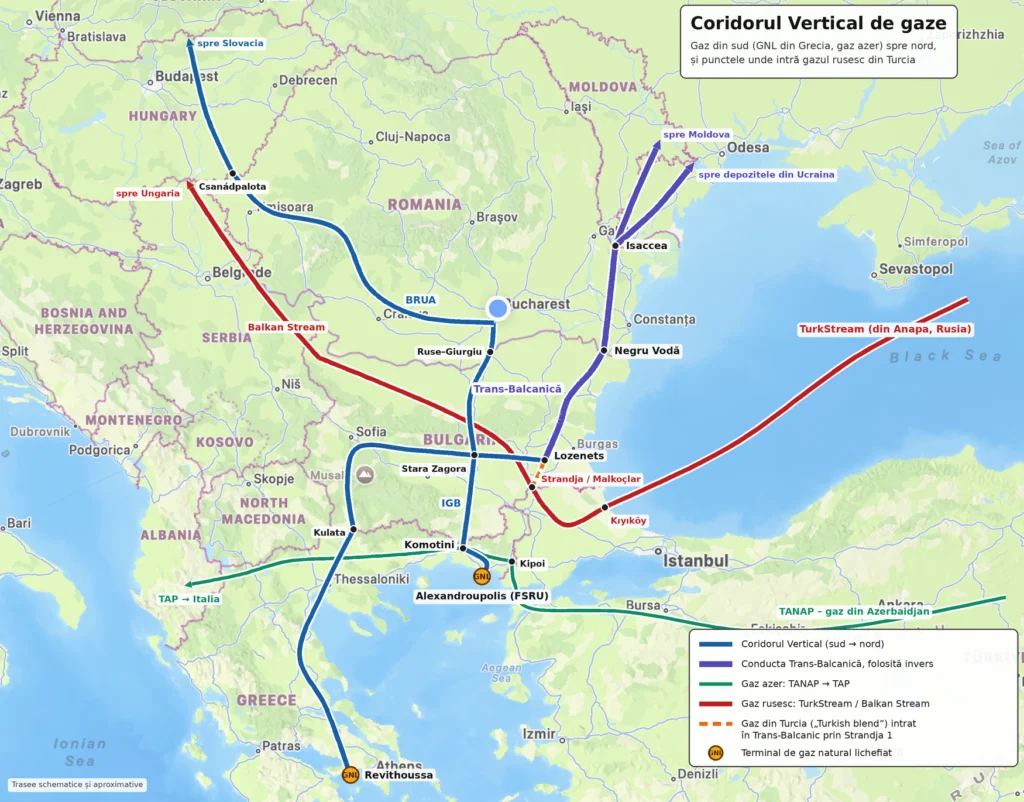
The pipelines pass through Greece, Bulgaria (IGB interconnector and Bulgartransgaz network), Romania (Transgaz), and head towards Hungary and Slovakia, with a route to Moldova and Ukraine also existing.
This transport route is partially supported by the European Commission, which has expressed reluctance in financing it.
Romania would need 1.6 billion euros, the cost of infrastructure works, according to a Transgaz report, but a funding request of approximately 500 million euros was rejected in 2023.
Although the "vertical corridor" was promoted as a solution to increase European countries' independence from Russian gas, many voices believe that it will end up like Nord Stream, with the main gas supplier eventually falling under Russian control.
MAGA - Russia
Kimberly Guilfoyle, the US ambassador to Athens, boasted, according to an article published by the Wall Street Journal, that she brought down the Bolojan Government in Romania precisely because it did not agree to accept expensive liquefied gas procurement contracts from America to the port of Alexandroupolis. The information in the American publication's article was independently confirmed by the Financial Times. Exactly what the Bulgarian expert announced two years ago is happening.
Furthermore, the association between the Trump family and Vladimir Putin is clearly seen in the case of the "vertical corridor," where Russia has access both through the influence Vladimir Putin holds in Greece and the fact that Russian gas reaches Turkish territory, from where it is sold further to Europe as a Turkish product.
In February 2026, the European Commission imposed an important condition for this transport corridor through the "decision on the definitive ban on imports of Russian gas... stating that any quantity of natural gas entering from Turkey into Greece and Bulgaria is considered prima facie of Russian origin. Consequently, the burden of proof that a shipment does not contain Russian gas falls on importers and Turkish authorities, allowing the EU to obtain a legal basis to block flows that are not certified as 'clearly differentiated' from Russian gas," as stated in a report by the World Ports organization.
Podcast Controversies, Episode 3, today at 4:00 PM, on the Spotmedia/YouTube channel

The strange events that have taken place in Romania over the past two years indicate that our country is on the front line of a significant geopolitical confrontation between the European Union and the MAGA-Russia association, a confrontation that has led to the fall of the government and a major political crisis, one that has been ongoing for over 5 months.
In Episode 3 of the "Controversies" podcast, which I host alongside journalist Matei Udrea, titled "The Battle for Romania," and which can be watched starting today at 4:00 PM, we will extensively discuss how our country is influenced by this confrontation and why it cannot cope with it.