
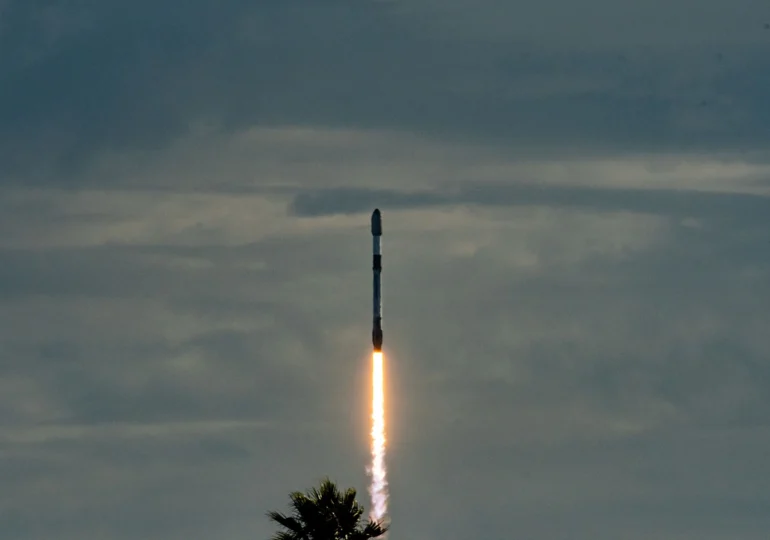
The upper stage of a SpaceX Falcon 9 rocket, launched 19 months ago, has veered off course and is set to collide with Earth’s natural satellite in the next few hours. At the moment of impact, the rocket will be traveling at a speed of approximately 8,700 km/h, which is seven times the speed of sound.
The impact is expected to be equivalent to the explosion of three tons of TNT, explained Bill Gray, an expert in monitoring space objects.
Although NASA spokesperson Jimi Russell stated that the impact "poses no danger to Earth," the entire world will be closely watching the moment of the spacecraft's crash, as reported by Sky News.
When Will the Collision Occur
The exact moment cannot be predicted. The collision is anticipated to take place on Wednesday morning, around 02:35 (Eastern US time).
Although it will be dark, the brightness from the impact will be too faint to observe the actual moment of collision. Nevertheless, the phenomenon may be visible through a telescope for several minutes.
The eastern regions of the US and Canada, as well as a large part of South America, are expected to provide the best viewing conditions.
What Scientists Expect
Nothing catastrophic is expected, as stated by the British television channel. However, researchers claim that the impact will be strong, creating a crater and generating a dust and debris cloud.
NASA's Lunar Reconnaissance Orbiter and South Korea's lunar probe Danuri will capture "before and after" images of the impact site.
Another scientist, Benjamin Fernando from the Los Alamos National Laboratory in New Mexico, confirmed this: "The Moon's gravity is low, and there is no wind to scatter the dust," he stated.
Following the impact, Fernando estimates that a crater with a diameter of nearly 27 meters and a depth of 5 meters will form, dimensions too small to be observed from Earth but visible to spacecraft.
However, both scientists stated that they are not very concerned about the impact itself.
What Are the Concerns, However?
The concerns primarily focus on the amount of space debris in Earth's orbit – where, according to data from the European Space Agency provided in July, there are estimated to be over 100 million small objects.
"One of the reasons for our interest in this event is to determine to what extent impacts with such debris pose a danger to future astronauts," Fernando stated.
"Space up there is becoming more crowded," Gray added.
Occasionally, debris from man-made objects falls from orbit to Earth:
- Last May, a fragment of the Soviet rocket Cosmos 482 – the size of a car – crashed to Earth after spending 53 years in orbit.
- In October last year, a flaming piece of space debris crashed to Earth and was discovered by workers in a mine about 30 km east of Newman, Western Australia.
What Do We Know About the Rocket?
The Falcon 9, built by SpaceX, is a two-stage, partially reusable rocket; the specimen in question was launched last year as part of a joint mission between the US and Japan to deliver two lunar lander modules and scientific equipment to the Moon.
Although the concept involves reusing the rocket and returning it to Earth for future missions, a portion of the Falcon 9 is detached in orbit, where it remains unless it collides with another object.
The element heading towards the Moon is the upper stage of the rocket; it is comparable in size to a five-story building and has a ground weight of at least 4,000 kg.
Has This Happened Before?
SpaceX's Falcon 9 rocket will be the second retired rocket to accidentally crash into the Moon.
The first such incident occurred in 2022 when a segment of a Chinese rocket created two craters on the far side of the Moon. Bill Gray stated that it was likely the third stage of a Chinese rocket that had carried a test sample capsule to the Moon and back in 2014.
Chinese ministry officials claimed that the upper stage reentered Earth's atmosphere and burned up completely.
A study published in 2023 in Planetary Science Journal definitively concluded that the debris originated from the Chinese Long March 3C rocket used in a lunar mission in 2014.