
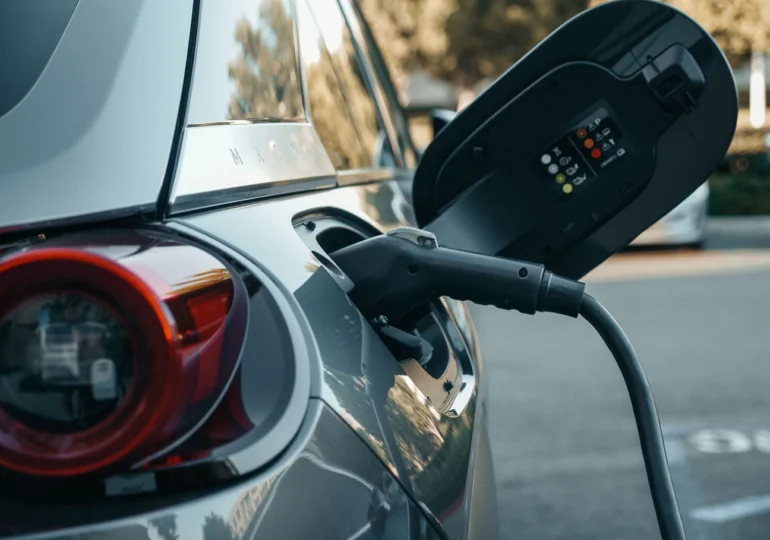
Electric vehicle owners in the UK will pay a mileage-based tax starting in April 2028 to compensate for the decrease in revenue from fuel taxes.
The British government has confirmed the introduction of the Electric Vehicle Excise Duty (eVED), calculated based on the distance traveled.
For fully electric vehicles, this will initially be 3 pence per mile, equivalent to approximately 2.2 euro cents per kilometer. The system will come into effect from April 2028.
Plug-in hybrid vehicles will also be taxed, but at half the rate applied to fully electric cars: 1.5 pence per mile traveled.
The British government justifies the introduction of the tax due to the declining revenues from gasoline and diesel taxes as more drivers opt for electric vehicles. Owners of these vehicles currently do not pay an equivalent usage-based tax, and authorities support the principle that those who drive more should contribute more.
How electric vehicles will be taxed
Drivers will not pay the tax at the time of charging their vehicle. The amount will be determined based on mileage.
Owners will declare the mileage of the vehicle and the estimated number of miles they intend to travel, and subsequently, the amount will be adjusted based on the actual distance traveled.
The system will work alongside the current UK vehicle tax. For an electric car traveling approximately 12,000 kilometers per year, the tax would amount to around 264 euros annually, according to British specialists' estimates.
The tax rate will not remain unchanged. Starting from the fiscal year 2029-2030, the tariff is set to be adjusted annually based on inflation.
France is next
France has not yet decided on a per-kilometer tax for electric vehicles, but the issue faced by the UK will arise in other European countries as well: as the number of electric vehicles increases, state revenues from gasoline and diesel taxation decrease.
Yves Carra, spokesperson for Mobilité Club France, an association representing drivers' interests, believes that a form of taxing electric vehicles will eventually emerge in France. "We are a bit behind, but it will come, either based on mileage or directly through the Linky meter," he said, quoted by Le Figaro, referring to the smart energy meters used in France.
The topic has also entered political debate. Florian Philippot, the president of the French party Les Patriotes, argues that the government is preparing a mileage-based taxation.
Additionally, the president of the French party Debout la France, Nicolas Dupont-Aignan, a former presidential candidate, criticized the perspective of taxing electric vehicles. "They sold them to us as ecological, virtuous, and, above all, economical, and now they want to tax them to fill the state's pockets," he stated.
As of now, France has not announced any official projects in this regard. However, the issue of budget revenues will become increasingly important as vehicles with internal combustion engines represent a smaller part of the car fleet, and taxes on petroleum products bring in less money for the state.
Where else this system is applied
The UK is not the first country to resort to taxing electric vehicles based on distance traveled. Such systems already exist in New Zealand and Iceland, as well as in some American states, including Oregon, Utah, and Hawaii.
Switzerland may also move in this direction. Swiss authorities are considering the possibility of introducing a similar system starting from 2030.
The expansion of electric vehicles thus puts governments in front of the same problem: how to replace the revenues obtained for decades from gasoline and diesel taxation in a car fleet where more and more vehicles no longer use fossil fuels.