
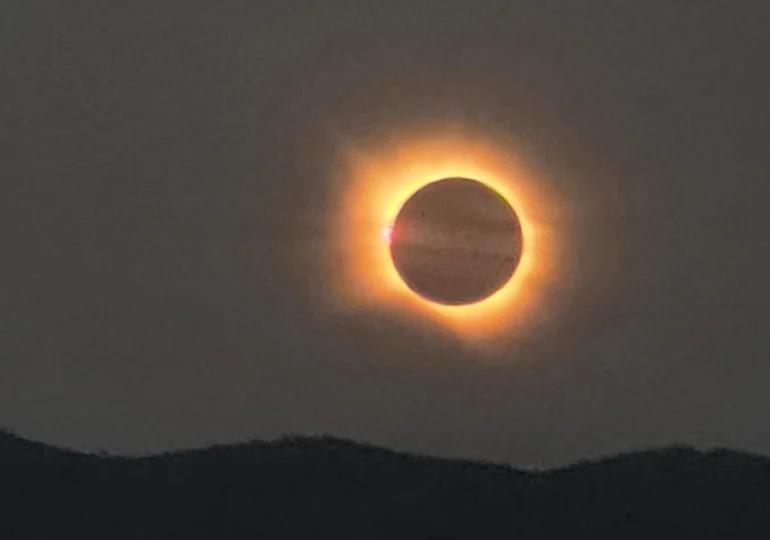
A total solar eclipse crossed Greenland, Iceland, and northern Spain on Wednesday, with partial phases visible across much of Europe. In Romania, the phenomenon was only partially visible for a short time, mainly in the western and northwestern parts of the country.
The solar eclipse began to be visible in Canada, Greenland, and Iceland, but the phenomenon could only be observed partially in certain regions of these countries, as reported by BBC.
In Iceland, despite the cloudy sky, thousands of curious onlookers plunged into total darkness when the Sun was completely covered by the Moon at 17:47 GMT – a phenomenon they could not admire due to the thick clouds.
Images from the UK:
And this is how the eclipse was seen from a plane:
And from the International Space Station:
The partial eclipse began shortly after 17:30 GMT in several regions of northern Spain, according to AFP journalists: in Burgos (north), Tarragona (northeast), and Colmenar Viejo, near Madrid, in central Spain.
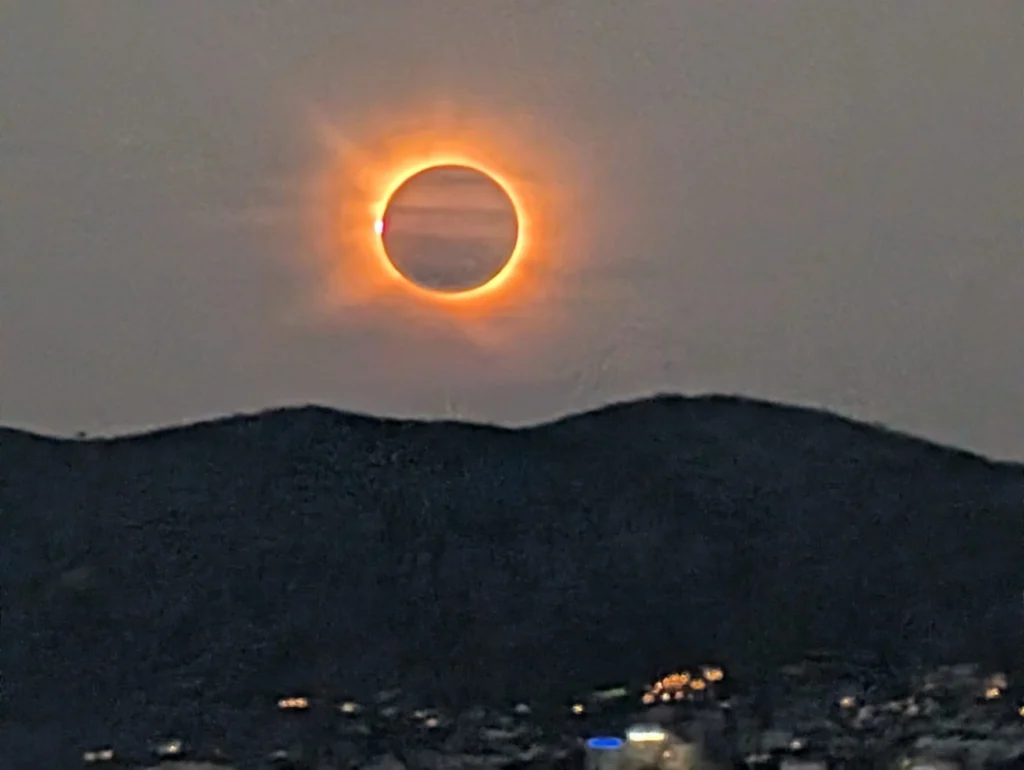
We also have images transmitted from Mallorca by the correspondent Spotmedia:
How the eclipse was seen in Romania
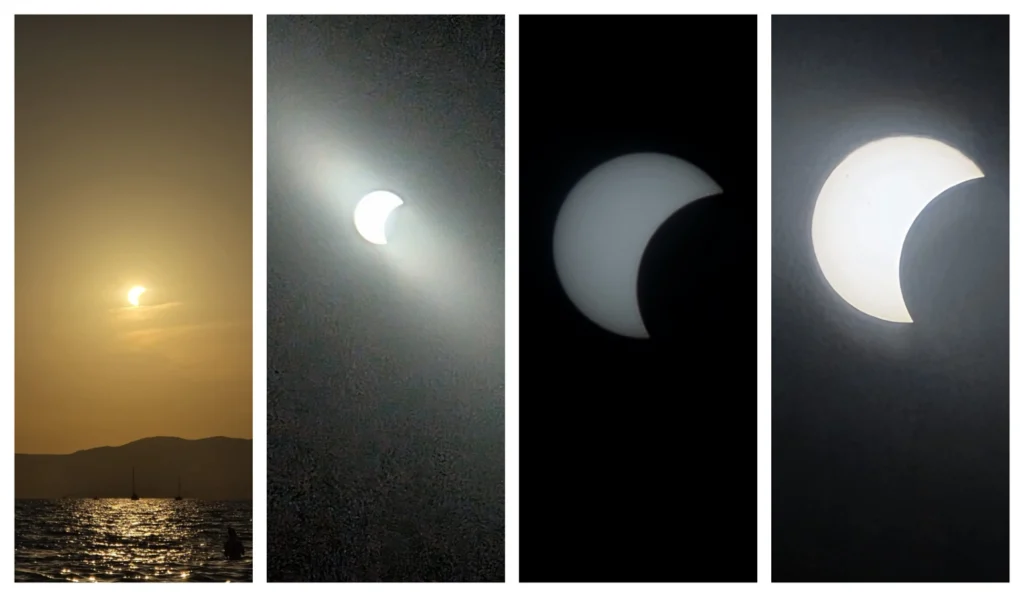
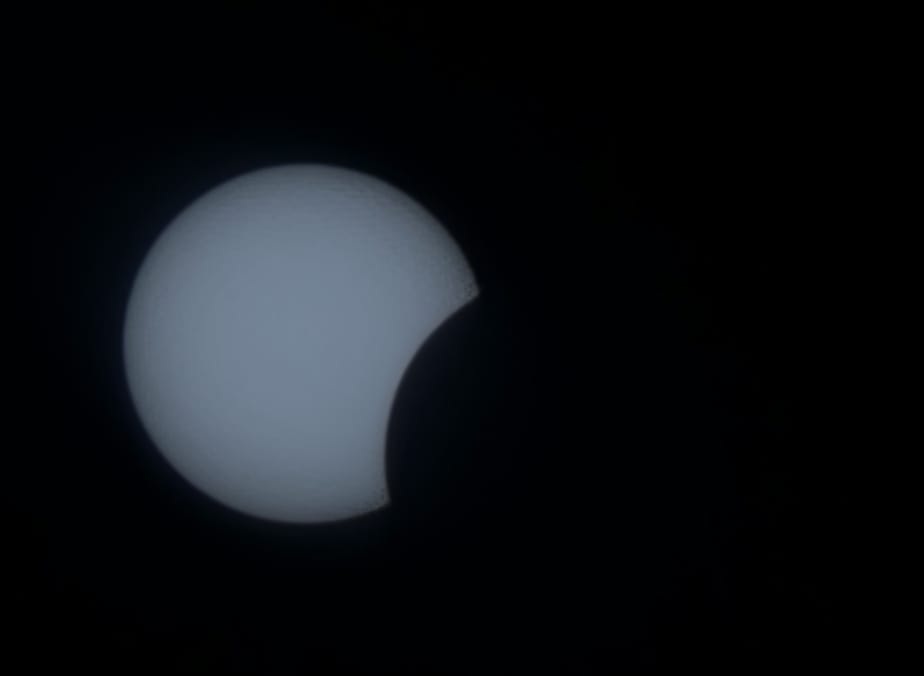
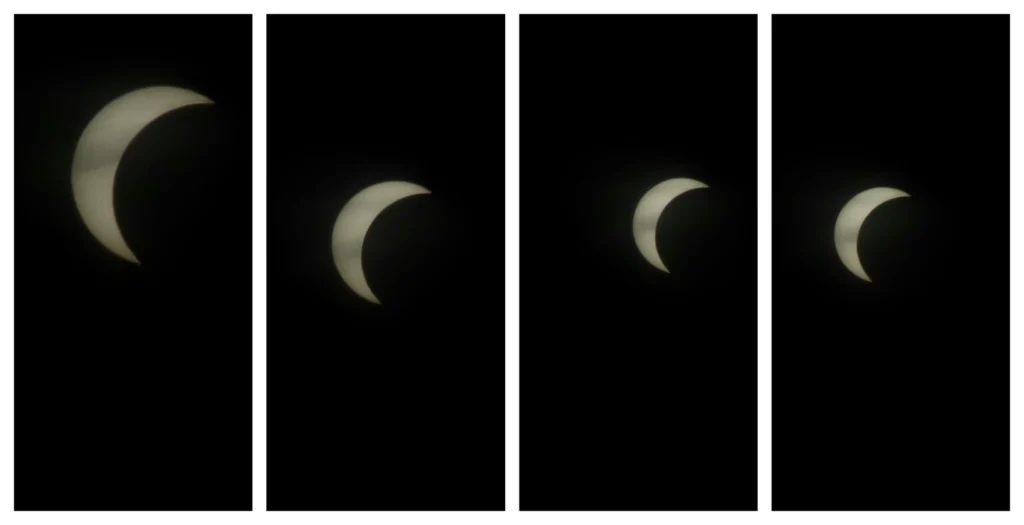
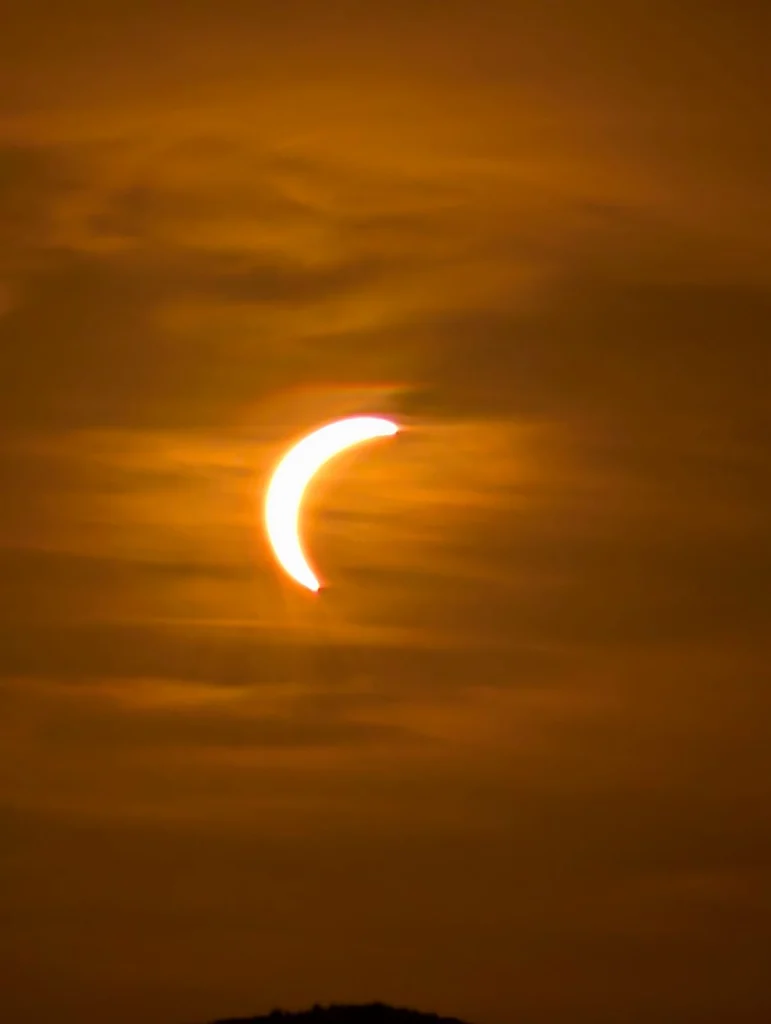
In Romania, the eclipse began around 20:20, very close to sunset. The Moon covered approximately one-third of the Sun’s disk, and the phenomenon ended with its disappearance below the horizon. The eclipse was not visible from Bucharest and the southeastern part of the country.
Around 200 people gathered this evening in Lucareț, Brestovăț commune, to watch the eclipse, as announced by the local publication Ediția de Timiș.
Splendid images also from Masivul Vlădeasa, Cluj County:
Where it was best seen in Romania
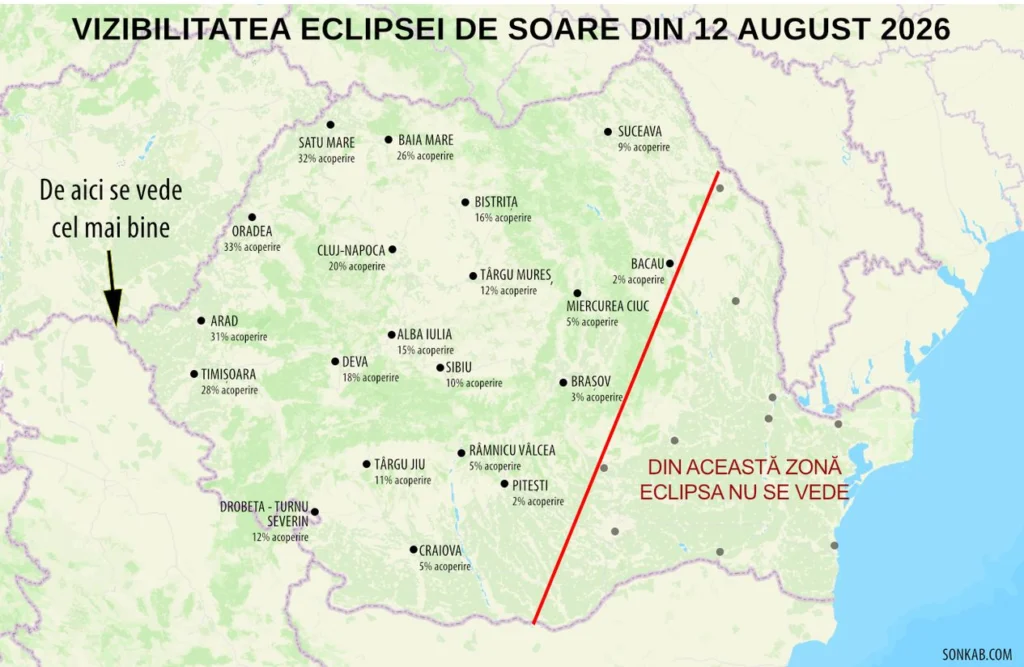
The largest coverage occurred in the westernmost part of the country. Beba Veche, in Timiș County, was the best geographically positioned locality, according to the map published by the "Amiral Vasile Urseanu" Astronomical Observatory.
Among the cities for which the Observatory published exact calculations, the best visibility was in Carei, Oradea, Salonta, Satu Mare, Arad, and Timișoara.
| Locality | Start | Maximum | Sunset | Sun covered |
|---|---|---|---|---|
| Carei | 20:21 | 20:45 | 20:48 | 34.2% |
| Salonta | 20:23 | 20:46 | 20:49 | 33.3% |
| Oradea | 20:22 | 20:45 | 20:48 | 33.2% |
| Satu Mare | 20:21 | 20:43 | 20:47 | 32.1% |
| Arad | 20:24 | 20:46 | 20:49 | 31.1% |
| Timișoara | 20:24 | 20:45 | 20:48 | 28.5% |
| Baia Mare | 20:21 | 20:40 | 20:43 | 25.9% |
| Sighetu Marmației | 20:20 | 20:39 | 20:43 | 25.4% |
| Lugoj | 20:24 | 20:42 | 20:45 | 23.2% |
| Cluj-Napoca | 20:22 | 20:38 | 20:41 | 19.4% |
| Deva | 20:24 | 20:38 | 20:42 | 17.9% |
| Alba Iulia | 20:23 | 20:36 | 20:39 | 14.7% |
| Sibiu | 20:23 | 20:33 | 20:37 | 10% |
In northern Moldova, the phenomenon was much more discreet: the Sun was covered by 9.3% in Suceava, 7.6% in Botoșani, and 4.9% in Pașcani. In Brașov, the coverage was only 2.7%, and in Craiova, 4.5%.
The complete list of localities and the calculated times for each are published by the "Amiral Vasile Urseanu" Astronomical Observatory.
Why did it last so shortly in Romania
The eclipse did not end at sunset in Romania. However, the Sun set below the horizon before the Moon completed its crossing of the solar disk.
For this reason, the maximum observable phase occurred only three to four minutes before sunset. In Carei, where conditions were the best among the analyzed cities, the phenomenon could be observed for approximately 26 minutes. In the central and eastern parts of the country, the observation window was only a few minutes.
It was not a total eclipse in Romania
One of the confusions in the reports about the phenomenon is the phrasing that "the total eclipse will be visible from Romania." Astronomically, the eclipse is classified as total, but totality can only be seen from within a narrow strip crossing the planet.
Romania was outside this strip. From here, only a partial eclipse could be observed, and in Bucharest and the southeast, not even the partial phase began before sunset.
In western Romania, it does not darken like night, and the solar corona does not become visible. With a coverage of approximately 30%, daylight can slightly change, but the effect is much less spectacular than in a totality zone.
Where the total eclipse was seen
The Moon's shadow crossed northern Russia, Greenland, Iceland, the Atlantic, northern Spain, and a small area in northwestern Portugal, according to NASA.
Within the totality strip, the Moon completely covered the Sun for at most about two minutes and 18 seconds. In most locations, the total phase lasted less than two minutes.
Among the cities along the route were Reykjavík, León, Zaragoza, Bilbao, Valencia, and Palma de Mallorca. Madrid and Barcelona were outside the strip and "hosted" a very deep partial eclipse.
In Reykjavík, totality began at 17:48 local time and lasted about a minute. In León, Spain, it started around 20:28 and lasted almost two minutes. In Valencia, the Sun was completely covered around 20:32, shortly before sunset.
It was the first total eclipse to cross the continental territory of the European Union since the one on August 11, 1999. Spain has not had a comparable total eclipse since 1905.
The next total solar eclipse will take place next year, on August 2, 2027, according to NASA. It will be visible in southern Spain, North Africa, Saudi Arabia, and Yemen, as reported by CNN.
Closed Roads and Very High Prices in Spain
The eclipse generated a wave of astronomical tourism in a period when Spain is already crowded. Demand for some rural accommodations along the route has increased several times, and hotel room prices and airfare have risen sharply.
In Mallorca, authorities prepared restrictions on about 20 roads, especially on routes to Serra de Tramuntana and to viewpoints vulnerable to overcrowding. Access was limited between 15:00 and 21:00, with some roads possibly closing earlier if areas became too crowded.
The Balearic Islands government chose not to promote the eclipse as an additional tourist attraction and set up official observation areas. The main concern was to avoid traffic jams, accidents, and fires in a high-risk period.
The Perseids Come the Same Night
The eclipse coincides with the new moon, and on the night of August 12 to 13, the peak of the Perseid meteor shower also occurs. The absence of moonlight will create very good observation conditions.
After the eclipse, those in a cloudless area can move to a dark place, away from the local lights. The Perseids can be seen with the naked eye, without a telescope or protective glasses. The best conditions will be after midnight and before dawn.
In ideal conditions, dozens of "shooting stars" can be observed per hour. Meteors can appear anywhere in the sky, so there is no need to constantly look towards the Perseus constellation. NASA describes the combination of the eclipse, new moon, and Perseid peak as the main astronomical event of August.