

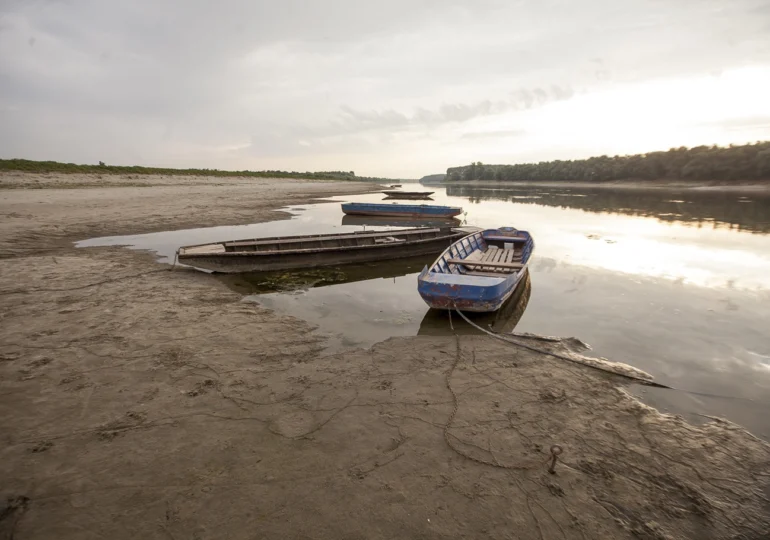
The very low level of the Danube River has forced Romania to shut down its last operational nuclear reactor and has led to the Paks plant in Hungary being close to a complete shutdown. The situation raises an increasingly important issue: how can nuclear power plants that rely on river water for cooling function in the face of increasingly severe droughts.
The problem is not new. Nuclear power plants in Europe have had to reduce their production during summers in other years, especially in France. However, the severe drought and heatwaves this summer have taken the situation to another level.
An analysis published on Thursday by Reuters shows that Romania and Hungary are now facing the same vulnerability. Both countries aim to produce more nuclear energy, but their plants rely on the Danube for cooling.
– Romania has asked the European Commission to postpone the closure of some coal-fired power plants
### Paks has dropped to 10% capacity. Cernavodă has shut down both reactors
The Paks nuclear power plant, which provides roughly half of Hungary’s electricity, was forced at the beginning of the month to reduce its production to just over 10% of capacity.
It was very close to a complete shutdown, a situation the plant had not faced in its 44 years of operation. The Danube level then rose slightly, and Paks is now operating at around 25% capacity.
In Romania, the situation led to both reactors at Cernavodă being shut down on Thursday. Unit 1 had already been shut down at the end of July. Nuclearelectrica also started disconnecting Unit 2 on Thursday, after measures to bring more water to the plant proved insufficient. These two reactors normally account for about 20% of Romania’s electricity production.
Authorities have tried unprecedented solutions in recent weeks. Dredging has been carried out, rocks have been dynamited, and barges loaded with stone have been sunk to direct more water towards Cernavodă.
– How consumers will be affected after the shutdown of the Cernavodă plant
### Central and Eastern Europe will become drier
The issue may arise more frequently. Diana Ürge-Vorsatz, a professor at the Central European University in Vienna, says that scientific models indicate a drying trend in Central and Eastern Europe.
It is not just about the amount of precipitation. Soil moisture and groundwater levels have decreased in recent years, and periods of little rain and heatwaves exacerbate the phenomenon, she explained to Reuters.
Engineers warned at a conference of the Hydrological Society in Hungary last year that Danube flows could have increasingly larger variations and become harder to predict.
For nuclear energy, a paradox arises. Nuclear power plants produce large quantities of electricity without carbon emissions and are seen as an important part of the response to climate change. At the same time, some of them are vulnerable to the effects of climate warming.
– The same extreme drought, different responses. How Hungary and Romania reduce energy consumption
### The solution for Cernavodă, a project worth over a billion lei
There is a long-term solution envisaged for Cernavodă, but the project is not yet complete.
The plant is supplied with water from the Old Danube, and the distribution of the flow is influenced by the Bala branch. In 2024, the Government approved a project worth 1.02 billion lei, approximately 225 million dollars, for hydraulic works in this area.
The project involves interventions on the riverbed threshold of the Bala branch and the modification of the bifurcation area so that a larger amount of water can be directed to the route on which the Cernavodă plant depends.
However, the works are delayed, and the Government has not specified when they could be completed, as noted by Reuters.
The delay becomes even more critical in the context of Romania’s plans to build Units 3 and 4.
– Romania has asked the European Commission to postpone the closure of some coal-fired power plants
### Can four reactors operate with such a low Danube level?
Reuters asked Nuclearelectrica about the Danube’s decrease and its impact on the plant’s expansion plans.
The company says that studies conducted so far indicate that the Bala project would provide the necessary water for all four reactors at Cernavodă to operate at full capacity.
Eugenia Gusilov, director of the Romania Energy Center, also believes the solution is feasible. In her opinion, before starting the works, other cooling methods could be analyzed.
„Building Units 3 and 4 still makes sense if the necessary hydraulic works are carried out,” Gusilov told Reuters.
There are other technical options as well. Nuclear power plants in the Czech Republic and Slovakia use cooling towers that require less water and eliminate some heat through evaporation. Another option being considered by specialists is hybrid cooling, which combines river water with cooling towers.
Adapting existing plants can be very expensive, though. Attila Aszódi, a professor and nuclear energy expert at the Budapest University of Technology and Economics, says that installing cooling towers at the old reactors at Paks would probably not be economically justified for the remaining operating period.
Hungary is already examining the issue for the future Paks 2 plant. The project is being revised precisely because the current version still relies on Danube water for cooling.
Budapest is also looking for immediate solutions. The Hungarian government plans to build a structure similar to a submerged weir on the Danube bed to raise the water level in the plant’s area. Authorities are even considering sinking barges, as the river level is expected to drop again in the coming days.
However, this summer’s experience shows that the problem is no longer just about a few days of low water. Romania and Hungary aim to expand their nuclear production, and severe droughts could become more frequent. This puts pressure on authorities to find solutions for the new reactors to operate even when the Danube reaches very low levels.