

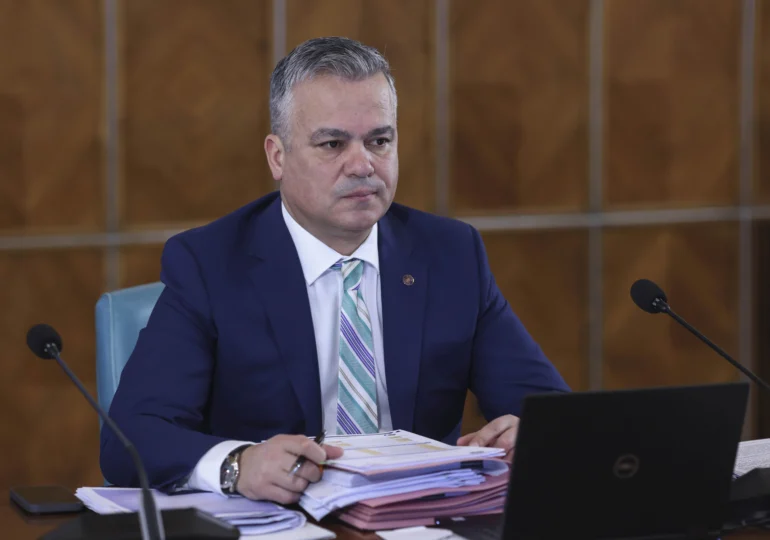
Designated Prime Minister Adrian Veștea submitted the list of the Government and the governance program to Parliament on Sunday evening. On Monday, the joint Bureaus of the Chamber and the Senate will meet to establish the schedule for the ministers’ hearings in committees and when the plenary session will convene to vote on confidence.
„I have submitted to Parliament the Governance Program and the list of Cabinet ministers that I propose for Romania. It is a necessary step to end a period of uncertainty and to bring the country back to a framework of stability, predictability, and normal functioning of institutions.
I trust that Parliament will handle this procedure responsibly and will establish a quick schedule for the ministers' hearings and the vote of confidence. Romania can no longer afford to waste time," wrote Adrian Veștea on Facebook.
The composition of the Cabinet is as follows:
- Adrian Veștea - Prime Minister (PNL)
- Marian Neacșu - Deputy Prime Minister and Minister of Internal Affairs (PSD)
- Alina Gorghiu - Deputy Prime Minister (PNL)
- Diana Morar - Deputy Prime Minister (independent)
- Luca Niculescu - Minister of Foreign Affairs (independent)
- Alexandru Nazare - Minister of Finance (independent)
- Florin Zaharia - Minister of Investments and European Projects (independent)
- Florin Manole - Minister of Labor, Family, Youth, and Solidarity (PSD)
- Monica Anisie - Minister of Education and Research (PNL)
- Marian Bârgău - Minister of Economy, Entrepreneurship, and Tourism (independent)
- Eduard Mititelu - Minister Delegate for Digitalization (PNL)
- Romeo Lungu - Minister of Development, Public Works, and Administration (PSD)
- Ionuț Vulpescu - Minister of Culture (PSD)
- Sorin Cîmpeanu - Minister of National Defense (PNL)
- Radu Marinescu - Minister of Justice (PSD)
- Alexandru Ghigiu - Minister of Environment, Waters, and Forests (PSD)
- Cristian Pistol - Minister of Transport and Infrastructure (PNL)
- Florin Barbu - Minister of Agriculture and Rural Development (PSD)
- Bogdan Ivan - Minister of Energy (PSD)
- Alexandru Rogobete - Minister of Health (PSD)
- Radu Oprea - Secretary General of the Government (PSD)
"The independent members of the Cabinet were included in the government team at my request, during the discussions held with the parties supporting this Government," Veștea said.
The designated Prime Minister also published the proposed governance program.
According to Veștea, the new Government has five immediate priorities:
- Political stability: Returning to institutional normality.
- European funds: Accelerating the attraction of funds from the PNRR.
- Economic stability: Maintaining the trust of partners and the country's rating.
- Investments: Unlocking projects in advanced stages.
- National security: Accelerating strategic projects (SAFE).
What happens after the submission of documents
After submitting the governance program and the list of ministers to Parliament, the Joint Standing Bureaus of the Chamber of Deputies and the Senate will decide on the schedule for the investiture procedure.
According to parliamentary rules, the proposed ministers will be heard in specialized committees, and subsequently, the joint plenary session of Parliament will be convened for the vote of confidence in the Government.
Where will it obtain the necessary 233 votes from?
It is unclear at this moment where the Veștea Government could obtain the 233 votes necessary for investiture.
PSD, which has 128 parliamentarians - 92 deputies and 36 senators - has decided to be part of the Veștea Government. However, it remains to be seen if the PSD vote will be unanimous, as at least six social-democrat parliamentarians have announced that they would not vote for the cabinet proposed by Adrian Veștea.
PNL, which has 76 parliamentarians - 54 deputies and 22 senators - decided at the Congress not to form a coalition with PSD and that voting, supporting, or participating in the construction of a government together with PSD would lead to exclusion. At the same time, it remains to be seen how many liberal parliamentarians will follow the party's official line and how many will align with the Veștea faction, after 23 liberals publicly contested the decisions of the Congress and announced the formation of the "Conservative Faction" within PNL.
USR, which has 59 parliamentarians - 40 deputies and 19 senators - announced that it does not support the Veștea Government.
UDMR, which has 31 parliamentarians - 21 deputies and 10 senators - also stated that it will not vote for the Veștea Government.
AUR, which has 90 parliamentarians - 62 deputies and 28 senators - announced that it does not support the investiture of the Veștea Government and demands early elections. AUR's First Vice President, Dan Dungaciu, stated after the PNL Congress that "the war between the userization of PNL and the nicușorization of PSD is not ours" and that AUR chooses "early elections."
SOS Romania has 15 deputies and stated that it does not support the Veștea Government.
The national minorities have 17 deputies, small parties and newly formed groups - UPR, PACE, Întâi România - have approximately 25 parliamentarians (14 deputies and 11 senators), and the unaffiliated have 24 parliamentarians (16 deputies and 8 senators). In total, 66 votes that the Veștea Government could potentially obtain.
233 votes are required for investiture. Even with full support from PSD, the Veștea Government still needs at least 105 votes. These votes should come from a combination of PNL parliamentarians who would vote against the Congress-established line, minorities, small parties, and unaffiliated members.