
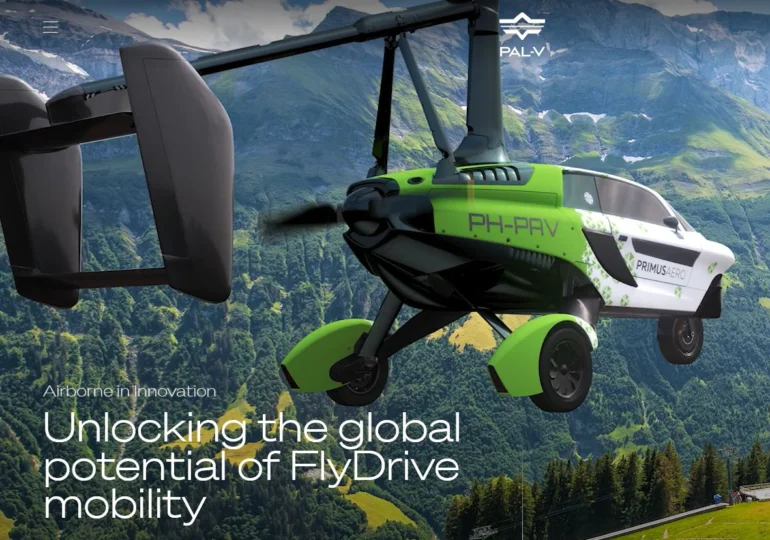
The Dutch company PAL-V has obtained European authorization allowing it to produce on an industrial scale vehicles capable of traveling both on the road and in the air, a first for the so-called „flying cars” sector.
However, the authorization granted based on the standards of the European Union Aviation Safety Agency (EASA) does not yet allow their operation in the air: the company still needs the final certification for the vehicles to be used as aircraft, EFE reports.
To operate these "flying cars," which according to the manufacturer can reach speeds of 160 km/h on the road and 500 km/h in the air, both a driver's license and a pilot's license are required.
PAL-V announced on Monday that it has received a Production Organization Approval (POA), a certification allowing the manufacturing of aeronautical products based on EASA standards. Thanks to this authorization, PAL-V now holds the necessary production approvals in both the automotive and aeronautical sectors to manufacture its vehicles on an industrial scale. These vehicles combine road transport with air transport.
The Netherlands-based company claims to be the first in the FlyDrive segment of the advanced air mobility sector to obtain this European approval, positioning it "ahead of American and Chinese initiatives."
However, this authorization is not the final certification for the flight of PAL-V vehicles, but confirms that the company's production system meets the requirements set for manufacturing "airworthy products."
"This is an important step for PAL-V. It confirms that not only have we developed a revolutionary platform for FlyDrive products, but we have also built a world-class organization capable of developing, certifying, and manufacturing airworthy products," said the company's founder and CEO, Robert Dingemanse.
The company presents its FlyDrive vehicles as an alternative for professionals and organizations that need to travel quickly to hard-to-reach locations, for example, to transport specialists, essential goods, or emergency operations personnel.
According to PAL-V, these vehicles would allow part of the journey to be completed by air, and the rest to be done on the road immediately after landing, without the need to change the mode of transport.
The company claims to have sufficient reserves to cover the first three years of production, although the press release did not specify when they expect to obtain the necessary certification to launch their vehicles on the market.
To achieve this, PAL-V will need to obtain approval for the vehicle itself, demonstrating that the "flying car" is safe enough to be used as an aircraft.