
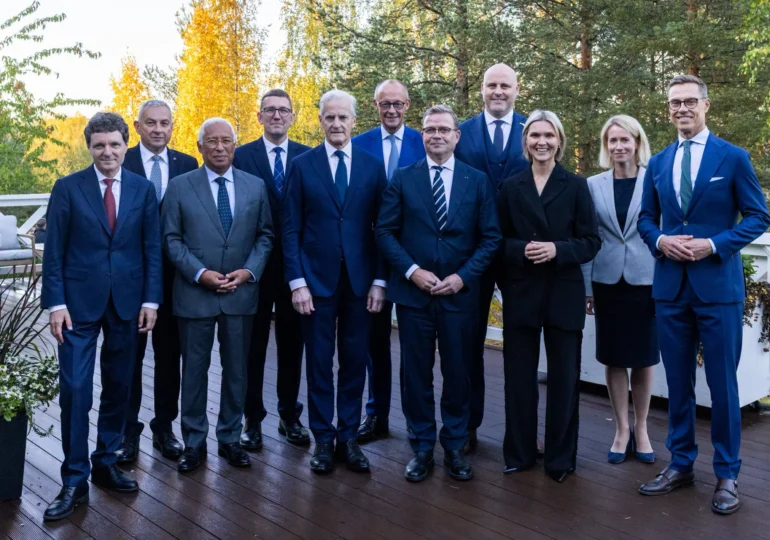
European leaders are gathering on Monday in Rovaniemi, in northern Finland, a place known as the „Santa Claus City,” to discuss the strengthening of the European Union’s presence in the Arctic, a region that has become increasingly important in the geopolitical competition among major powers.
The summit is also attended by Nicușor Dan, alongside German Chancellor Friedrich Merz, Danish Prime Minister Mette Frederiksen, European Council President António Costa, and the EU’s foreign policy chief, Kaja Kallas, as reported by AFP.
The meeting, organized by Finnish Prime Minister Petteri Orpo, aims to strengthen the EU's strategic approach in a region whose geopolitical, economic, and climatic importance is rapidly increasing, according to the announcement by the Finnish government.
For Romania, the discussions are relevant due to the connection between the security of the northern flank of Europe and that of the Black Sea region. Nicușor Dan will present Bucharest's perspective on the security challenges stretching from the Arctic to the Black Sea at the summit.
Nicușor Dan's Schedule
President Nicușor Dan's Monday schedule includes visiting the Lapland Air Wing military base and the "Arctic Opposites" exhibition, according to the Presidential Administration.
The head of state will then participate in a working session on current developments, security, and the future of the Arctic, as well as in a working lunch dedicated to the role and actions of the European Union in the region. At the end of the meeting, Nicușor Dan will hold a press conference alongside other attending leaders.
What AFP Notes About Nicușor Dan
AFP notes that the participation of leaders from states without direct Arctic interests, such as the President of Romania, Nicușor Dan, or the French Foreign Minister, Jean-Noël Barrot, shows how much interest the entire Union has developed in this region.
"The security context has changed profoundly, and the region now attracts much more interest," explained Tuomas Tikkanen, an advisor to the Finnish prime minister, to AFP.
The summit takes place ahead of the presentation of a new European Commission strategy for the Arctic. Member states can still influence the document that will set the EU's directions in the region for the coming years.
No official decisions are expected in Rovaniemi. However, the leaders will adopt a joint declaration and discuss security, access to natural resources, new maritime routes, and environmental protection.
Russia's Pressure and Trump's Threats
Europe's interest in the far north has increased following repeated threats by American President Donald Trump regarding taking control of Greenland, an autonomous territory of the Kingdom of Denmark.
In February, NATO launched the "Arctic Sentry" mission aimed at coordinating and strengthening allied military presence in the region. The initiative also aims to respond to Russia's military activities and the growing interest shown by China.
In early September, European Commission President Ursula von der Leyen visited Greenland and announced a European investment package of 200 million euros for the period 2026–2027. The funds will be used for projects in areas such as energy, sustainable mining, digital infrastructure, education, and fishing.
Von der Leyen promised at that time that the EU will become "more present and more involved" in Greenland and the entire Arctic region.
Ice Retreats, Competition Grows
The Arctic is warming nearly four times faster than the global average. The retreat of ice has serious effects on ecosystems and local communities but also opens up access to natural resources and new maritime routes.
Russia, China, and the United States have intensified their presence in the region. In August, China and South Korea sent container ships along the Northern Sea Route, which passes through Russian territorial waters, to test its viability.
This route remains navigable for increasingly longer periods as sea ice retreats and could significantly shorten transportation between Asia and Europe. It is precisely this combination of climate change, economic interests, and military rivalry that is turning the Arctic into one of the new strategic areas of the world.