

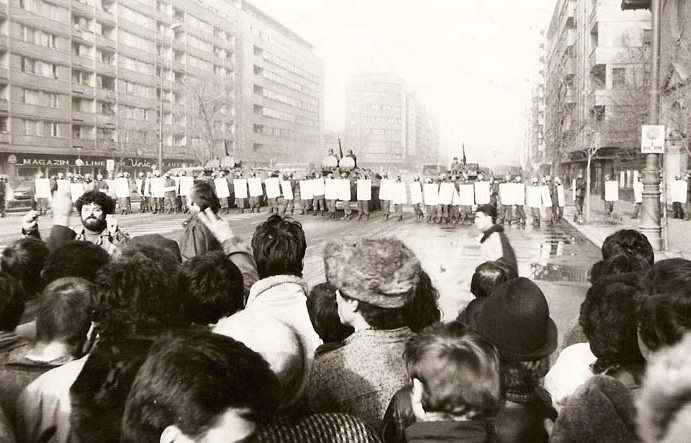
In 1988, there were 14,629 employees working in the State Security Department, according to a report published by CNSAS.
But the repressive system in Romania was much more extensive and complex, consisting of networks of informants, PCR activists, as well as other structures within the Ministry of Defense. Additionally, the Ministry of Internal Affairs, as a whole, was at the disposal of the Security in certain situations.
In December 1989, when the dictatorial regime of Nicolae Ceaușescu collapsed, two major hostile groups were operating within the defense and oppression system in Romania – the kaghebist group, consisting of officers and agents of influence, subordinated to the Kremlin, which had controlled the country in the ’50s and ’60s, the second being that of the “patriotic securitate”, created by Nicolae Ceaușescu after the Prague Spring of 1968, when he refused to join the USSR in the operation to invade Czechoslovakia.
Nicolae Ceaușescu knew from that moment that he had ended up on the Kremlin's blacklist and that, at some point, he might have to pay for his disobedience.
Since Ceaușescu could not remove the kaghebists from Romania's force system, he created one to protect himself and to monitor Moscow's people.
The crisis of the communist system, which led to shortages of food, fuel, and electricity, plummeted the popularity of the Romanian dictator, while the leadership of the Soviet Union began to explore solutions to reform the communist bloc.
In 1984, a few months before Mikhail Gorbachev came to power, during Yuri Andropov's term, the first Soviet leader to lay the foundations for the "liberalization of communism," through what later became known as "perestroika" and "glasnost," the first confrontation between the "Romanian kaghebists" and the "nationalist securitate" took place.
The Good Securitate and the Bad Securitate Clash
On October 15, while Nicolae Ceaușescu was on an official visit to West Germany, General Nicolae Militaru, along with retired Generals Ion Ioniță and Ștefan Kostyal, joined by Virgil Măgureanu, Ion Iliescu, and Silviu Brucan, planned a coup to remove Nicolae Ceaușescu, using an "assault detachment" made up of military personnel.
The plan did not materialize because the "nationalist securitate" found out and thwarted it, initiating the interrogation of the coup plotters.
In 1989, after the fall of Nicolae Ceaușescu, the kaghebist group around Ion Iliescu took political power in Romania, which they directly exercised for a decade. It was forcefully reactivated by Vladimir Putin after February 2022, when Russia invaded Ukraine.
The presentation above is simplified to describe and understand the factions confronting each other within the Romanian state.
Over time, some actors have died, others have withdrawn, and others have switched sides, but the confrontation is more alive today than ever.
The significant dissatisfaction in the public opinion, generated by this type of "controlled democracy," where the services are involved in everything, is hard to combat.
Within intelligence agencies, the Kremlin's camp has achieved huge successes in the past two years, managing to compromise institutions, key individuals, parties, and even the entire electoral process in 2024.
To have a clearer picture of the seriousness of the situation, the Foreign Intelligence Service has requested the Parliament to expand its powers to conduct investigations on its own employees.
If an agency makes such a request, it means there are reasonable suspicions that its personnel have been exposed to hostile entities and it needs legal leverage to establish an internal protection direction.
"Law 593/2025 does not revive binomials and does not transform the Foreign Intelligence Service into a criminal prosecution body, attention, esteemed colleagues! It does something much more modest and at the same time necessary: it creates within a militarized institution a legal instrument through which military prosecutors can more effectively exercise their competence over criminal acts committed exclusively by SIE personnel, attention!", announced Felix Stroe in the Senate PSD plenary session.
The Burden of Healthy Nationalism
Recently, Nicușor Dan used the term "healthy nationalism" in a speech, causing bewilderment, especially in the context of a severe ideological disorientation caused by the current president among his voters.
But "healthy nationalism" is nothing more than the political expression promoted by the enlightened circles of Ceaușescu's security, who clashed with Iliescu's kaghebists.
This idea of "wise patriotism," generous indeed, runs through all political regimes in Romania that emerged after 1996, the moment when, in the context of the collapse of the Soviet Union, the political and military elite decided to orient towards the West.
However, under the guise of this concept that sounds good, all parties, institutions, agencies, boards of directors, and important private companies have been infiltrated by individuals trained in the military system - see here the explosion of postgraduate courses in national security around the 2000s and after, offered by the National Defense College (Ministry of Defense) and the National Intelligence Academy (SRI).
For example, in 2005, Elena Udrea attended postgraduate courses at the National Defense College. Alongside her, a plethora of politicians, public servants, and opportunists seeking leadership positions became reliable figures of "wise patriotism."
"The National Security Strategy affirms the quality of NATO member, future member of the European Union, and strategic partner of the USA and proposes both proactive strategic action directions, in line with our country's new international status, and measures to strengthen national power and development of competitive advantages in the new global context," states the CSAT report for 2006, published a few months before Romania's official accession to the European Union.
Romania as a Target
From the cited document, it is evident that the country's leadership was concerned that, with NATO and EU accession, much of the "national power" would be lost. In other words, the westernization of the country was associated with its weakening.
An extremely prevalent idea today in the minds of many in the political, military, and intelligence systems.
Here originates the institutional indecision, the strategy promoted through all power channels, according to which "one must always play on both sides." In other words, simplifying, if we are partners with the USA, we must also give something to the Russians.
But this deep-rooted fear that Romania weakens through liberalization and westernization was, in fact, the fear of those in power systems that they were losing their influence.
Everyone knows what followed. An unprecedented infiltration and duplication of institutions, parties, NGOs, boards of directors, leading to a situation where intellectual elites, successful personalities in their fields, who had the power to shape political themes and societal trends, were replaced with a simulacrum created in laboratories, which many commentators called "controlled democracy."
This "wise patriotism" suffered a severe blow in 2024, brought down by the successors of Iliescu's kaghebists, Militaru, Măgureanu, energized by Vladimir Putin's resources and influence, who saw Romania as a strategic target whose vulnerability could compromise NATO.
A Vicious Circle
For over a year and a half, we have witnessed a revival of an old confrontation from the '90s that effectively brought down the national security system.
Romania has entered a vicious circle. Such a crisis cannot be resolved by spies, influencers, generals, or reservists but by politicians.
But what do you do when even the parties have been used in this battle and compromised, being led by mediocre leaders, lacking courage, vision, and moral compass?
What do you do when the first thing done by the President of Romania after winning the elections was to alienate his own electorate, and now he is politically isolated, afraid of a possible suspension?
Strengthening the state does not mean more securitate agents but rules, meritocracy, transparency, law enforcement, ethical systems for law enforcement control, promoting, from a young age, moral conduct, as well as a spirit of fair play in society, and last but not least, more democracy and less corruption.