
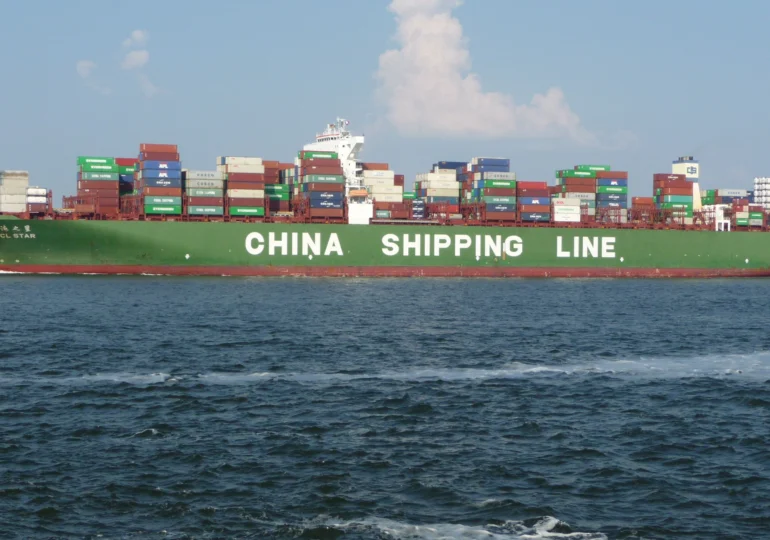
Romania imported goods from China worth 9.1 billion euros in 2025, an increase of +16.2% compared to 2024 when imports from this country amounted to 7.84 billion euros, according to data from the National Institute of Statistics (INS).
At the same time, Romania’s exports to China remained almost unchanged, at 715 million euros compared to 719 million in 2024 (-0.6%).
The result is a bilateral trade deficit of 8.4 billion euros, 1.27 billion higher than in 2024, which continues to place China at the top of Romania’s external trade imbalance structure.
Furthermore, the ratio between imports and exports deteriorated from 10.9:1 in 2024 to 12.7:1 in 2025. In other words, for every euro Romania exports to China, it imports 12.7 euros, a structural imbalance that has been steadily increasing in recent years and shows no signs of reversal.
Overall, Romania’s trade deficit with China represents approximately a quarter of the country’s total goods trade deficit, which slightly contracted in 2025.
**China, the hole in Romania’s economy. Three categories cover more than half of imports**
Electrical equipment (1.87 billion euros), machinery and equipment (1.6 billion euros), and computers and electronic products (1.57 billion euros) totaled 5.04 billion euros in 2025, accounting for 55% of total imports from China.
These three categories reflect the depth of Romania’s industrial dependence on Chinese supply chains, especially in the electrical and electronic equipment industry – sectors where Romania itself is a producer and exporter, but not on the scale or with the technology that China operates.
Ranked 4-10 are products from the metal construction industry (707 million euros), rubber and plastics (383 million), chemicals (375 million), other industrial goods (369 million), vehicles (345 million), textile products (297 million), and metallurgical products (261 million). Vehicle imports – 345 million euros – reflect the Chinese manufacturers’ offensive on the European market for new cars, which is also visible in Romania’s registration data.
**Monthly dynamics: 2025 brought a higher level of imports**
Compared to 2024, monthly imports from China in 2025 jumped to a significantly higher level, especially in the first half of the year. If in January 2024 monthly imports from China were 418 million euros, in January 2025 they reached 747 million euros – an increase of nearly 80% compared to the same month of the previous year.
The monthly deficit with China fluctuated in 2025 between 609 million euros (March) and 770 million (September), with no month below 600 million – compared to 2024, when the monthly minimum was 365 million (January) and the maximum was 796 million (October, the month with the highest level in 2024).
It is worth noting that the Chinese are required to pump exports worldwide to compensate for losses in the American market, where in the entire year of 2025, there was a -29% decrease in goods exports.
As we have shown on several occasions, Chinese exports to European and other continents have surged massively in the past year and a half, with Chinese exporters desperately trying to find new consumer markets after the United States, the largest such consumer market, erected tariff barriers around it.
Analysts have explained over the past year that Beijing cannot slow down exports because weak domestic demand cannot absorb the huge production – a production that depends on export performance.
According to them, when tariffs were imposed, Beijing redirected trade flows and began flooding global markets with discounted goods – the most well-known examples being Temu and Shein platforms.
Left in China’s domestic economy, cheap goods would produce even more deflation, leading not only to lower selling prices but also to the cannibalization of producers, a decrease in domestic production, and unemployment – economic phenomena exported to other states where there is a risk of suffocating local producers.
**What does Romania export to China – The trade relationship with China is the most imbalanced**
Romanian exports to China are dominated by categories such as wood and wood products (118 million euros, 16.6% of total exports), computers and electronic products (115 million, 16%), and electrical equipment (109 million, 15%).
Machinery and equipment (96 million) and metallurgical products (68 million) complete the top five positions, and the export structure reflects Romania’s weak position in terms of trade with China: exporter of natural resources and intermediate products, with a limited presence of high value-added final goods.
Compared to 2024, exports remained practically at the same level, meaning that the deterioration of the bilateral trade balance solely stems from the increase in imports.
Structurally positive, although the impact will not be as significant in compressing the trade deficit, is China’s decision to open Romania’s access to its dairy market, a market worth 70 billion dollars.
**Read the full analysis on [Curs de Guvernare](https://cursdeguvernare.ro/romania-import-china-deficit-comercial-crestere-exporturi-lactate-taxa-temu-shein-25-lei.html) regarding the trade with China – Romania’s most imbalanced trade balance: imports over 12.7 times larger than exports in 2025 – The bilateral trade deficit reached 8.4 billion euros. Why on [Curs de Guvernare](https://cursdeguvernare.ro/)**.