
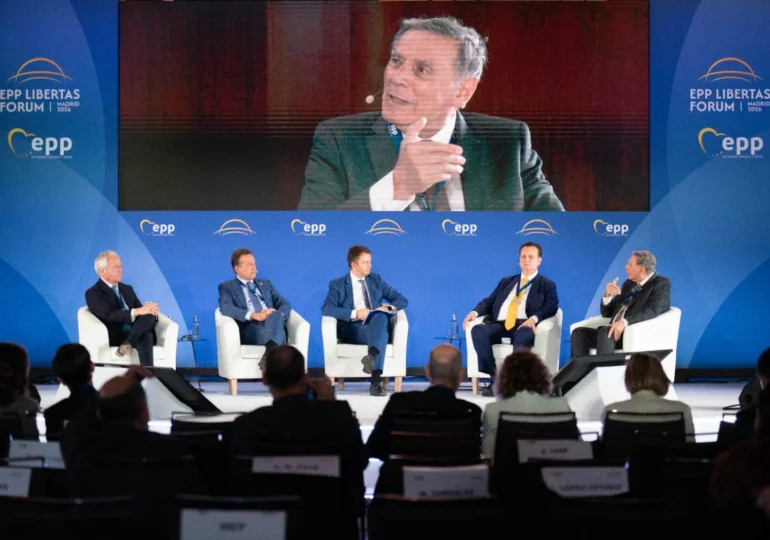
The European People’s Party (EPP) has already begun preparing for the 2029 European Parliament elections. It aims to regain voters attracted to the far right, but its members do not agree on how to do so. One of the questions is whether the EPP should collaborate with these parties. Another is how closely they should align with their positions.
Romanians in the EPP oppose any alignment with the far right, as shown in an analysis by Politico, based on interviews and internal documents. Siegfried Mureșan, the party’s vice president and designated for the position of Prime Minister of Romania, believes that this will be the main political confrontation in the coming years.
"The main polarization on the continent, in many national elections, and certainly in the 2029 European elections, will be between the anti-European populists and the EPP parties," said Mureșan.
A task force for the 2029 elections
EPP President Manfred Weber launched a task force called "Win2029" internally two weeks ago. This will contribute to developing an electoral program attractive enough to compete with the far right.
The preparations are starting unusually early: the European Parliament has not even reached the halfway point of the current term. The group is coordinated by Spanish MEP Esteban González Pons. The first discussions are scheduled for October at a meeting in Sicily and will continue until the next spring's EPP congress in Rome.
For Pedro López de Pablo, the spokesperson for the EPP group, anything other than "fighting" with the far right "will be of secondary importance." "Because they are not in power, they can promise anything. Faced with such rhetoric, we need to think about what alternatives we can offer to people," he said.
Within the party, the question is how far the EPP can go to attract these voters without losing its center-right identity.
"This is the historical dilemma, politically speaking, that the EPP must resolve. We must be clear and honest with the voters: are we a center-right party or are we still a right-wing party?" said Finnish MEP Sirpa Pietikäinen.
Romanians and Poles reject approach to the far right
EPP parties have different political experiences. In some countries, conservatives have governed alongside far-right formations. In others, these are their main opponents, and collaboration is excluded.
According to Politico, Romanians and Poles oppose any alignment with the far right. Conservatives in Spain, Sweden, Finland, Denmark, and the Netherlands have governed with such parties. In Germany, some politicians are beginning to question the refusal to collaborate with the Alternative for Germany (AfD) after the party's electoral successes. Most German members of the EPP in Brussels still oppose collaboration.
"This discussion has always existed within the party: whether we should prioritize policy content or center positioning," said Mika Aaltola, head of the Finnish delegation in the EPP.
Internal documents consulted by Politico show that in the last six months, the EPP has tried to keep its distance from the far right in the European Parliament. MEPs have been repeatedly asked to reject initiatives from the Patriots group but to support similar proposals from the European Conservatives and Reformists (ECR), which the EPP considers an acceptable partner. The ECR includes the party of Italian Prime Minister Giorgia Meloni.
The EPP excluded Slovenian MEP Branko Grims after he participated in an event organized by the AfD. However, in some votes, party members sided with the far right.
An example is a dossier on the EU's long-term budget. A right-wing majority voted to remove environmental criteria and gender equality from expenditure oversight. PPE leaders had promised to vote alongside center parties but failed to convince all MEPs to follow this line.
At the last plenary session, the EPP also discussed how to adopt a resolution on the migration crisis in Ceuta, a Spanish territory, after failed negotiations with the Socialists and Democrats. According to internal notes, the strategy was for the Patriots to feel "included": the EPP was deliberately going to support one of their amendments. The idea came from the Spanish delegation, aiming for a political success in Madrid, and received the support of the group's leadership.
How much does the EPP change on the migration issue
After the 2024 European elections, Weber said he wanted to change the EPP's discourse to regain voters attracted by far-right populists. The proposed direction meant tougher migration policies, more deportations, and the withdrawal of some environmental norms.
Although the EU has introduced faster asylum procedures and border controls, and negotiators have agreed on rules to expedite deportations, the EPP continued to call for tougher measures.
At a meeting in June in Vienna, the party called for more investments in Frontex, the European border agency, and simpler procedures for sending migrants back to the EU's external borders. Delegates also decided to replace the term "irregular migration" with "illegal migration" throughout the text, a formulation more commonly associated with the far right, according to the minutes cited by Politico.
The change raises reservations within the party. At the same meeting, Mairead McGuinness, EPP Vice President and former European Commissioner, warned her colleagues "not to confuse religious faith with political extremism" during a debate on political Islam. She called for "a clear commitment to religious freedom."
German MEP Dennis Radtke says the rise of the far right cannot be explained solely by migration.
"Of course, we must ensure border security, there is no doubt about that. But I doubt that the success of the far right in Europe can be solely linked to the migration issue. The number of asylum seekers is decreasing, but the far right continues to grow because many social problems are not resolved or even addressed," he said.
Disputes about social rights and environmental policies
Tensions within the EPP do not stop at migration. While the leadership emphasizes competitiveness and reducing regulations, some members fear that social rights and workers' rights are being sidelined.
In February, party organizations representing workers, seniors, and women proposed a resolution to strengthen social protection, develop skills, and support youth employment. Delegates from Austria, Finland, Germany, and Sweden opposed. According to internal documents, they argued that the emphasis on social justice sends the wrong signal regarding the EPP's priorities of competitiveness and productivity. The vote was postponed, and the resolution did not appear on the agenda of the next meeting.
"If we are not willing to achieve results regarding workers' rights and social issues, then we cannot claim to be the ultimate popular party in Europe," said Radtke.
Positions on gender equality and reproductive rights also provoke disputes. According to MEP Sirpa Pietikäinen, the EPP has traditionally supported sexual and reproductive rights, allowing national delegations to vote freely on abortion. Now, consensus is increasingly difficult to achieve, and free voting is permitted on several issues, including analyzing how public spending affects women and men.
At the last plenary session, a report on gender inequalities in health sparked a strong dispute within the group. Irish, Polish, and Luxembourgish MEPs called for its support. Spaniards labeled it "absurd," while Croatians described the "gender ideology" in the text as "radical" and "extreme."
There is no agreement on environmental standards either. EPP MEPs have different opinions on how much the rules on phasing out combustion engines and restrictions on industrial emissions should be weakened.
All these disputes will weigh in on shaping the program for 2029. The EPP must decide whether to harden its positions to regain voters from the far right or maintain its center line, risking in both cases to deepen divisions among its national parties.
G.P.