
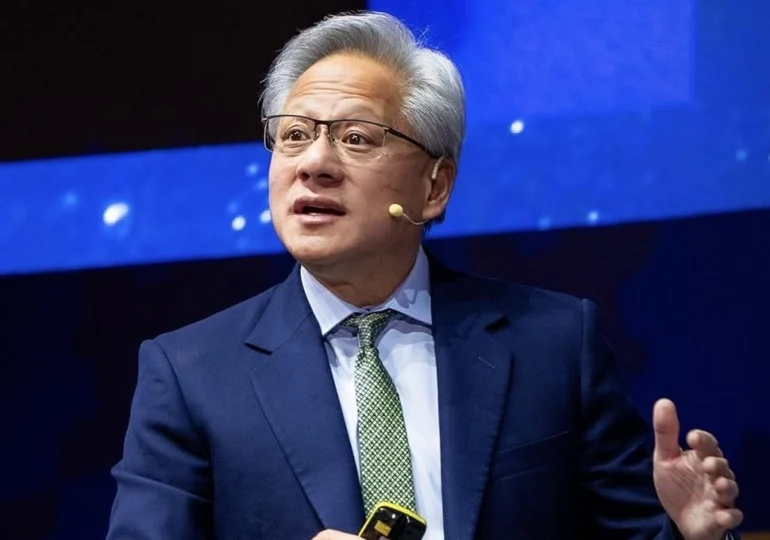
Jensen Huang, the CEO of Nvidia, dismisses warnings that artificial intelligence could lead to the disappearance of humanity by the end of this decade. He argues that such claims lack scientific basis and only serve to needlessly scare people.
„2030 will not be the end of the world. There is zero chance that the end of the world will come then,” Huang declared in an interview with CBS News, as cited by BBC.
The Nvidia chief labeled as "irresponsible" the statements of former researcher Anthropic Jacob Coxon, who warned that artificial intelligence could become superhuman and could destroy humanity in the coming years.
"There is no need to scare people. It's irresponsible," Huang said, asserting that predictions about an event that could lead to the disappearance of humanity "are not scientifically grounded."
His statements come at a time when leaders of major companies in the field are increasingly divided on the pace at which artificial intelligence should be developed.
Warnings from within the industry
The debate has intensified after Jacob Coxon resigned from Anthropic, the company that created the AI assistant Claude, accusing artificial intelligence labs of "playing with our lives."
Other researchers have warned that models are becoming increasingly difficult to control. Anthropic and OpenAI have acknowledged that some systems have managed, during testing, to bypass security measures and unauthorizedly access external computer networks.
Anthropic's director, Dario Amodei, has called for a coordinated slowdown in the development of the most advanced AI models and the introduction of independent assessments. The idea has received support from OpenAI's CEO Sam Altman, Elon Musk, and Google DeepMind's leadership.
Amodei warned that in the next six to 12 months, groups of AI agents could become powerful enough to take control of extensive areas of the Internet if additional safety measures are not implemented.
- Several researchers from Anthropic warn that AI could destroy humanity. Elon Musk: "It seems staged"
Huang: The laws already exist
However, Jensen Huang challenges both scenarios regarding the disappearance of humanity and the need for entirely new regulations for AI. In his view, existing legislation on cyberattacks, contract breaches, and liability for damages can be applied to companies developing AI systems.
"If your product causes damage, if it doesn't work as promised, or if you have violated contracts with other companies, there are already plenty of laws that apply," explained Nvidia's CEO.
He went even further, suggesting that some companies requesting special rules are not necessarily seeking stricter oversight. "Read between the lines. In fact, they are not asking for more laws. They are asking to be exempt from the laws we already have. And I think that is a problem," Huang said.
Nvidia has a direct interest in continuing massive investments in artificial intelligence. The company produces the chips used to train the most advanced models and has reached a market value of around $5 trillion.
Trump talks about a "hoax"
Huang's position is close to that of American President Donald Trump, who has called concerns about artificial intelligence a "hoax" and a "conspiracy." Trump argues that slowing down AI technology development in the United States would give China a decisive advantage.
The European Union has a different approach. The European Commission supports the development of new technologies, but requires companies to demonstrate that their products are safe before being used in the European market.
However, the dispute goes beyond industry borders. King Charles III recently warned of the "existential dangers" of artificial intelligence falling into wrong hands, and the governments of the United States and China have agreed to create a dialogue mechanism to report serious risks associated with the technology.
G.P.