

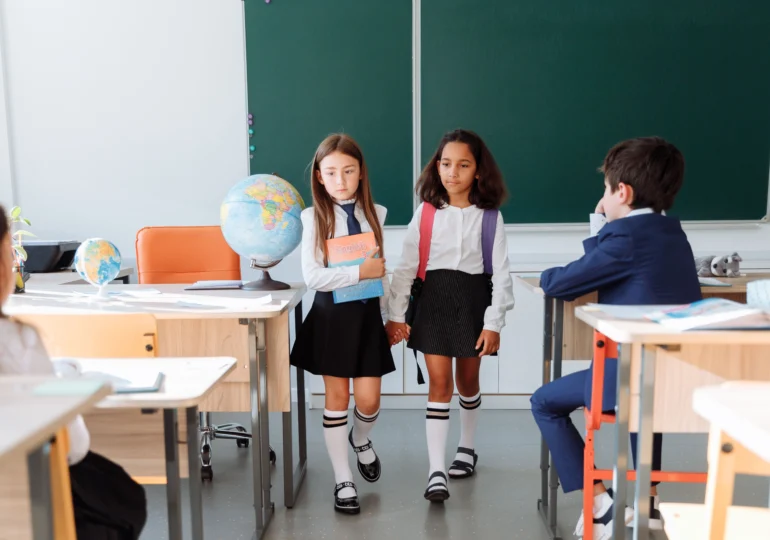
Students are encouraged today to come to school dressed in black. Or at least one of the clothing items they wear should be black. They want to show that they can choose to wear the same color without anyone imposing what to wear on them.
The gesture is a response to the project that would make uniforms mandatory in public schools in Romania. The Senate has adopted it, and the Chamber of Deputies will have the final say. For supporters of the law, uniforms would reduce the differences between children who can afford expensive clothes and those who cannot. Student representatives say that an identical shirt will not make poverty or bullying disappear.
In countries where uniforms are already used, discussions have often revolved around their price, overly strict rules, and how much children are listened to. Studies have also checked whether uniforms improve school attendance or reduce bullying. The results show that simply wearing the same clothes does not guarantee these changes.
What the project in Romania aims to change
The initiative belongs to some PSD parliamentarians and passed the Senate with 84 votes in favor, 18 against, and four abstentions. If it becomes law, students will have to attend school in uniform. There would not be a single model for the whole country: each school would determine what the outfit looks like. The project provides that uniforms could be offered for free or purchased with subsidies, including using funds from local authorities. Families could buy uniforms from wherever they want: the project prohibits a school from imposing a single supplier.
"School should be about what the student can do, about their value in school, not about the material possibilities of the parents," explained PSD Senator Daniel Zamfir, the initiators' argument. In his opinion, children who cannot afford trendy clothes would be less exposed to mockery if everyone wore a uniform. Parliamentarians also cite a safety reason: school staff could more easily distinguish students from strangers. Zamfir says he would like the uniform to represent "pride, belonging, and definitely not constraint."
The obligation is precisely what displeases the protesting students. The National Council of Students states that it opposed the project from the start but was not invited to debates. "We were not invited to debates, we were not consulted, but they expect us to comply," their representatives conveyed. They also challenge the promise that the uniform would eliminate inequalities: "Inequality does not disappear under a vest, bullying does not stop if we wear the same shirt, and belonging is not sewn on a lapel."
Among the arguments of the two sides, there are also very practical questions. How many uniforms should a child have to be able to dress appropriately every day? How much would the school-chosen pieces cost? Would there be enough money for all children who need support? These details matter at least as much as the promise that the uniform will be free or subsidized.
Why uniforms evoke unpleasant memories in Romania
School uniforms did not appear with the communist regime. They can also be found among the objects from the interwar period exhibited by the National Museum of Romanian History. However, the generations that went to school before 1989 experienced it in a system where clothes, identification numbers, and pioneer emblems were part of a much broader set of rules and rituals.
Therefore, for some adults, the uniform reminds them of the strict rules of the school before 1989 and the punishments for those who did not comply. However, not all those who oppose the project think about the communist period. Many students talk about costs, about the freedom to choose, and the fact that they were not consulted. They explain why the phrase "mandatory uniform" can trigger a stronger reaction than "outfit chosen by the school community."
Kelemen Hunor shared just such a memory when he announced that he would ask UDMR deputies to vote against the project: "I also started school wearing a uniform. Then I gave it up, and I was punished for it." He argues that students, parents, and teachers should be able to choose the uniform without an obligation imposed on all schools by law.
In England, the question became: who can afford the uniform?
England has a long tradition of uniforms, but even there, the law does not require all schools to adopt them. Each school sets its own rules, and authorities have been trying for several years to prevent excessive costs. The difference can lie in a seemingly small detail: a simple sweater can be bought from several stores. One with the school logo or a specific design sometimes has to be purchased from specific suppliers.
The data show why it matters. In a survey conducted in 2025 for The Children's Society organization, 38% of interviewed parents said they found it difficult to pay for their child's uniform. The proportion reached 54% among families with the lowest incomes. The study included 3,000 parents from the United Kingdom. It does not show that the uniform is, in itself, a bad idea. It shows how quickly a rule meant to reduce differences can become a burdensome expense for those it aims to help.
And changing the rules affects the budget. In a survey by the British Department of Education, 53% of parents whose children needed fewer personalized school items said the uniform became cheaper. Among parents for whom the number of these items increased, 79% said it became more expensive. That is why limits have been introduced in England for the special items that schools can request.
Children have challenged more than just the price. In Northern Ireland, two 11-year-old students, Rhea and Astrid, convinced their school to allow girls to choose between a skirt and trousers. They then asked for this choice to be available in other schools as well. "It is important to be able to choose, for our privacy and comfort," explained Astrid to the BBC. Their example shows that the dispute is not always about "uniform or no uniform." Sometimes, children simply ask to be listened to when deciding how they will dress every day.
France tried the uniform. Directors and students did not see it the same way.
France chose to test the common attire in about a hundred schools in 2024 and 2025. The goal was to see if students feel closer to school and if the atmosphere among them improves. In the evaluation published by the Ministry of Education, three out of four primary school principals said they noticed a stronger sense of belonging. Regarding academic results and other expected effects, opinions were less enthusiastic.
When researchers went to schools and spoke to students, the picture changed. They found little support from children for the common outfit and observed that not complying with the rule can create new tensions. This does not mean that the experiment failed in all schools. It means that a measure that the leadership sees as a sign of unity can be experienced differently by those who have to adhere to it daily.
Does the uniform improve behavior? What do we know from studies
An American study using data from 6,320 primary school children did not find, overall, better social behavior or attendance in schools that required uniforms. Researchers noted a possible advantage regarding the attendance of children from low-income families. They also warn that students were not randomly assigned to schools with and without uniforms, so they cannot say that the uniform alone made the difference.
The study also does not confirm the idea that the uniform automatically makes children feel more connected to school. Students in schools where it was required reported, on average, a weaker sense of belonging. It is an association, not evidence that the uniform was the cause. However, it is enough to view with caution the promise that identical clothes will create a more united community on their own.
Another study, conducted on 988 adolescents in Chile, compared traditional uniforms with sportswear. Researchers did not find significant differences in grades or cognitive tests. Regarding discrimination, the school's social situation weighed more than the type of uniform. The authors also point out comfort: if clothes hinder children from running and playing, this is a real cost of the rule. However, the study compares two types of uniforms, not schools with and without uniforms.
The uniform can make it easier for some families to choose morning clothes and can be appreciated by students and teachers in certain schools. Available evidence, however, does not show that it alone solves bullying, inequality, or discipline issues. Experiences from other countries shift the discussion to more concrete matters: how much it costs, how comfortable it is, who sets the rule, and whether students were asked before being required to comply.