
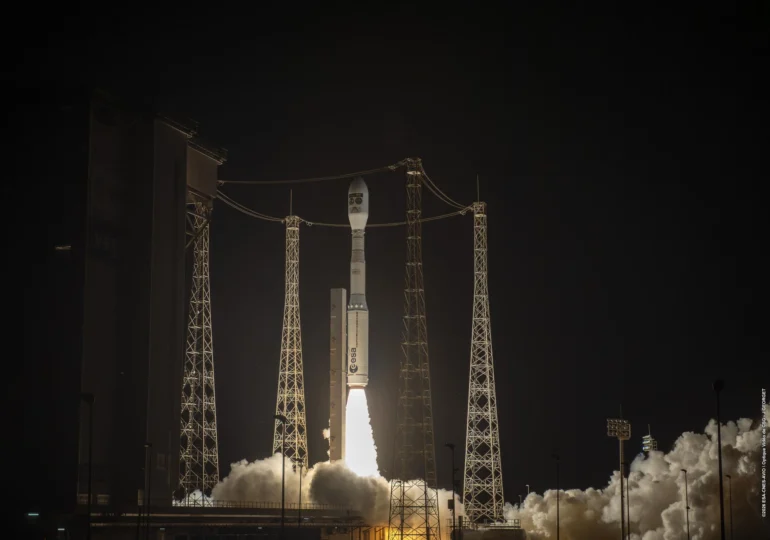
The European Union has successfully launched a new satellite from the Copernicus program, which will monitor the state of the oceans, land, and climate from approximately 800 kilometers above Earth.
Sentinel-3C was launched on Tuesday at 04:21 Romanian time from the European Space Center in Kourou, French Guiana. The satellite was carried by a Vega C rocket and made first contact with Earth at 05:33. The signal received confirmed that it is in good condition, according to the European Commission.
The new satellite will provide information about changes in oceans and polar regions, as well as vegetation fires, drought, and episodes of extreme heat.
What it will monitor from 800 kilometers altitude
From its orbit at approximately 800 kilometers above Earth, Sentinel-3C will measure the temperature and sea level, track ocean currents, and analyze coastal water quality. Its data will also help identify the dangerous proliferation of algae.
On land, the satellite will monitor fires, drought, vegetation status, surface temperature, and heatwaves. Its instruments will also observe changes in ice caps and other transformations related to climate change.
The collected information can be used for weather forecasts, agriculture, water resource management, maritime safety, and climate monitoring. The data can assist authorities in responding to natural disasters and assessing the extent of damages.
A few months of testing before becoming operational
Sentinel-3C will work alongside the other satellites of the Sentinel-3 mission and ensure the continuity of Earth observation data.
In the coming months, its instruments and systems will be tested and calibrated. The satellite will begin providing data after this stage is completed.
Sentinel-3C is owned and operated by the European Commission under Copernicus, the EU Earth observation program. The mission was carried out in collaboration with the European Space Agency, the European organization for meteorological satellites EUMETSAT, and the aerospace company Avio.
The satellite's transmitted data will be available for free to public and private users worldwide.
G.P.