

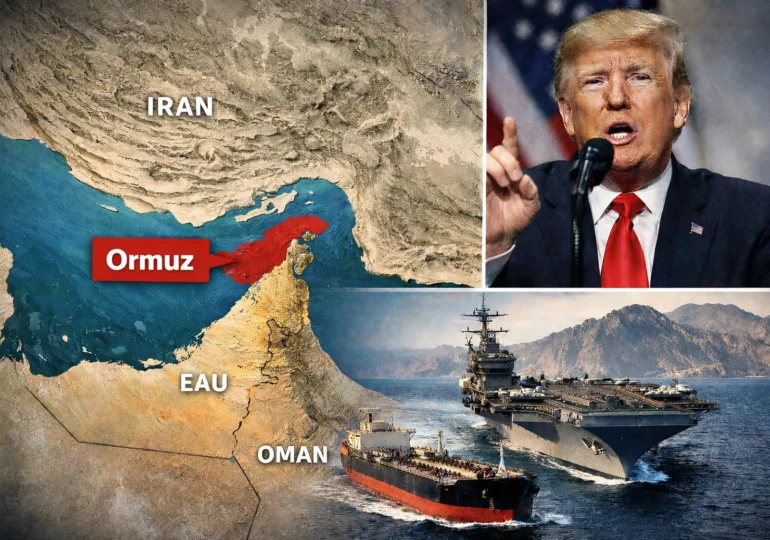
President Donald Trump suggested that the United States could remain in Iran and could „keep the oil,” following the model of the agreement reached with Venezuela.
The White House leader stated that the revenues obtained by the US from Venezuelan oil would have covered the costs of the war „several times.” However, Trump did not provide data to support his claim.
The statements were made on Sunday in Ireland, where the American president attended the Irish Open golf tournament, as reported by Reuters.
"Ultimately, we will withdraw from Iran unless we decide to stay and keep the oil, just like in Venezuela," said Trump.
The American president reiterated his estimate that the war with Iran could end this year, possibly immediately after the midterm elections scheduled for November 3.
Trump claimed that gasoline prices would "fall like a rock" after the conflict ends. He specified that he would only accept "the right deal," one that would be advantageous for the United States. According to the White House leader, Iran constantly requests peace negotiations. Tehran has previously rejected this claim.
What the agreement with Venezuela entails
In August, the Trump administration announced an energy agreement through which the US would have gained majority control over more than 65 billion barrels of proven reserves in Venezuela, approximately one-fifth of the total.
The 25-year agreement aims to develop 17 oil fields with an initial production of over 1.5 million barrels per day. However, Caracas claims that Venezuela retains ownership and sovereignty over natural resources.
Oil surpasses $100
Trump's statements come at a time when the escalation of conflict in the Middle East once again threatens global energy supplies.
Drone attacks have shut down Saudi Arabia's East-West pipeline, the main route through which the world's largest exporter can transport oil to the Red Sea without passing through the Strait of Hormuz.
Saudi Arabia reportedly has sufficient reserves in the Yanbu port to continue exports for only five to seven days. If the damage is not repaired by then, up to 4% of the world's oil supply could be at risk, as reported by Reuters.
Last week, the price of oil exceeded $100 per barrel for the first time since July. In the United States, diesel prices reached a new high of over $6.20 per gallon.
Trump attributed the rise in diesel prices to Ukrainian attacks on Russian refineries and urged President Volodymyr Zelensky to stop them.
Iranian ship hit in the Strait of Hormuz
Also on Sunday, an Iranian commercial ship was hit near Qeshm Island in the Strait of Hormuz. One person died, and four others were injured, according to Associated Press. When asked if the United States had attacked the vessel, Trump replied, "I don't want to say."
Prior to the attack, Iranian President Masoud Pezeshkian rejected the idea of capitulation. "Our people cannot be intimidated to submit. Iran will not surrender," he conveyed.
A meeting scheduled for Monday in Oman, where Iran was to discuss navigation through the Strait of Hormuz with regional states, was postponed. According to Reuters, after the interim agreement reached in June fell apart within weeks, peace negotiations did not take place.