

After four months since the dismissal of the Bolojan Government by a PSD-AUR alliance, the public opinion barometer has reappeared, conducted by INSCOP.
The mere fact that, once again, an independent sociological study has appeared in the public space is a sign that the current political crisis has entered a new stage.
At the beginning of the week, the appointment of Luca Niculescu, a diplomat and coordinator of Romania’s accession dossier to the OECD, for the position of prime minister was tested.
The test did not go well. Although the party leaders did not formally reject him in their discussions, when the negotiations progressed, it all fell apart.
Sorin Grindeanu hopes that under the shadow of a reputable prime minister's name, he can push people controlled by the PSD to impose their agenda - halting the reforms in public administration.
Dominic Fritz and USR have decided not to vote for any government alongside the PSD anymore, and Ilie Bolojan has set an impossible condition for the social democrats to accept - continuing the reforms in public administration.
The deadlock is total, and President Nicușor Dan has long lost the authority to resolve it.
However, according to political sources, the head of state will make a designation. It is not clear whether it will be Luca Niculescu or someone else. Thus, an important step will be taken towards early elections. But that does not mean that they will actually take place.
Suspension, dissolution
There is a high possibility that a number of parliamentarians, scared of the premature end of their mandate, will vote for anything that comes from the Cotroceni Palace.
Only if the prime minister designated by Nicușor Dan does not receive validation from Parliament, can we truly talk about a timeline for the dissolution of the Legislature and the organization of elections.
Here comes into play the survey published by INSCOP, which conveys a message from the president and the power networks around him that early elections should be avoided.
Why is Nicușor Dan afraid to start the procedures for dissolving Parliament? Because he can be suspended.
If the prime minister designated by him does not obtain 233 votes, the majority of deputies and senators, then a political battle will be triggered in which each party will seek to stand out in front of the voters, to achieve a symbolic victory before the election in order to maximize their electoral score.
It is currently difficult to predict what a new attempt by AUR to create an alliance for the suspension of the head of state would mean, what effects it would have.
Therefore, Nicușor Dan hesitates to make a new designation. Therefore, he asks the political parties for a majority before announcing a new name.
AUR has reached its potential
If the INSCOP survey is carefully examined, it is noted that AUR has been stagnant around 40% for some time, while the support of other political parties fluctuates.
Another observation is that PNL has become the second political party in Romania, surpassing PSD both in May and in September. We are talking about figures indicating the number of those who are certain to vote, with a margin of error of +/- 3%, which could mean a difference of up to 6 percentage points between the two parties, in either direction. However, the trend favors the liberals.
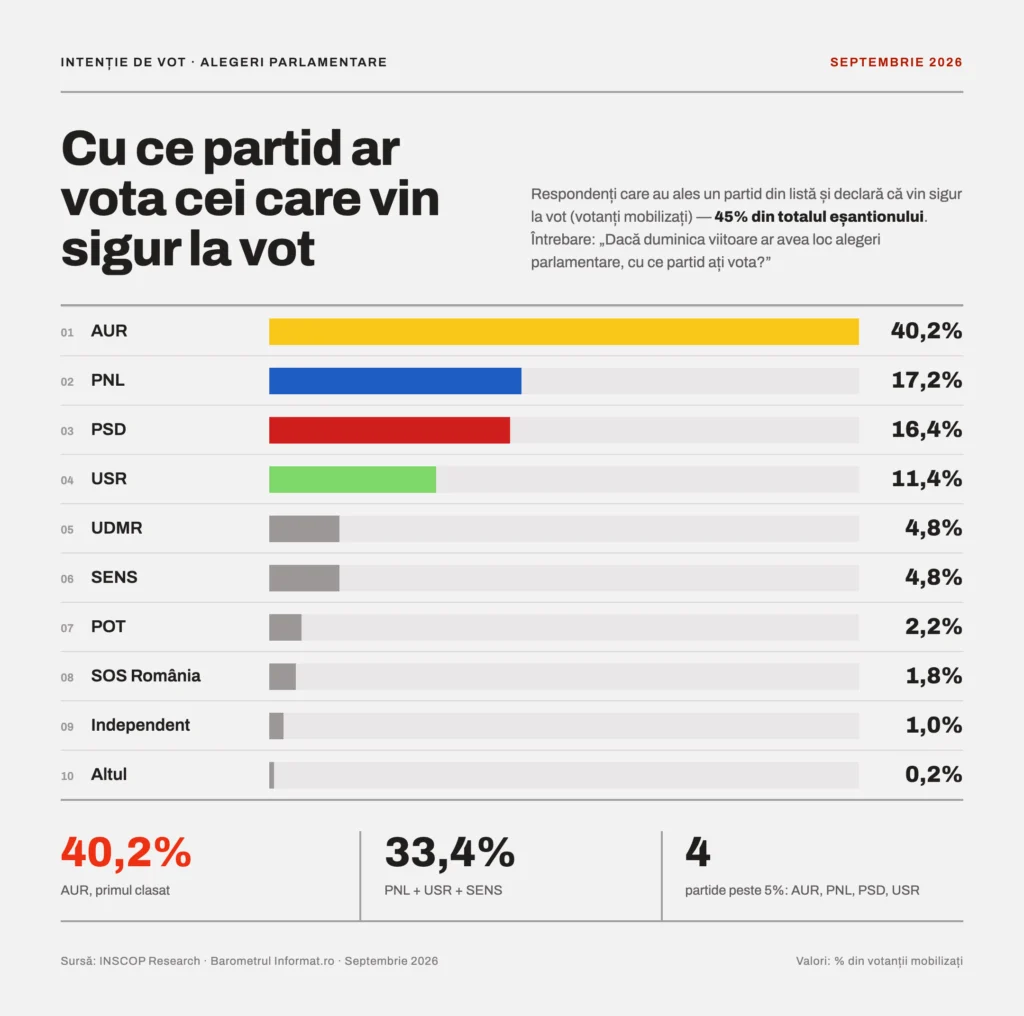
The fact that AUR has been stagnant at 40% since last year shows that it has reached its potential, and in the case of elections, it will be difficult for them to surpass this threshold.
It should also be noted that in the event of heading towards an early parliamentary election, major changes will truly emerge within the political parties and in terms of interaction and forming electoral alliances.
For example, SENS, a progressive party supported mainly by representatives of Generation Z in urban areas, has a chance to enter Parliament. It is close to 5%. Thus, the pro-European zone - PNL, USR, SENS - is heading towards 34%, without UDMR. In this scenario, PSD becomes a "swing party" for the first time in history, which will be a truly significant change in Romanian politics.
PSD with Grindeanu in elections
Although current calculations show that an AUR-PSD alliance has 56%, neither of the respective parties can afford to lose voters to govern.
The only measure that PSD can take to bring new energy to the party and among supporters would be to replace Sorin Grindeanu.
Most likely, in the case of early elections, the internal crisis among the social democrats will explode. And if they decide to go with the current leader in the elections, they will fare worse than they did with Marcel Ciolacu.
"This solution for early elections, although it does not scare us, but we might get there, and I say this more as a warning signal, that if we get there, PSD says like this: we are not afraid, we do not cling to the idea of not doing it, just because we want to be responsible, we warn that things will degenerate a lot and whoever wants to trigger them must understand that Romania will pay some costs as a country, primarily," stated Claudiu Manda, the general secretary of PSD.
The official position above reveals a strong fear among the social democrats regarding elections, indicating the possibility that, despite the scandal so far, PSD parliamentarians may vote for the next presidential designation, whatever it may be.
A series of events
According to the presented data, AUR has the first chance to come to power, but this can only happen if they achieve a score of over 35% in early or regular elections.
AUR is an extremist party, with dual leadership, in Bucharest and Moscow, heavily used by groups connected to budgetary resources, making hundreds of millions of euros on the backs of Romanian taxpayers.
Furthermore, the party is used as a scarecrow, as a threat to the country's future.
For months now, efforts have been made to legitimize it. To move it out of the extremist zone and transform it into a socially acceptable political movement, but all attempts so far have failed because any moderation of the message immediately leads to a loss of support. AUR is forced to remain extremist, reaching its growth limit. From now on, most likely, the ultranationalist bubble will deflate, leading to fragmentation.
Soon, President Nicușor Dan will be pressured by the internal situation to make a new prime minister designation, triggering a series of events and developments impossible to predict and control, which will fundamentally change Romania.
The current power system, built almost 37 years ago on the ruins of the Ceaușescu regime, is nearing its end.