

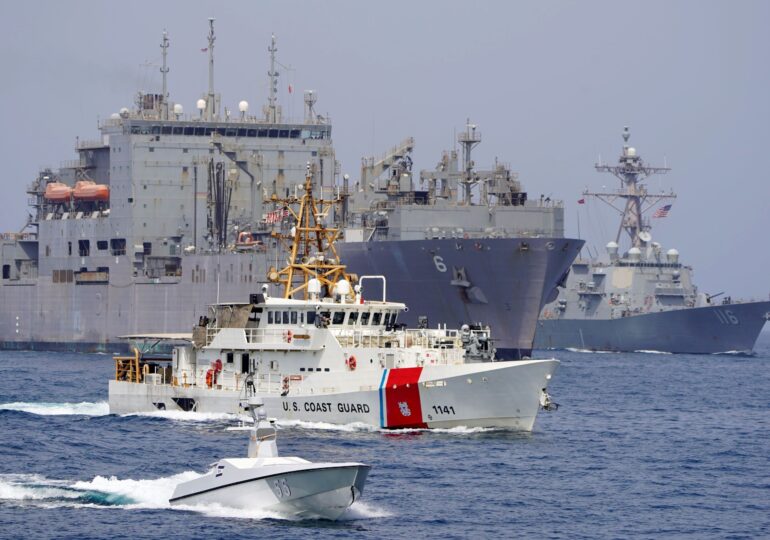
The agreement between the United States and Iran has ended the blockade in the Strait of Hormuz, one of the world’s most important maritime routes. American President Donald Trump enthusiastically announced the resumption of traffic and the return of oil exports.
In practice, however, a return to normalcy is far from occurring. Several days after the announcement of the agreement, traffic through the strait remains extremely limited, with hundreds of ships still waiting on either side of the maritime corridor.
According to an analysis published by Al Jazeera, maritime transport operators and insurance companies prefer to wait until they have guarantees that the agreement between Washington and Tehran, signed on Wednesday evening, is stable and that security risks have been eliminated.
Over 550 ships are still blocked
Before the outbreak of the war between the USA, Israel, and Iran, between 120 and 140 ships crossed the Strait of Hormuz daily. Approximately half of these were oil tankers transporting a total of about 20 million barrels of oil per day.
After the American-Israeli bombardments on Iran began on February 28, Tehran closed the strait, and the USA subsequently imposed a naval blockade on Iranian ports.
Although the preliminary agreement between Washington and Tehran was announced on Sunday, only seven ships have crossed the strait so far, according to MarineTraffic data. Meanwhile, over 550 ships remain blocked awaiting transit permission.
Among the few ships that have passed were tankers loaded with Iranian oil, the first oil exports from Iran in the past two months, according to the TankerTrackers monitoring platform.
Resumption of traffic could take months
Industry experts warn that returning to pre-conflict traffic levels will not be quick.
Svein Ringbakken, director of the Norwegian War Risk Insurance Association, told Al Jazeera that the blockade has affected the entire logistics chain.
"Production lines have been halted for many products due to lack of storage capacity. This is compounded by damage to production facilities and port infrastructure. All of this generates inefficiencies even after the strait's reopening," he explained.
While Trump claims that Hormuz is "completely open," Iranian authorities have stated that ships still need to coordinate their transit with the Islamic Revolutionary Guard Corps and follow the corridor established by Tehran.
Fear of war reigniting
One of the main reasons shipowners are not rushing to return is the lack of confidence that the ceasefire will hold.
In recent weeks, the Persian Gulf has seen intense rocket exchanges and drone attacks. Both the USA and Iran have targeted or opened fire on commercial ships in the area.
Last week, the US military attacked at least three commercial ships, and in one of the incidents, three Indian sailors died.
A day before the agreement was announced, the US Central Command (CENTCOM) stated that the naval blockade had caused 142 commercial ships to change their routes and that nine ships that did not follow instructions were neutralized.
"Shipowners need to see real security and stability over a longer period. A sustained period without incidents is needed before shipowners and insurers consider that the risk has decreased sufficiently," said Haider Anjum, an analyst at Jyske Bank, to Al Jazeera.
According to him, it could take about four months for trust to be restored.
Marine mines, the invisible danger
Another major problem is the risk of marine mines in the strait.
Iran threatened at the beginning of the conflict to mine the route, but never officially confirmed doing so. Instead, the USA repeatedly stated that the danger was real and claimed to have targeted Iranian vessels used to deploy mines during the conflict.
On June 2, US Secretary of State Marco Rubio stated in the Senate that Iran had "mined extensive areas of Hormuz."
For insurance companies, even the possibility of mines is enough to halt transit.
"Even after reopening, the risk level remains high. The main threat comes from mines," said Anjum, estimating that verifying and securing a completely safe corridor could take about two months.
Dispute over transit fees
In addition to security issues, a new dispute is emerging over the fees Iran intends to charge for coordinating transit through the strait.
Tehran insists it will not introduce actual tolls, prohibited by international law, but rather fees for navigation coordination and security services.
However, the United States and Gulf Cooperation Council countries reject this interpretation and argue that such fees would violate the principle of freedom of navigation.
Iranian-American economist Nader Habibi believes that Washington will continue to oppose these measures, but it is unlikely to risk a new military confrontation solely over fees.
Insurance remains at very high levels
Insurance costs represent another major obstacle to resuming maritime transport.
Before the war, war risk insurance premiums were about 0.25% of a ship's value for a single crossing. During the conflict, these rose to 5%.
Currently, costs have decreased but remain several times higher than before the war, ranging between 1% and 3% of the ship's value, according to analysts cited by Al Jazeera.
Oscar Seikaly, director of the American company NSI Insurance Group, stated that rates are recalibrated daily and currently range between 2.5% and 5% of the ship's value. "Rates may start to decrease, but it is unlikely to return to pre-war levels," he said.
An agreement that does not yet mean normalcy
The International Maritime Organization (IMO), the UN agency for maritime transport, welcomed the reopening of the Strait of Hormuz and described it as an important step for navigational safety.
However, organization officials warn that implementing the agreement will take time and additional security guarantees are needed.
The conclusion of experts cited by Al Jazeera is that the risk has not disappeared, but has only changed. If previously the main concern was the complete closure of the strait, now shipowners must navigate a much more complicated landscape: possible marine mines, the risk of military confrontations resuming, and high insurance costs.
As analyst Haider Anjum summarizes, there are now "mines underwater, rockets above, and insurance constraints in the Strait of Hormuz."