

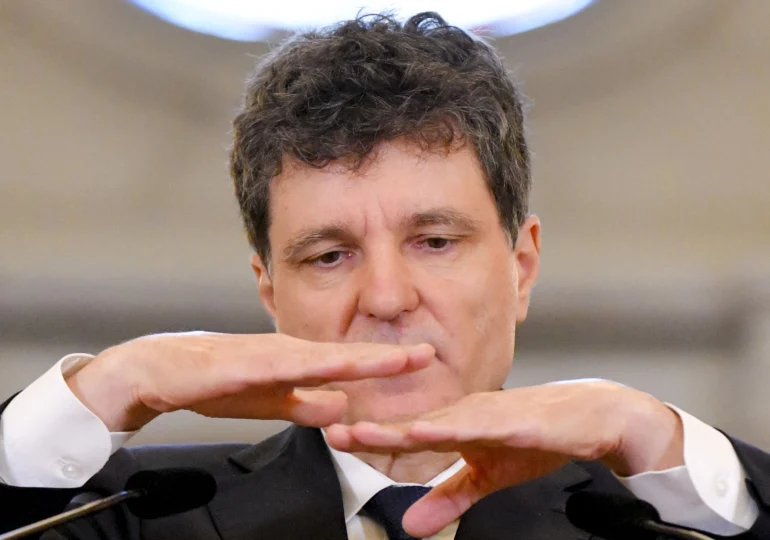
In the heated public debate in Romania, there are two schools of thought, one arguing that Nicușor Dan, assisted by an institutional group, is developing a complicated gambit to deparasitize and relaunch the political system in Romania.
A second school of thought argues that the President of Romania has been taken hostage by the power system, which has perpetuated itself for over three decades and controls the entire country, conditionally helping him not to lose his mandate.
It should be noted that, at this moment, there is not enough factual information to confirm either of these two theories.
These theories have arisen due to a lack of institutional communication, fierce battles between parties, and a deep political crisis that has been affecting Romania since 2024, following the annulment of the presidential elections.
What is certain is that around 70% of the population is dissatisfied with the current political life in Romania, lacking trust in institutions, in Parliament, in the President, in parties, thus endangering Romania's democratic and Euro-Atlantic path.
Early elections, hard to avoid
We are also witnessing a collapse of the PSD, which, after 34 years, has failed to bring a candidate to the presidential final, received a low score in the parliamentary elections, and lost ground in the local administration of medium and large cities.
All these failures indicate that the party no longer has enough electorate to support the network of influence spread throughout the entire power architecture of the state.
The crisis of confidence in democracy, combined with the collapse of the largest party formed after the 1989 Revolution, in the context of a border war, as well as major transformations in international relations, have created an explosive cocktail that, if not detonated in a controlled manner, could lead to a social collapse that would once again lead to Romania's isolation, as happened in the 1990s.
They are trying to melonize AUR. What does that mean? Washing AUR, making it compatible with governance. That's what we see...
Kelemen Hunor, UDMR President
Controlled detonation means, nothing more, nothing less, than reforming the entire political class and connecting it to a reality shaped by technology, more transparent and responsible.
This cannot be done without elections, without calling citizens to the polls to decide the future of Romania.
Regardless of which school of thought is leading the hostilities, early parliamentary elections are hardly avoidable in the coming months.
The Alliance against Voters
All the turmoil now is related to forming a new political offer for citizens. After the collapse of the PSD-PNL alliance, which led to the rise of extremist threats and the vulnerability of Romania, which lost the hybrid war with Russia, a functional solution must be found, in line with public expectations.
In 2020, citizens called to vote, who stamped the PNL logo, did so because, during the campaign, the party leaders promised that the liberals would fight against the PSD and limit the influence of this party in society.
After just one year, Klaus Iohannis forms USL 2, without considering the vote and expectations of the people.
The PSD-PNL alliance ensured the tranquility of its creator, guaranteed access to resources for the mayors of the two formations and local barons, while the voters' feeling of being deceived intensified, fueling all extremist and populist political movements.
PNL and USR, the President's Only Anchors
Nicușor Dan, over the past few years, did not give the impression of an irrational political leader, hungry for positions, or one who lets himself be dominated by instincts. But power can change people.
There have been no corruption accusations against him, and in the electoral campaign, his message was one that did not have fissures related to Romania's Euro-Atlantic path, but also not related to economic issues and national security, domains affected by the war in Ukraine.
I can guarantee one thing, because I keep hearing these rumors that some votes from USR will fly directly into Mr. Veștea's bag. I inform Mr. Veștea that this is as ridiculous as the news that Mr. Veștea will pass with unanimous support in the National Bureau of the PNL... So, the statements are extremely ridiculous. The reality will be that we will all vote against...
Diana Buzoianu, USR deputy, Minister of Environment
For many of his voters, it is difficult to accept such a rapid and radical change in attitude. People look at his recent decisions and, rightfully so, do not understand anything. The governmental crisis has extended to the Cotroceni Palace. There is a possibility that, following the loss of support from USR and PNL, which emerged after PSD broke the governing coalition, Nicușor Dan may no longer have the necessary political resources to retain his position.
In the event of the president's resignation or a suspension validated by referendum, the future candidate from the liberal, pro-Western area, most likely Ilie Bolojan, must develop a political project to impose and organize early elections. The strategy devised by Iohannis in 2020, which he abandoned due to the pandemic, could serve as a model.
PSD, Closer to AUR
People cannot be called to vote again for the presidential election, while a fragmented parliament, elected in the strange context of 2024, holds an entire nation hostage.
If Adrian Veștea goes to Parliament without transparent support, playing the lottery, a potential rejection of him will mean the first step towards early parliamentary elections.
This is the main reason why Sorin Grindeanu is working hard to find political support for a Veștea Government. He knows very well that once the wheel starts turning, it is hard to stop.
Moreover, in the event that the Veștea Government does not pass the Parliament vote, to postpone the procedure for early elections, PSD, together with AUR, could trigger the procedures for the president's suspension. It should not surprise anyone if a competition arises between suspension and early elections. It must be noted here that the procedure for the president's suspension is faster in the presence of a parliamentary majority.
Isolation at the Palace
One of the most serious accusations leveled against the president by a large part of those who voted for him is opacity. He promised transparency but has hidden behind the massive doors of the Cotroceni Palace, avoiding any communication with the people. This attitude is toxic. It generates conspiracy theories, alternative discourses, and social insecurity. Due to secrecy, lack of courage to face criticism, and respond to questions, a space is left open for populism and extremism.
Since the political crisis began, the president has not held any press conferences, has not communicated anything about negotiations with parties, about how he intends to get the country out of the impasse, and about the reasons why he is not succeeding.
The crisis affects all citizens of Romania, but they are kept in the dark by the president elected by over 6 million people, while political support has disappeared.