

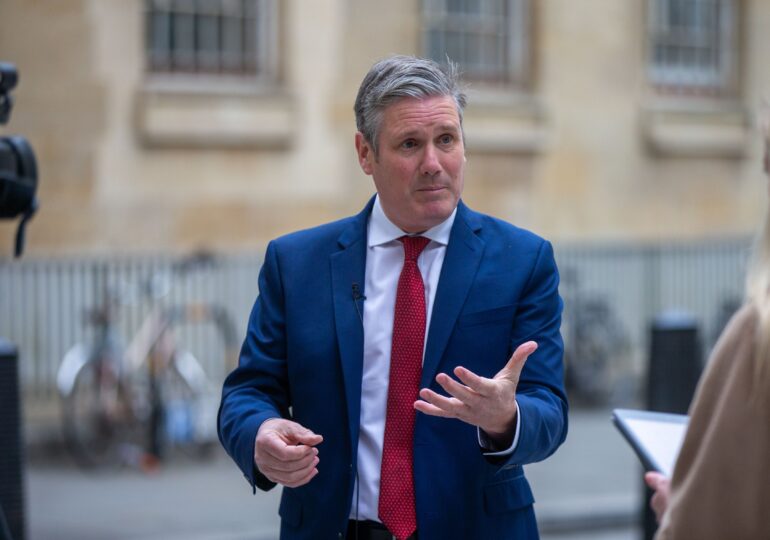
The Prime Minister of the United Kingdom, Keir Starmer, confirmed on Monday morning that he is resigning.
He stated that he has already spoken with the king and paved the way for his successor – most likely his internal rival from the Labour Party, Andy Burnham.
Thus, the United Kingdom reaches its sixth prime minister changed in the last ten years.
Starmer stated that he accepts "with dignity" the decision that he is no longer the most suitable person to lead the Labour Party in the upcoming general elections.
Resigning from the leadership of the governing party in the UK automatically means resigning from the head of the Cabinet.
"The question my party is now asking itself is whether I am the most suitable person to lead the party in the next general elections.
I have heard the answer of my parliamentary group to this question, and I accept it with dignity.
Every decision I have made has been aimed at putting the country I love first. That is why, I will resign from the position of leader of the Labour Party.
This morning, I spoke with His Majesty the King to inform him of my decision."
Who will take his place
In recent times, pressures have increased within the Labour Party for Keir Starmer's resignation.
Andy Burnham (56 years old) won the partial elections in the Makerfield constituency on Friday.
Therefore, the Mayor of Greater Manchester and the frontrunner to succeed Keir Starmer are set to be sworn in as a Westminster MP on Monday, an essential step in taking over the leadership of the Labour Party, and then the government.
What's next
Starmer presented the timeline for his withdrawal from the party leader and prime minister positions.
"I will ask the National Executive Committee of the Labour Party to set a timeline, with candidate nominations opening on July 9 and the process concluding before the summer parliamentary recess.
In the case of a competition, this will ensure that a new leader will be appointed before Parliament resumes its activities in September.
I will remain as prime minister until the end of the competition and will do everything in my power to ensure an orderly transfer of power."
The summer recess of the House of Commons is scheduled to begin on July 16, so if Andy Burnham remains the sole candidate - a scenario increasingly likely - he could become prime minister by mid-next month, as explained by The Guardian.
If there is a competition for party leadership, the new prime minister is expected to be appointed by the end of August. The British Parliament will resume its activities after the summer recess on September 1.
Leaving with dignity
Starmer also stated that the moment he stepped into Downing Street two years ago was the proudest of his life. "A new Labour government, the first in 14 years. A new page in our country's history was opened after years of disappointment and despair, offering the chance to positively change the lives of millions of people. That's why I entered politics.
The road to that moment was not easy. Six years ago, I took over a politically, financially, and morally bankrupt Labour Party.
I was told countless times that my party was finished, that it was doomed to remain just a page in history, and that winning a majority in the general elections - let alone a crushing victory - was impossible."
Starmer believes he has proven his critics wrong.
"I have proven those people wrong because we changed our party: we removed the poison of antisemitism, restored confidence in economic policies, defense, and national security, and became a party that proudly stands by national values and symbols.
The hard work of change had one purpose: not power for the sake of power, but transforming Britain into a better, fairer country, built on dignity and respect, where every person is seen and appreciated, and prosperity and opportunities are for all, not just for a few privileged."
10 tumultuous years since Brexit
Tomorrow marks 10 years since the referendum on the United Kingdom's exit from the European Union, which means Wednesday marks 10 years since David Cameron announced his resignation as prime minister, as recalled by The Guardian.
After Cameron was forced to resign following the result of his own referendum, three other Conservative prime ministers were ousted by their own MPs - Theresa May, Boris Johnson, and Liz Truss - and another, Rishi Sunak, was removed by the electorate.
In the United Kingdom, a recent poll shows that voters, including those of Reform UK, believe that Brexit has had a negative impact on the country and on key campaign issues from 2016.
66% of respondents say that Brexit has negatively affected the cost of living, 65% believe it has affected the economy, 57% say it has affected opportunities for young people, 56% think it has worsened illegal immigration, and 56% say it has affected trade.
A significant detail is that 58% of those who voted to leave the EU in 2016 now say that Brexit has worsened illegal immigration, one of the central themes of the pro-Brexit campaign.